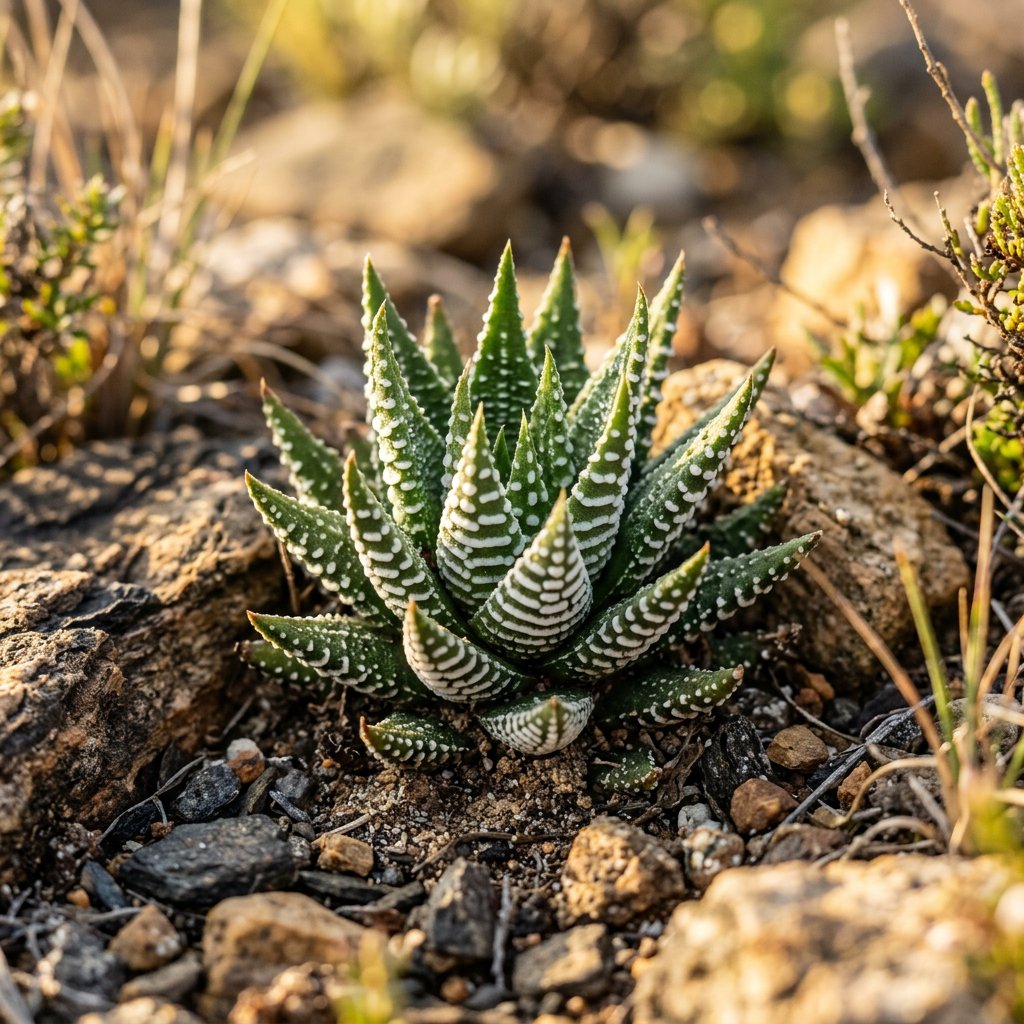
Plant Overview
Often mistaken for a miniature Aloe, the Zebra Haworthia is the ultimate "starter plant" for those who worry they lack a green thumb. Native to the Eastern Cape of South Africa, this resilient succulent is famous for its striking white ridges that wrap around dark green, pointed leaves. It is a slow-growing architectural gem that brings a touch of the desert to any bookshelf or office desk.
🔍 How to Identify
- 🦓 Zebra Stripes: The most defining feature is the horizontal white "tubercles" (raised bumps) that form vivid, stripe-like patterns across the dark green leaves.
- 📐 Rosette Shape: The plant grows in a compact, stemless rosette, with stiff, tapering leaves that reach upward and slightly outward.
- 🔎 Leaf Texture: Unlike some lookalikes, the Attenuata variety features these white bumps on both the inner and outer surfaces of the leaves, giving it a rough, sandpaper-like feel.
🏡 In Your Garden
- ⛅ Indirect Light Lover: While many succulents crave blistering direct sun, the Zebra Plant is sensitive to intense heat. It thrives in "bright, indirect light," making it one of the few succulents that can actually survive and look beautiful in slightly shadier indoor corners.
- 🚿 Drought Logic: This plant stores water in its thick leaves to survive South African droughts. In a home setting, it is far more likely to die from "kindness" (overwatering) than neglect. Always let the soil dry out completely before giving it a deep drink.
⚠️ Safety & Toxicity
- 🐾 Pet-Friendly: This is a fantastic choice for pet owners! It is widely considered non-toxic to cats and dogs by the ASPCA.
- 👶 Safe for Humans: The plant is non-poisonous to humans and, unlike many desert cacti, it lacks sharp spines or needles that could prick curious fingers.
✨ Fun Fact
🧬 The Great Reclassification: For over 200 years, this plant was known simply as a Haworthia. However, in 2013, botanists used DNA sequencing to discover it was genetically distinct enough to deserve its own genus, Haworthiopsis, which translates to "Haworthia-like."

Detailed Care Instructions
| Humidity | Normal |
| Lighting | Part Sun |
| Difficulty | Medium |
| Temperature | 19°C - 29°C |
| Hardiness Zones | 11 - 11 |
To grow Haworthiopsis Attenuata successfully, follow these steps:
- Choose the right pot: Select a shallow pot with good drainage holes. This type of plant has a shallow root system and prefers a small container.
- Soil: Use well-draining soil that consists of a mix of potting soil, perlite, and sand. This will prevent excess moisture and help prevent root rot.
- Light: Place the plant in bright, indirect sunlight. Haworthiopsis Attenuata prefers bright but filtered light. Avoid exposing it to direct sunlight, as this can scorch the leaves. Southern or eastern-facing windows are ideal.
- Watering: Allow the soil to dry out completely before watering. Haworthiopsis Attenuata is a succulent and prefers dry conditions. Overwatering can cause root rot, so it's better to underwater than overwater. Water sparingly and ensure the soil is well-drained.
- Temperature and Humidity: This plant prefers average room temperatures ranging from 60-85°F (15-30°C). It can tolerate low humidity environments, but it might appreciate occasional misting during extra dry seasons.
- Fertilizer: During the growing season, which is typically from spring to summer, use a balanced, water-soluble fertilizer diluted to half-strength. Apply the fertilizer once a month to provide the plant with the nutrients it needs.
- Propagation: Haworthiopsis Attenuata can be propagated through offsets or leaf cuttings. To propagate through offsets, separate the baby plants from the mother plant and allow them to dry for a day before planting them in well-draining soil. If propagating through leaf cuttings, carefully remove a healthy leaf and allow it to dry for several days before planting it in soil.
- Repotting: Repotting is typically only necessary if the current pot becomes too crowded or if the soil has become overly compacted. If repotting is required, choose a pot that is only slightly larger than the current one and ensure it has drainage holes.
By following these steps, you should be able to successfully grow and care for the Haworthiopsis Attenuata plant.

Place in a window with dappled sun or a spot in the middle of a room. Or directly in a window facing west or east.

When watering this plant, it is important to avoid getting water on the leaves or in the center rosette as it can lead to rot. Instead, water the soil directly around the base of the plant. Allow the soil to dry out almost completely between waterings but do not let it become bone dry. In general, it is best to underwater rather than overwater this plant as it is highly susceptible to root rot. Furthermore, it is important to use well-draining soil and a pot with drainage holes to prevent water from accumulating in the soil. Consider adjusting your watering schedule based on the climate and time of year as this plant may require more or less frequent watering depending on environmental conditions.
To fertilize this plant, use a water-soluble fertilizer formulated for succulents once a month during the growing season (spring and summer). Dilute the fertilizer to half its recommended strength and water the soil thoroughly. Avoid fertilizing during winter and fall when the plant is dormant. Also, make sure the soil is dry before fertilizing to prevent root damage.
The ideal soil for the Haworthiopsis Attenuata plant is a well-draining potting mix that is slightly alkaline in nature. This type of soil should be composed of a combination of materials such as perlite, sand, and pumice for optimum drainage. It should also have enough water holding capacity to retain enough moisture for the plant's roots, but not so much that it becomes waterlogged. A soil mixture that contains a significant amount of organic matter may hold too much water and may cause rotting of the plant's roots. It is important to avoid using soil that contains peat moss, which can retain too much moisture and be too acidic for the plant. In general, a mixture of half inorganic material and half organic matter will provide the perfect balance of drainage and moisture retention for the Haworthiopsis Attenuata plant.
To propagate this plant, you will need to carefully remove offsets or "pups" from the base of the parent plant. Use a clean, sharp knife or shears to cut the offset away from the main stem. Be sure to keep some of the roots attached to the offset. Allow the cut to callus over for a few days, then plant the offset in a well-draining soil mix. Water the new plant sparingly at first and gradually increase watering as it establishes roots. Place the new plant in a bright, indirect light and avoid direct sunlight. With proper care, the new plant should grow and flourish.
Common pests of the zebra haworthia include Mealybugs, thrips. Make a habit of checking your zebra haworthia frequently for pests so that any infestations can be caught and managed early.








