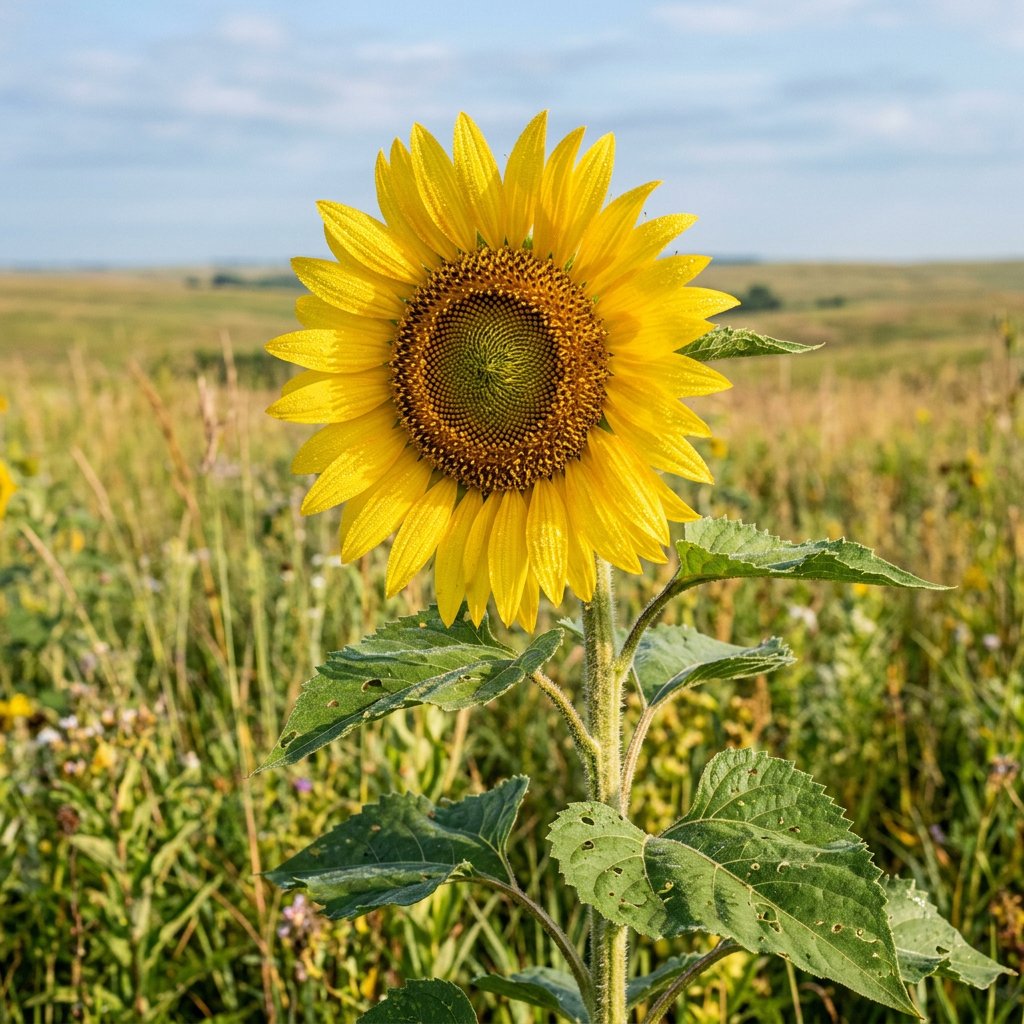
Plant Overview
The quintessential symbol of summer, the Common Sunflower is more than just a pretty face—it is a historical powerhouse. Indigenous to North America, it was cultivated by Native Americans thousands of years ago for food, oil, and dye. These "sun-worshippers" are famous for their remarkable ability to track the sun across the sky during their youth, a poetic movement known as heliotropism.
🔍 How to Identify
- 🌻 The Composite Head: What looks like one giant flower is actually a "pseudanthium." The outer yellow "petals" are individual ray florets, while the dark center consists of hundreds of tiny disk florets that eventually turn into seeds.
- 🍃 Rough Foliage: The leaves are large, heart-shaped, and covered in coarse, bristly hairs. Touching them feels like rubbing your hand against fine-grit sandpaper.
- 🦒 Stately Stems: They are rapid growers with thick, fibrous, and often unbranched stems that can tower anywhere from 3 to 15 feet depending on the variety.
🏡 In Your Garden
- ⚓ The Deep Anchor: Sunflowers develop a massive, powerful taproot to support their height. Because of this, they "resent" being moved. It is always best to sow the seeds directly into the ground rather than transplanting them from a pot.
- 🧪 Chemical Warfare: Be careful who you plant them next to! Sunflowers are "allelopathic," meaning they release chemicals into the soil that can inhibit the growth of certain neighboring plants, like potatoes or pole beans.
- 🍽️ Heavy Feeders: To reach those record-breaking heights, they act like sponges for nutrients. They require rich soil and consistent hydration, especially when the flower bud is first forming.
⚠️ Safety & Toxicity
- ✅ Pet & Child Safe: The Helianthus annuus is generally considered non-toxic to cats, dogs, and horses. The seeds are a popular snack for humans and wildlife alike.
- 🤧 Allergy Note: While the plant is safe, the heavy pollen can be a trigger for people with hay fever. If you have sensitivities, look for "pollen-free" hybrid varieties for your cutting garden.
- 🌵 Skin Irritation: The coarse hairs on the stems can sometimes cause mild skin redness or itching for those with sensitive skin. Wearing gloves while harvesting is recommended.
✨ Fun Fact
Sunflowers are "hyperaccumulators," meaning they are nature's vacuum cleaners. They were planted in massive quantities at the sites of the Chernobyl and Fukushima nuclear disasters because they are incredibly efficient at pulling toxic heavy metals and radioactive isotopes out of the soil.

Detailed Care Instructions
| Color | Yellow, Red, Mahogany, Bicolor |
| Soil Ph | 6.0-7.5 |
| Humidity | Normal |
| Lighting | Full Sun |
| Toxicity | Non-Toxic |
| Soil Type | Well-Drained |
| Bloom Time | Summer, Fall |
| Difficulty | Medium |
| Plant Type | Annual |
| Hibernation | Cold Period |
| Mature Size | 3–10 Feet Tall |
| Native Area | North America |
| Temperature | 18°C - 25°C |
| Sun Exposure | Full Sun |
| Hardiness Zones | 2-11 |
Here are some steps you can follow to grow a Helianthus annuus plant, commonly known as a sunflower:
- Choose the right location: Sunflowers thrive in full sunlight, so select a spot that receives at least six hours of direct sunlight each day. Make sure it has well-draining soil.
- Prepare the soil: Sunflowers prefer fertile soil, so add compost or well-rotted manure to improve the soil quality. Ensure that the soil pH is between 6.0 and 7.5.
- Sow the seeds: Sunflowers can be grown from seeds. Plant them directly into the garden soil after the danger of frost has passed and the soil has warmed up to at least 55°F (13°C). Make 2-3 inch deep holes spaced about 6-8 inches apart and drop one seed in each hole. Then cover the seeds with soil and gently water the area.
- Watering and maintenance: Keep the soil consistently moist, but avoid over-watering as that can lead to root rot. Water the plants deeply once a week or as needed.
- Provide support: As sunflowers grow tall and may become top-heavy, it is advisable to provide support such as stakes or trellises to prevent them from toppling over in strong winds.
- Mulching: Apply a layer of organic mulch around the base of the plant to retain soil moisture, suppress weeds, and regulate soil temperature.
- Fertilizing: Sunflowers generally do not require much additional fertilizer. However, if the soil is poor, you can fertilize lightly with a balanced, slow-release fertilizer at planting time.
- Pest and disease control: Monitor the plants regularly for common pests like aphids and caterpillars. Apply insecticidal soap or organic pest control methods if necessary. Sunflowers are generally quite resistant to diseases.
- Harvesting: Harvest the sunflower heads when the green bracts turn yellow or brown and the back of the head turns yellow. Cut the heads with about 12 inches of stem attached. Hang the flower heads upside down in a dry, well-ventilated area to dry completely.
By following these steps, you should be able to successfully grow Helianthus annuus plants and enjoy their beautiful blooms.

Place in a bright room that is sun drenched almost all day. Or directly in a south-facing window.

To water this plant, the gardener should ensure that the soil is moist but not waterlogged. The frequency of watering will depend on the climatic conditions and soil type. It is important to water deeply and consistently, allowing the water to reach the root system of the plant. Watering in the morning or evening is preferred as it avoids evaporation of water due to sunlight. Over-watering can lead to root rot and plant death, so it is important to avoid this. It is also important to avoid getting water on the leaves and flowers as this can lead to fungal diseases.
To fertilize this plant, use a balanced chemical fertilizer with equal amounts of nitrogen, phosphorus, and potassium. Apply the fertilizer at a rate of 1 tablespoon per plant and mix it into the soil around the base of the plant. Water thoroughly after fertilizing. Repeat the application every 4-6 weeks during the growing season. Avoid over-fertilizing, as it can lead to tall, weak stems and fewer blooms.
Helianthus Annuus plants thrive in well-draining soil that is rich in nutrients and organic matter. The soil should have a pH range of 6.0-7.5, which is slightly acidic to neutral. It should have a loamy texture that allows for proper aeration and drainage. Avoid using heavy soils that retain too much water and may cause root rot. The ideal soil should also have good water retention to keep the plant's roots hydrated. It is recommended to incorporate compost or well-rotted manure into the soil to increase its fertility and improve soil structure. Additionally, adding perlite or vermiculite to the soil mixture can help improve drainage.
There are different methods you can use to propagate this plant, but one common way is through seed propagation. To do this, you will need to collect the mature seeds from the flower heads and then sow them in the soil. It is recommended to start the seeds indoors during the early spring and transplant them to the garden when they reach a certain size. Sunflowers grow best in warm weather, so make sure to plant them in an area that receives full sun.
Another method of propagation is through division. You can divide mature plants by separating the root ball into several sections and then replanting them in a well-prepared soil. This method is typically used for mature plants that have outgrown their current location.
Finally, you can also propagate Helianthus Annuus through stem cuttings. To do this, select a healthy stem and cut it at a 45-degree angle. Remove the leaves from the bottom half of the stem and dip it in rooting hormone. Place the stem cutting in moist soil and cover it with a plastic bag. Keep the soil moist and in a warm, well-lit area until you see signs of new growth.
Common pests of the common sunflower include Spider mites, thrips, whiteflies. Make a habit of checking your common sunflower frequently for pests so that any infestations can be caught and managed early.








