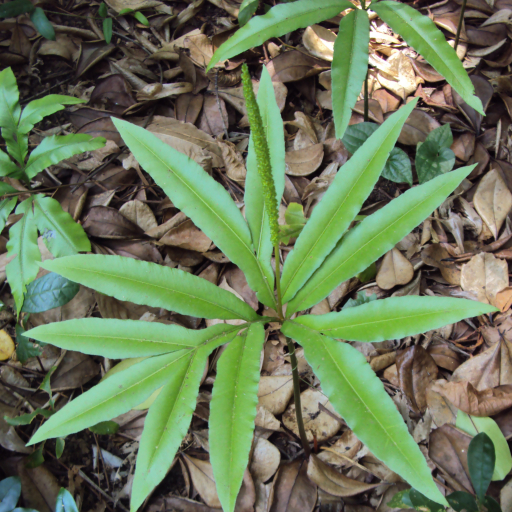
Plant Overview
Known as the Kamraj or the Worm-Spike Fern, this ancient beauty is a "living fossil" from the primitive Ophioglossaceae family. Found tucked away in the humid wetlands of Southeast Asia and Australia, it has been revered for centuries in traditional medicine as a potent tonic for vitality and strength. It is a rare find for collectors, prized for its strange, alien-like reproductive structures that look nothing like a typical fern.
🔍 How to Identify
- 🌿 The Frond: Unlike typical feathery ferns, it produces a single, fleshy, tripartite (three-part) leaf that fans out horizontally, often appearing more like a small herb than a fern.
- 🐛 The "Worm" Spike: Its most striking feature is the fertile spike that rises from the base of the leaf. This stalk is covered in tiny clusters of spores that resemble a small green caterpillar or a centipede.
- 🍠 The Rhizome: Beneath the soil lies a thick, succulent, creeping underground stem (rhizome) that acts as a storage organ, allowing the plant to survive in its muddy, tropical habitat.
🏡 In Your Garden
- 💧 The "Wet Feet" Rule: This plant is naturally a swamp-dweller. It thrives in boggy, waterlogged conditions and will quickly go into shock if the soil dries out. It is perfect for the edges of a garden pond or a high-humidity terrarium.
- 🌑 Deep Shade Specialist: In the wild, it hides under the dense canopy of tropical forests. It detests direct sunlight, which can scorch its waxy leaves; it prefers the soft, dappled light of a "jungle floor" environment.
⚠️ Safety & Toxicity
- ✅ General Status: Generally non-toxic to touch and safe to have around curious pets.
- 🍵 Medicinal Caution: While the young fronds are occasionally eaten as a vegetable in parts of Asia and the roots are used in traditional tonics, you should never consume it yourself. Many primitive ferns contain high levels of tannins or specific enzymes that require expert preparation to be safe.
✨ Fun Fact
The name Helminthostachys is derived from the Greek words helmins (worm) and stachys (spike). If you look closely at the spore-bearing spike, it looks exactly like a colony of tiny green worms huddling together!

Detailed Care Instructions
To grow Helminthostachys zeylanica, also known as "spike moss," you need to follow specific instructions:
- Obtain the plant: Find a reputable nursery or plant supplier that offers Helminthostachys zeylanica. You may also try finding it through online plant sellers or botanical gardens.
- Choosing the right pot and soil: Select a suitable pot with good drainage holes and fill it with a well-draining potting mix. A mix containing equal parts of perlite, peat moss, and sand will work well for these plants.
- Sow or transplant: If you have seeds, gently press them into the soil's surface. Alternatively, transplant a healthy plant into the pot, ensuring you don't bury it too deep.
- Light requirements: Place the pot in a location that receives indirect or filtered sunlight. Avoid exposing the plant to direct sunlight, as it can scorch the delicate foliage.
- Temperature: Helminthostachys zeylanica thrives in warm temperatures between 60-80°F (15-27°C). Protect it from extreme cold or frost.
- Watering: Keep the soil evenly moist but not waterlogged. Water the plant whenever the top inch of soil feels dry. Do not let the plant sit in standing water, as it can lead to root rot.
- Humidity: These plants appreciate high humidity levels. Mist the plant regularly with water or place a small humidifier nearby.
- Fertilization: Feed the plant with a balanced liquid fertilizer diluted to half strength once every two weeks during the growing season (spring and summer). Avoid fertilizing during winter when the plant is not actively growing.
- Pruning: If the plant becomes overgrown or leggy, you can trim it back by removing any excessively long or untidy stems. This will help maintain the plant's shape and overall health.
- Propagation: Helminthostachys zeylanica can be propagated through spores. Collect the spores from mature fronds and sow them on a moist surface, such as peat moss mixed with vermiculite. Keep the surface moist and cover it with plastic or a glass lid to maintain humidity. The spores will germinate within a few weeks.
Remember that Helminthostachys zeylanica is a slow-growing plant, so be patient as it develops over time.

Place in a window with dappled sun or a spot in the middle of a room. Or directly in a window facing west or east.

Helminthostachys Zeylanica is a type of plant that requires a careful watering schedule to thrive. Watering this plant can be a bit tricky, as it is quite sensitive to changes in moisture levels. Here's how to water Helminthostachys Zeylanica:
1. Water when the top inch of soil feels dry to the touch. It's important to wait until the soil has dried out a bit before watering this plant, as overwatering can harm it.
2. Water slowly and evenly. When you do water your Helminthostachys Zeylanica plant, be sure to do it slowly and evenly. This will help ensure that the soil absorbs the water evenly, and will prevent any waterlogging or puddling around the roots.
3. Use room temperature water. Helminthostachys Zeylanica can be sensitive to temperature changes, so it's important to use room temperature water when watering it. This will help prevent any shock to the roots.
4. Don't let the soil dry out completely. While it's important to let the soil dry out between waterings, you don't want it to dry out completely. This could cause the plant to wilt and become stressed.
5. Use a well-draining soil mix. The soil mix you choose for your Helminthostachys Zeylanica plant should be well-draining, to help prevent overwatering and promote healthy root growth. A mix of peat moss, perlite, and vermiculite can work well.
By following these tips, you can keep your Helminthostachys Zeylanica plant healthy and thriving.
To fertilize the plant, use a balanced fertilizer with NPK ratio of 10-10-10 or 12-12-12. Apply every two weeks during the growing season, which is typically spring and summer. Dilute the fertilizer to half the recommended strength, and apply it to the soil around the base of the plant. Water the plant immediately after fertilizing to help the nutrients penetrate the soil. Avoid over-fertilizing, as this can damage the roots and leaves of the plant.
Helminthostachys zeylanica is a type of fern that requires a well-draining soil mixture for optimal growth. The soil should be composed of a combination of organic matter, sand, and perlite or vermiculite to ensure proper drainage. The pH level of the soil should be slightly acidic, around 6.0-6.5. It is also important to keep the soil moist, but not waterlogged, as this can cause root rot. Avoid using heavy clay soils as they can retain too much moisture and suffocate the roots of the plant. Using a standard potting mix for ferns or orchids is a good start, but it is recommended to add additional organic matter, such as peat moss or leaf litter, to provide the necessary balance of nutrients and aeration for Helminthostachys zeylanica to thrive.
To propagate this specific plant, you need to follow certain steps.
Step 1: Select a healthy mother plant from which you need to take a cutting for propagation.
Step 2: Choose a stem section that has at least one node.
Step 3: Use a sharp knife or scissors to cut the stem section at a 45-degree angle.
Step 4: Remove any leaves or small branches from the bottom of the stem section.
Step 5: Dip the cut end of the stem section in rooting hormone.
Step 6: Prepare a potting mix of equal parts perlite and peat moss.
Step 7: Insert the stem section into the potting mix up to the first node.
Step 8: Water the soil until it is moist.
Step 9: Cover the pot with a clear plastic bag to create a greenhouse effect.
Step 10: Place the pot in indirect sunlight and wait for the roots to grow.
Step 11: After about four to six weeks, check the stem section for root growth.
Step 12: Once you see roots growing, remove the plastic bag and move the plant to a larger pot with regular potting soil.
Step 13: Continue to care for the plant as you would the mother plant, and watch it grow.








