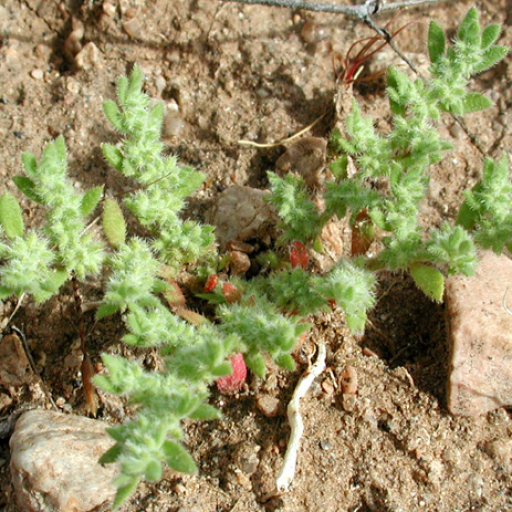
Plant Overview
Often called the Gray Rupturewort, this humble ground-hugger is a master of survival in the driest, stoniest corners of the Mediterranean and beyond. It forms soft, dusty-green carpets that look like a natural velvet spilled across the earth, earning it a place in xeriscape gardens and between paving stones. Despite its delicate appearance, it is a rugged pioneer plant that thrives where others wither.
🔍 How to Identify
- 🌿 Foliage: Tiny, oval leaves that are a distinct grayish-green. The "gray" comes from a fine coating of microscopic hairs (cinerea means ash-colored).
- 🌱 Growth Habit: It is strictly prostrate, meaning it hugs the ground tightly. It spreads outwards in a dense, circular mat that rarely rises more than an inch high.
- 🌸 Flowers: The blooms are nearly invisible to the naked eye. They appear as tiny, greenish clusters tucked deeply into the junctions between the leaves and the stem.
🏡 In Your Garden
- 🏜️ Crevice Specialist: This is a "gap-filler" plant. Because it lacks a wide root system but has a sturdy taproot, it is perfect for tucking into the cracks of stone walls or between garden "steppers" where soil is minimal.
- ☀️ Heat Shield: It loves a baking-hot environment. The fine hairs on its leaves reflect intense sunlight and trap a thin layer of moisture, allowing it to stay green when the surrounding grass has turned brown.
⚠️ Safety & Toxicity
- ✅ General Safety: Herniaria cinerea is generally considered non-toxic to humans and common household pets. It is not known to contain the harsh alkaloids found in some other groundcovers.
- 🧤 Sensory Note: While not poisonous, the plant’s texture can be slightly "scratchy" due to its hairy stems. If you have very sensitive skin, you might feel a mild tingle after weeding a large patch of it.
✨ Fun Fact
The genus name Herniaria dates back to the Middle Ages. It was named by early botanists who believed the plant’s "knotted" growth appearance resembled a hernia, leading to the folklore that it could be used to treat "ruptures" or intestinal ailments.

Detailed Care Instructions
To grow Herniaria cinerea, also known as green carpet or rupturewort, follow these steps:
- Choose the right location: Herniaria cinerea prefers full sun to partial shade. It can tolerate a wide range of soil conditions but prefers well-draining soil.
- Prepare the soil: Amend the soil with organic matter, such as compost, to improve drainage and fertility. Remove any weeds or grass from the planting area.
- Sow seeds or plant seedlings: Herniaria cinerea can be grown from seeds or transplanted as seedlings. If sowing seeds, scatter them evenly over the prepared soil and lightly press them into the soil surface. If using seedlings, dig holes according to the spacing requirements, usually around 6-12 inches apart, and place the seedlings in the holes.
- Water regularly: Water the plants regularly to keep the soil evenly moist, especially during the establishment phase. Avoid overwatering, as it can cause root rot.
- Mulch the area: Apply a layer of organic mulch, such as wood chips or straw, around the plants to help retain moisture, suppress weeds, and provide insulation.
- Prune as needed: Herniaria cinerea is a low-growing ground cover plant that does not require much pruning. However, you can trim it back lightly if it becomes too dense or starts to spread beyond its intended area.
- Fertilize sparingly: Herniaria cinerea does not have high fertilizer requirements. However, you can apply a balanced slow-release fertilizer in spring to provide nutrients.
- Monitor for pests and diseases: Watch out for common garden pests, such as aphids or snails, and treat accordingly. Herniaria cinerea is generally disease-resistant, but it's still important to keep an eye out for any signs of disease, such as leaf discoloration or wilting.
- Propagate if desired: Herniaria cinerea can be propagated by dividing established plants or taking cuttings.
By following these steps, you can successfully grow Herniaria cinerea and enjoy its attractive green carpet-like growth in your garden.

To water this plant, place it in a well-draining pot or container with a mixture of dry, sandy soil and compost. Ensure that the soil is moist, but not soaking wet, by watering it about once a week during the growing season and less frequently during the dormant period. Use room temperature water and avoid getting water on the leaves or stems of the plant. If the plant becomes excessively dry, it will begin to wilt, so be sure to monitor it closely.
To fertilize this plant, apply a balanced fertilizer with equal parts nitrogen, phosphorus and potassium. Use a slow-release granular fertilizer or a liquid fertilizer every two weeks during the growing season. Avoid over-fertilization as this may lead to excessive growth and poor plant health. Additionally, it is recommended to water the plant before and after fertilization to prevent root burn and ensure proper nutrient uptake.
Herniaria Cinerea prefers well-drained soil with a pH level between 6.0 and 7.0. It can tolerate poor soil, but it won't grow well in soil that is waterlogged or has poor drainage. Sandy loam soil that has been enriched with organic matter, such as compost or peat moss, is ideal for this plant. Avoid using heavy clay soils, as they can hinder the plant's growth and root development. The soil should also be kept slightly moist, but not waterlogged. Adding gravel or sand to the soil mixture can help improve drainage.
To propagate this plant, you can take stem cuttings in the spring or summer. Choose healthy stems that have at least two sets of leaves and are about 4-6 inches long. Cut the stem just below a node with a clean, sharp pair of scissors or pruning shears.
Remove the leaves from the lower half of the stem and dip the cut end in a rooting hormone powder to encourage root growth. You can then plant the stem cuttings in a well-draining soil mix and keep them moist but not waterlogged. Place the pot in a warm, bright location but out of direct sunlight.
Within a few weeks, you should see new root growth and new leaves emerging from the stem. Once the new growth is established, you can transplant the young plants into individual pots or into your garden.








