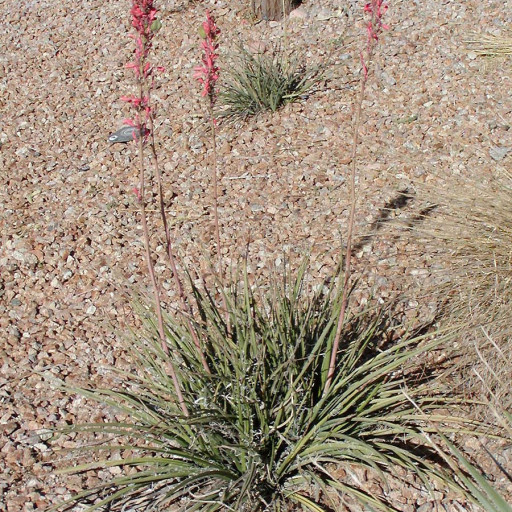
Plant Overview
Known affectionately as the Red Yucca or Texas Red Yucca, this Chihuahuan Desert native isn't actually a yucca at all—it belongs to the Agave family. It is a superstar of water-wise landscaping, prized for its ability to survive blistering heat and drought while producing elegant, arching wands of coral-colored flowers that last for months.
🔍 How to Identify
- 🌿 The Foliage: Long, narrow, sword-like leaves that arch gracefully outward. Unlike true yuccas, these leaves are flexible and lack the dangerous, needle-sharp tips that can puncture skin.
- 🧵 Curly Fibers: One of its most charming traits is the presence of thin, white, thread-like filaments that peel away from the leaf margins, giving the plant a slightly "shaggy" or fuzzy appearance.
- 🌸 The Bloom Stalk: In late spring, it sends up tall, slender red spikes (reaching up to 5 feet) covered in tubular, bell-shaped flowers that range from deep coral to soft rose.
🏡 In Your Garden
- 🌵 The "Anti-Rot" Rule: While incredibly hardy, this plant’s Achilles' heel is soggy soil. It thrives in rocky or sandy earth; if planted in heavy clay, it may suffer from root rot during wet winters.
- 🦜 A Pollinator Party: The tubular shape and bright color of the blossoms are specifically designed to attract hummingbirds. If you plant these near a patio, you’ll have a front-row seat to a summer-long bird show.
- ❄️ Winter Transformation: When the temperature drops, the usually blue-green foliage often takes on a stunning bronze or reddish-purple tint, providing a splash of "ever-changing" color in a dormant garden.
⚠️ Safety & Toxicity
- ✅ Pet Friendly: Unlike many desert succulents, Hesperaloe parviflora is generally considered non-toxic to dogs, cats, and horses.
- 🤏 Mild Irritation: While not poisonous, the sap can occasionally cause mild skin irritation in sensitive individuals. It is always best to wear gloves when pruning away old flower stalks.
✨ Fun Fact
Despite its delicate appearance, the Red Yucca is a "tough nut." It is one of the few desert plants that can handle extreme heat (above 100°F) and extreme cold (down to -20°F) without skipping a beat!

Detailed Care Instructions
| Color | Grey-Green |
| Soil Ph | 6.8–7.2 |
| Humidity | Normal |
| Lighting | Full Sun |
| Toxicity | Poisonous |
| Soil Type | Well-Draining Soil, Preferably Somewhat Sandy |
| Bloom Time | Summer (Sometimes Spring) |
| Difficulty | Easy |
| Plant Type | Evergreen, Perennial Succulent |
| Hibernation | Cold Period |
| Mature Size | 3 – 5 Feet Tall |
| Native Area | Western Texas – North-Eastern Mexico |
| Sun Exposure | Prefers Full Sun |
| Hardiness Zones | 5-10 |
To grow a Hesperaloe Parviflora plant, also known as red yucca or desert candle, follow these steps:
- Location: Choose a sunny spot in your garden or yard as this plant thrives in full sun. Ensure the location has well-draining soil to avoid waterlogged roots.
- Soil: Use well-draining soil, such as sandy or loamy soil, enriched with organic matter. Avoid heavy clay soil to prevent water retention that can lead to root rot.
- Planting: Dig a hole slightly wider and deeper than the plant's root ball. Place the plant in the hole, ensuring the top of the root ball is level with or slightly above the ground. Backfill the hole with soil, gently firming it around the roots.
- Watering: Initially, water the plant deeply after planting to promote root establishment. After that, water sparingly as Hesperaloe Parviflora is drought-tolerant. Water deeply and less frequently, ensuring the soil dries out between waterings.
- Mulching: Apply a layer of organic mulch, such as wood chips or straw, around the base of the plant to help retain soil moisture and suppress weed growth. Make sure to keep the mulch away from the plant's crown.
- Fertilization: Hesperaloe Parviflora plants do not typically require regular fertilization. However, if you want to promote faster growth or enhance blooming, you can apply a slow-release granular fertilizer designed for desert plants in the spring.
- Pruning: Trim any dead or damaged leaves as needed. You can also cut back flowering stems after they have finished blooming to maintain a tidy appearance.
- Overwintering: Hesperaloe Parviflora is hardy in USDA zones 5-10. In colder regions, protect the plant from freezing temperatures by mulching around the base or covering it with a frost cloth during winter.
By following these steps and providing proper care, your Hesperaloe Parviflora plant should grow and thrive.

Place in a bright room that is sun drenched almost all day. Or directly in a south-facing window.

Water the plant by thoroughly saturating the soil around the plant's roots. Allow the soil to dry out partially between watering, and be careful not to overwater the plant as it is susceptible to root rot. Ensure that the plant is planted in well-draining soil to prevent standing water around the roots. Water deeply and less frequently rather than frequent, shallow watering. During hot weather, increase watering to keep the soil lightly moist. Avoid getting water on the foliage, as this can lead to sunburn or fungal problems.
To properly fertilize this plant, make sure to first apply a balanced fertilizer in early spring before the growing season begins. During the growing season, use a slow-release fertilizer every six to eight weeks. Ensure that the fertilizer is spread evenly over the soil surface and avoid applying it directly to the plant's leaves. Finally, reduce fertilization in the fall to allow the plant to prepare for the winter months.
It is recommended to use a well-draining soil mixture with good aeration for this plant, as it does not tolerate wet feet. A mix of sandy soil and organic matter like peat moss or compost can be used. Adding perlite or coarse sand to the mixture can also improve drainage. It is important to avoid heavy or clay soils, as they can cause root rot. pH levels should be kept neutral to slightly acidic. Additionally, the soil should be enriched with a balanced fertilizer during the growing season.
To propagate this plant, select a healthy mature specimen and use clean, sharp pruning shears to remove one or several offsets, which are small shoots growing from the base of the parent plant. Choose offsets with a good root system, at least 4-6 inches in length. Allow the offsets to dry and callus over for one to two days to prevent rotting before planting.
Fill a small container with a well-draining soil mix and insert the offsets into the soil, burying the roots and leaving the top of the offset exposed. Water lightly and place in a bright but sheltered location, out of direct sunlight. Keep the soil lightly moist and avoid over-watering, as this plant is drought-tolerant. After a few weeks, the offset should begin to root and grow.
Alternatively, this plant can also be propagated by seed. Collect ripe seed pods and remove the seeds. Plant the seeds in a well-draining soil mix and water lightly. Keep the soil moist and place in a bright location but out of direct sunlight. It may take several weeks for the seeds to germinate and grow.
Common pests of the red yucca include Scale insect, mealybugs. Make a habit of checking your red yucca frequently for pests so that any infestations can be caught and managed early.








