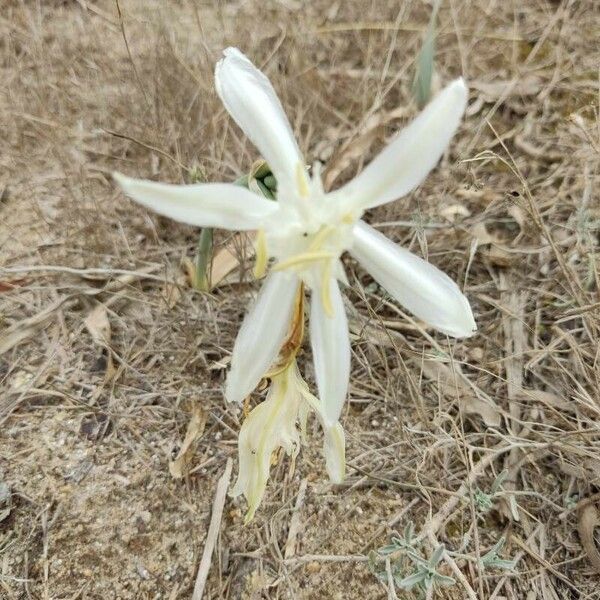
Plant Overview
Commonly known as the Desert Lily or Ajo Lily, this stunning wildflower is the Mojave and Sonoran Deserts’ answer to the classic garden lily. Despite its delicate appearance, it is a master of survival, remaining dormant deep underground for years until the right winter rains coax it into a spectacular, fragrant bloom. In Spanish, "Ajo" means garlic, a nod to the plant’s bulb, which smells and tastes remarkably like the kitchen staple.
🔍 How to Identify
- 〰️ The Leaves: Look for long, blue-green, ribbon-like leaves that grow in a basal rosette. They have distinctly crinkled or "undulated" (wavy) white margins, which give the plant its scientific name.
- 🎺 The Blooms: Large, funnel-shaped white flowers sit atop a thick stalk. Each of the six petals features a striking silvery-green or gray stripe running down the outer center.
- 📏 The Stature: While the leaves hug the ground, the flowering stalk can reach up to 6 feet in a "superbloom" year, though 1 to 3 feet is more common.
🏡 In Your Garden
- 🏜️ The Deep Sleeper: If you attempt to grow this at home, keep in mind it grows from a bulb buried very deep (up to 2 feet) to escape the desert heat. It requires extremely well-draining, sandy soil to prevent bulb rot.
- 💧 Rainfall Mimicry: This plant is highly specialized; it may not even sprout if it doesn't sense sufficient "winter" moisture. Once it finishes blooming, it retreats back into the ground and disappears entirely during the summer heat—don't dig it up thinking it's dead!
⚠️ Safety & Toxicity
- 🟢 Pet & Human Safety: The Desert Lily is generally considered non-toxic. Historically, the bulbs were used as a food source by Indigenous peoples, such as the Tohono O'odham, who ate them fresh or roasted.
- 🌱 Conservation Note: While not toxic, they are fragile. In the wild, please do not pick the flowers or attempt to dig up the bulbs, as they rarely survive transplanting and are a vital part of the desert ecosystem.
✨ Fun Fact
Native American tribes and early Spanish explorers used the Desert Lily as a natural seasoning. Because the bulb contains the same sulfur compounds found in garlic, it can be used as a flavorful (though rare) substitute in cooking!

Detailed Care Instructions
To grow Hesperocallis undulata, also known as the desert lily or onion leaf, you can follow these steps:
- Location: Find a suitable location with full sun exposure. Hesperocallis undulata requires at least 6-8 hours of direct sunlight daily.
- Soil: Ensure the soil is well-draining and slightly sandy. Hesperocallis undulata prefers soil with good drainage. If your soil is heavy or clayey, amend it by adding sand or compost to improve drainage.
- Planting: Plant the bulbs in late summer or early fall. The bulbs should be placed about 2-4 inches deep and 6-8 inches apart from each other. Make sure the pointed end of the bulb faces upwards.
- Watering: Initially, provide enough water to keep the soil consistently moist, but not waterlogged. Once established, reduce watering and let the soil dry out slightly between waterings. Avoid overwatering as it may cause bulb rot.
- Mulching: Apply a layer of organic mulch around the plants to help retain moisture and regulate temperature.
- Fertilization: Hesperocallis undulata doesn't require much fertilization. However, you can apply a slow-release granular fertilizer in early spring before new growth appears. Follow the manufacturer's instructions for application rates.
- Maintenance: Remove any weeds or competing plants around the Hesperocallis undulata to minimize competition for resources. Deadhead the flowers after blooming to divert energy to bulb development. Allow the foliage to die back naturally after blooming to allow the nutrients to be stored back into the bulb for the next season.
- Division: Every few years, when the clumps become crowded, you can dig up the bulbs, separate them, and replant them in fresh soil. This will help prevent overcrowding and promote healthier plant growth.
- Protection: In colder regions or during winter, protect the bulbs with a layer of mulch to prevent freezing. Consider bringing potted plants indoors before the first frost.
With proper care and maintenance, your Hesperocallis undulata plant should thrive and produce beautiful flowers during the blooming season, generally in late winter or early spring.

Place in a bright room that is sun drenched almost all day. Or directly in a south-facing window.

The plant in question requires regular watering to thrive, but care should be taken not to overwater. Water should be applied gently to the soil around the plant, taking care not to disturb the surrounding area or any nearby plants. It is recommended to water deeply, allowing the water to penetrate the soil to a depth of at least six inches. It is important to allow the soil to dry out slightly between waterings to prevent waterlogging. In hot, dry weather, the plant may require more frequent watering. Additionally, care should be taken not to water the plant's leaves, as this can promote fungal growth.
To fertilize this plant, use a balanced fertilizer with an N-P-K ratio of 10-10-10 or 20-20-20. Apply the fertilizer once a month during the growing season, which is typically from spring to fall. Follow the manufacturer's instructions for application rates. Water the plant well after fertilizing to help the nutrients reach the roots. Avoid over-fertilizing, as this can lead to excessive growth and weak stems.
To grow a Hesperocallis Undulata plant, it is best to use well-draining soil with a sandy or loamy texture. The soil should also be slightly acidic with a pH range of 6.0-7.0. It is important that the soil is not too rich in nutrients as this may cause the plant to become leggy and weak. Adding some organic matter, such as compost or peat moss, to the soil can help improve its structure and fertility. When planting the Hesperocallis Undulata, it is recommended to mix some slow-release fertilizers into the soil to provide a steady supply of nutrients over time. Additionally, it is important to maintain proper watering habits, ensuring the soil stays moist but not overly wet, as this can lead to root rot.
Hesperocallis undulata is a plant that can be propagated through seeds or division of the bulbs. Here is a detailed guide on how to propagate the plant without mentioning its common names:
Seed propagation:
- Collect fresh seeds from a healthy Hesperocallis undulata plant.
- Prepare a seed-starting mix using equal parts of peat moss, coarse sand, and perlite.
- Sow the seeds on the surface of the prepared seed-starting mix, spacing them 1-2 inches apart.
- Cover the seeds with a thin layer of the same seed-starting mix.
- Water the seeds gently to ensure that the mixture is moist but not too wet.
- Place the container in a warm, bright location, ensuring that the temperature remains between 68-75°F. This can be achieved by placing a heating pad under the container or using a grow light.
- Keep the seed-starting mix moist but not too wet by misting it with water as needed.
- After about two weeks, the seeds should germinate. Once the seedlings have developed their first set of true leaves, they can be transplanted into individual pots or into the garden.
Division of bulbs:
- Choose a healthy Hesperocallis undulata plant that has been growing for at least three years.
- In the fall, when the plant has finished blooming and the foliage has died back, dig up the bulbs using a garden fork.
- Use a sharp knife to separate the bulbs into individual sections, ensuring that each section has some roots and a growing shoot.
- Dust the cut surfaces with a fungicide to prevent infection.
- Prepare a planting bed by loosening the soil and adding organic matter.
- Plant the bulbs at a depth of 3-4 inches and space them 6-8 inches apart.
- Water the newly planted bulbs thoroughly and keep the soil moist but not too wet.
- Once the bulbs have established themselves, they will produce flowers in the spring and summer.








