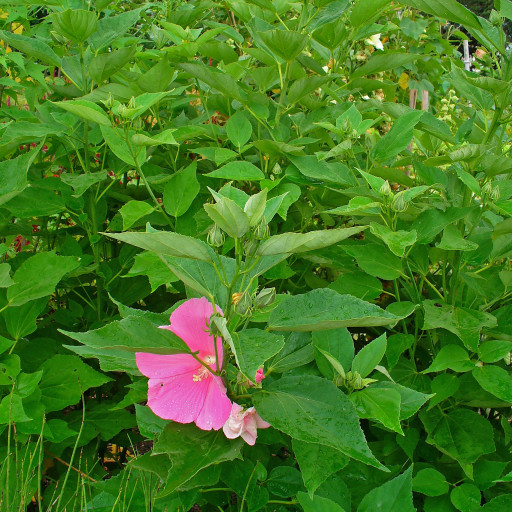
Plant Overview
Often called the "Dinner Plate Hibiscus" for its impossibly large blooms, Hibiscus moscheutos is a show-stopping wetland native of North America. It brings a touch of the tropics to colder climates, appearing like a lush, exotic guest that unexpectedly thrives in boggy garden corners. While the flowers look like they belong in the deep jungle, this hardy perennial is tough enough to survive freezing winters, waiting patiently beneath the soil to explode into growth each summer.
🔍 How to Identify
- 🌸 Enormous Blooms: The flowers are the primary giveaway, reaching a staggering 6 to 10 inches in diameter. They feature five overlapping petals with a texture reminiscent of delicate crepe paper.
- ❤️ The Crimson Eye: Most wild and garden varieties feature a deep red or burgundy "eye" at the center of the flower, which serves as a visual bullseye for pollinators.
- 🍃 Robust Foliage: The leaves are large, heart-shaped or slightly lobed, and have a soft, velvety underside. Unlike the glossy leaves of tropical hibiscus, these are a matte, dusty green.
- 🏛️ Stately Stature: It grows as a multi-stemmed, shrub-like plant that can reach 3 to 7 feet tall in a single season, creating a dense wall of greenery.
🏡 In Your Garden
- 💧 Thirsty Roots: Because its natural habitat is the swamp, this plant is the perfect solution for "problem areas" in your yard where water tends to pool. It loves "wet feet" and is an excellent choice for rain gardens or pond edges.
- ☀️ Sun and Energy: To produce those massive flowers, it requires a full day of direct sunlight. If grown in the shade, the stems may become "leggy" and require staking to prevent them from flopping over.
- ❄️ The Late Waker: Gardeners often worry their plant has died because it stays dormant much longer than other perennials. It is one of the last plants to emerge in spring, often waiting until the soil is consistently warm in late May or June before showing new green shoots.
⚠️ Safety & Toxicity
- ✅ Non-Toxic: Hibiscus moscheutos is generally considered non-toxic to humans, dogs, and cats by major veterinary and botanical organizations.
- 🦋 Garden Friendly: It is a safe, "friendly" addition to family gardens. However, as with any ornamental plant, it’s best to discourage pets from munching on the foliage to avoid minor digestive upset from the plant's fibrous texture.
✨ Fun Fact
The Hibiscus moscheutos has a "best friend" in the insect world: the Rose Mallow Bee (Ptilothrix bombiformis). This specialist bee has evolved specifically to forage on these giant flowers; the bees even sleep inside the wilted blooms at night, using the folding petals as a cozy, waterproof sleeping bag!

Detailed Care Instructions
The two types of hibiscus are hardy and tropical. Hardy hibiscus typically survives the winters outdoors though it dies back to the ground on its own while dormant in the cold weather. Tropical hibiscus needs to be brought indoors for the winter.
Can hardy hibiscus grow in partial shade?
The plant can be grown in partial shade, but it probably won't bloom very well. It needs sun to create blooms. If the plant is in the ground and can't be moved, see if you can remove any barriers preventing sunlight from bathing the plant. Even one or two hours a day can help increase the blooms.
Can hardy hibiscus be grown indoors as a houseplant?
Many tropical hibiscus plants can grow indoors as houseplants, but it's best to leave hardy hibiscus outdoors. One reason is that it can grow out of control indoors, and if it's not placed in full sunlight, it won't even produce blooms.
| Color | White, Red, Pink, Blue |
| Soil Ph | Neutral To Slightly Acidic |
| Lighting | Full Sun |
| Soil Type | Loamy |
| Bloom Time | Summer |
| Plant Type | Herbaceous Perennials |
| Mature Size | 3 To 7 Feet Tall And 2 To 3 Feet Wide |
| Native Area | Eastern North America |
| Sun Exposure | Full Sun |
| Hardiness Zones | Usda 4-9 |
To grow Hibiscus Moscheutos (also known as rose mallow or swamp mallow), follow these steps:
- Choose the right location: Hibiscus Moscheutos prefers full sun to part shade. Ensure the area receives at least 6 hours of direct sunlight daily.
- Prepare the soil: The plant thrives in moist, well-draining soil. Amend it with organic matter like compost to improve fertility and drainage.
- Planting: Dig a hole that is wider and deeper than the plant's root ball. Place the plant in the hole, ensuring the crown is at the same level as the soil. Fill the hole with soil and gently tamp it down around the plant.
- Watering: Water the plant deeply after planting and continue to water regularly. The soil should be kept consistently moist, but not waterlogged.
- Mulching: Apply a layer of organic mulch around the base of the plant to conserve moisture, suppress weed growth, and regulate soil temperature.
- Fertilization: Feed the Hibiscus Moscheutos plant with a balanced slow-release fertilizer in spring and mid-summer. Follow the instructions on the fertilizer packaging for application rates.
- Pruning: In spring, trim back any dead or damaged branches. Additionally, you can trim the plant to promote bushier growth or to maintain its desired size and shape.
- Pests and diseases: Keep an eye out for common problems like aphids, spider mites, or fungal diseases. Treat any issues promptly using appropriate organic or synthetic remedies.
- Winter care: In colder regions, where the plant is not hardy, provide winter protection. Cut back the plant to a few inches above the ground after the first hard frost, then cover it with a layer of mulch or straw to insulate the roots.
By following these guidelines, you can successfully grow Hibiscus Moscheutos plant and enjoy its beautiful flowers throughout the growing season.

Place in a window with dappled sun or a spot in the middle of a room. Or directly in a window facing west or east.

The best way to water this particular plant is to provide moderate watering as per its specific needs. It is important to avoid overwatering as it can cause root rot and other diseases. In general, it likes well-draining soil and requires watering once or twice a week depending on the weather condition. During the hot season, it may require more frequent watering.
One way of identifying if the plant needs water is by checking the moisture level in the soil. Do this by sticking your finger about 1-2 inches deep into the soil. If it feels dry, it's time to water the plant.
When watering, be sure to water the soil around the base of the plant and not the foliage. This will help protect the plant from diseases and also prevent water wastage. It is also recommended to use a watering can or a hose with a gentle sprinkle nozzle to control the amount of water being dispersed. Finally, it is always best to avoid watering during the hottest part of the day. Watering early in the morning or late in the evening will allow the plant to absorb water efficiently.
To fertilize this plant, use a slow-release granular fertilizer with a balanced N-P-K ratio. Apply the fertilizer evenly around the base of the plant, avoiding direct contact with the stem. Water the plant thoroughly after application to ensure the nutrients are absorbed by the roots. For best results, fertilize the plant once every 2-3 months during the growing season.
The soil should be well-draining and rich in organic matter. A pH level of 5.5-7.5 is ideal for optimal growth. It is also important that the soil is moist but not waterlogged, as this can lead to root rot. Mulching around the base of the plant can help to retain moisture and keep the soil cool. Additionally, fertilization with a balanced fertilizer in the spring and summer can encourage healthy growth and blooming.
The process of propagating the Hibiscus Moscheutos plant can be achieved through a technique known as softwood stem cutting. This involves selecting and cutting healthy green stems from the plant, ensuring that there are several pairs of leaves on the stem.
The stem cutting is then dipped in a rooting hormone and planted in a well-draining soil mixture. The cutting is then kept in a spot with bright, indirect light and watered regularly to maintain moisture levels. Within a few weeks, new roots should begin to grow from the stem cutting.
Once the roots are established, the newly propagated plant can be transplanted into a larger pot or an outdoor garden. It is important to note that the Hibiscus Moscheutos plant requires a lot of sunlight and warm temperatures to thrive, so it is best to plant it in a location that receives full sun.
Common pests of the swamp rose mallow include Mealybugs, spider mites, fungus gnats, aphids, thrips. Make a habit of checking your swamp rose mallow frequently for pests so that any infestations can be caught and managed early.








