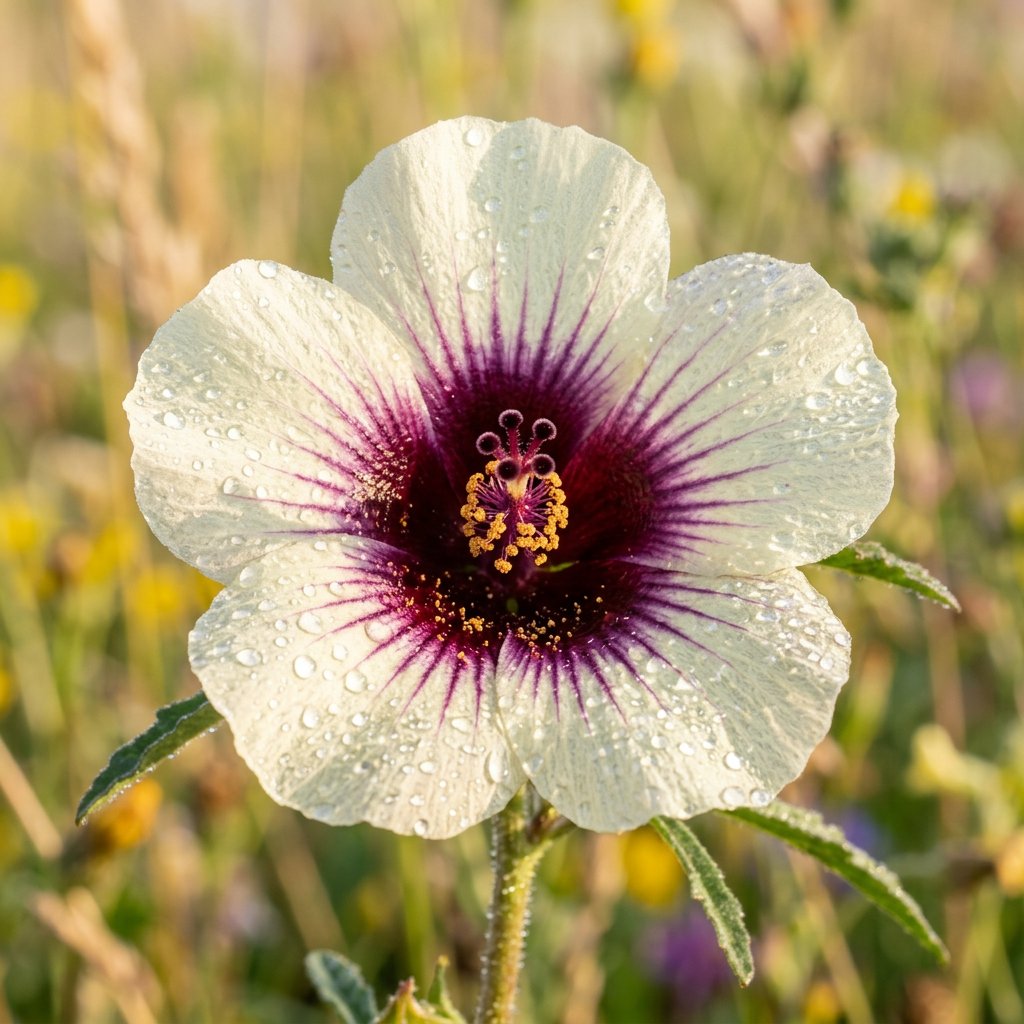
Plant Overview
Often called the "Flower-of-an-hour" or "Bladder Ketmia," this delicate member of the mallow family is a fleeting beauty. While some gardeners treat it as a cheeky weed due to its hardy nature, others adore its stained-glass-like petals and unique, papery seed pods. It is a plant that teaches us to appreciate the moment, as its blossoms are famously short-lived and shy.
🔍 How to Identify
- 🌼 The Petals: Creamy white to pale yellow petals featuring a striking, deep maroon or "chocolate" center that looks like a dark eye.
- 🎈 The "Bladder": After the flower fades, the calyx (the base of the bloom) puffs up into a translucent, papery green "balloon" with dark vertical veins.
- 🍃 The Foliage: The leaves are deeply lobed and slightly hairy, often appearing jagged or lace-like, which distinguishes it from other common garden hibiscus.
🏡 In Your Garden
- ☀️ Sun-Seeker: This plant is a dedicated sun-worshipper. It will refuse to open its blooms on cloudy days or if it is tucked away in a shady corner.
- 🌱 The Great Traveler: Because it produces a high volume of seeds within those "balloons," it is a prolific self-seeder. If you don't want it spreading, you’ll need to snip off the pods before they dry and shatter.
- 🏜️ Tough Texture: It is surprisingly drought-tolerant once established. It prefers well-drained soil and can thrive in spots where more "refined" flowers might wither.
⚠️ Safety & Toxicity
- ✅ Status: Hibiscus trionum is generally considered non-toxic to humans, dogs, and cats.
- 🧤 Mild Irritation: While not poisonous, the stems and leaves are covered in tiny, stiff hairs. If you have sensitive skin, handling the plant without gloves might cause a light, itchy sensation.
✨ Fun Fact
The name "Flower-of-an-hour" is quite literal! On a warm day, a single blossom may open at 9:00 AM and be completely closed and shriveled by noon, giving it one of the shortest blooming windows in the plant kingdom.

Detailed Care Instructions
| Color | Dark Red/Purple And White |
| Soil Ph | Neutral To Acidic |
| Invasive | Weed |
| Lighting | Full Sun |
| Toxicity | Non-Toxic |
| Soil Type | Moist But Well-Drained |
| Bloom Time | Summer To Fall In Containers; Year-Round Outdoors In Tropical Climates |
| Plant Type | Annual |
| Mature Size | 2' Tall |
| Native Area | West Africa |
| Sun Exposure | Full Sun, Partial Shade |
| Hardiness Zones | 9-11 |
To grow Hibiscus Trionum plants, you can follow these steps:
- Obtain seeds: Purchase Hibiscus Trionum seeds from a reputable nursery or online store.
- Prepare the soil: Choose a sunny location with well-draining soil. Remove any weeds or rocks from the area and dig the soil to loosen it.
- Sow the seeds: Sow the seeds directly into the soil, about 1/4 inch deep, and gently cover them with soil. Space the seeds about 6-12 inches apart.
- Water: After sowing the seeds, water the area thoroughly and keep the soil consistently moist but not waterlogged. Ensure that the soil doesn't dry out completely between watering.
- Provide proper care: Hibiscus Trionum plants prefer warm temperatures between 65-78°F (18-25°C). It is essential to provide them with full sun exposure, at least 6-8 hours per day.
- Fertilize: Hibiscus Trionum plants benefit from regular fertilization. Use a balanced, water-soluble fertilizer every 4-6 weeks during the growing season. Follow the instructions on the fertilizer label for proper application.
- Pruning: While not necessary, you can prune your Hibiscus Trionum plant to maintain its shape or encourage bushier growth. Pruning is typically done in early spring before new growth emerges.
- Watch for pests and diseases: Keep an eye out for common pests such as aphids, whiteflies, and spider mites. If infestations occur, treat them with appropriate organic or chemical insecticides. Also, watch for signs of diseases such as leaf spot or powdery mildew and take appropriate measures to prevent or treat them if necessary.
- Harvesting: Hibiscus Trionum plants produce attractive flowers that last only a day. Once the flowers fade, they produce round seed pods. If you want to collect seeds, allow the pods to mature on the plant until they turn brown and dry out. Harvest the pods and remove the seeds for future plantings.
By following these steps, you can successfully grow Hibiscus Trionum plants in your garden.

Place in a bright room that is sun drenched almost all day. Or directly in a south-facing window.

To water this plant, ensure that you first check the soil to determine if it is dry or moist. If the soil is dry to touch, it's time to water the plant. Water the plant slowly and evenly around the base of the stem, being careful not to get water on the leaves. Watering frequency may vary depending on the environment and location of the plant, but generally, it prefers to have moist soil. To avoid over-watering, test the soil with your finger to feel whether the soil is damp to the touch. If the soil is still wet, refrain from watering and wait until the soil becomes dry before watering again.
To properly fertilize this plant, it is important to use a balanced fertilizer that contains equal parts of nitrogen, phosphorus, and potassium. The fertilizer should be applied every two weeks during the growing season, starting in early spring and continuing into early fall. It is important to water the plant well before applying the fertilizer to prevent burning the roots. Additionally, avoid using too much fertilizer, as this can lead to excessive foliage growth at the expense of flower production.
For Hibiscus Trionum plant, it is recommended to use well-draining soil that is rich in nutrients and organic matter. The soil pH should be slightly acidic to neutral, ranging from 6.0 to 7.0. It is best to avoid using heavy clay soils or those with high alkalinity as it can lead to poor growth and nutrient deficiencies. A good potting mix can be made by combining equal parts of peat moss, perlite, and vermiculite. Adding compost, manure, or a slow-release fertilizer can provide additional nutrients for the plant. Regular watering is crucial, but overwatering should be avoided as it can lead to root rot. The soil should also be mulched to retain moisture and suppress weed growth.
The Hibiscus Trionum plant can be propagated through stem cuttings. To do this, select a healthy stem that is about 6 inches long and has multiple leaves. Cut the stem below a leaf node with a clean, sharp pair of scissors or shears.
Remove the leaves from the bottom half of the stem, leaving only a few leaves at the top. Dip the cut end of the stem into rooting hormone, then plant it in a small pot filled with moist potting soil.
Place the pot in a bright, warm location out of direct sunlight. Keep the soil evenly moist and mist the cutting daily with water to keep it hydrated. Within a few weeks, the cutting should start to develop new growth.
Once the cutting has grown several new leaves, it can be transplanted into a larger pot or planted in the garden. It is best to wait until the plant has established a strong root system before transplanting.
Common pests of the flower-of-an-hour include Mealybugs, spider mites, fungus gnats, aphids, thrips. Make a habit of checking your flower-of-an-hour frequently for pests so that any infestations can be caught and managed early.








