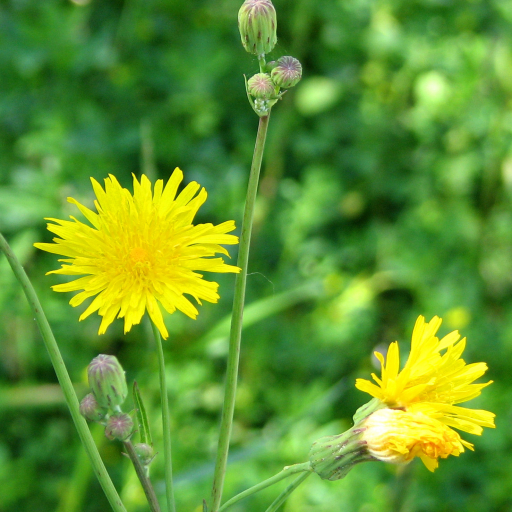
Plant Overview
Known as the Narrow-leaf Hawkweed or Umbellate Hawkweed, this resilient wildflower is like a taller, more sophisticated cousin of the common dandelion. Native to temperate regions across the Northern Hemisphere, it is often found dancing in the wind along forest edges and sandy dunes. In old European folklore, it was believed to be the source of a hawk’s legendary eyesight, earning it a mystical reputation among ancient herbalists.
🔍 How to Identify
- 🌼 The Flowers: It features bright golden-yellow flower heads composed entirely of "ray florets" (the strap-like petals), clustered together at the top of the stem in an umbrella-like shape.
- 🍃 The Foliage: Unlike many other hawkweeds, its leaves are narrow, lance-shaped, and distributed all the way up the stem rather than sitting in a flat rosette at the ground.
- 🌵 The Stem: The stalks are stiff, upright, and often covered in fine, bristly hairs or a light "bloom" that gives them a slightly grayish-green tint.
🏡 In Your Garden
- 🌱 Tough Transitions: This plant is a survivalist. It thrives in sandy, rocky, or nutrient-poor soils where more delicate garden flowers might wither. Because it develops a tenacious taproot, it dislikes being moved once it has found a home.
- 🦋 Wildlife Magnet: While some gardeners treat it as a "decorative weed," it is a powerhouse for biodiversity. It serves as a vital nectar source for late-summer bees and is a host plant for several species of moth larvae.
⚠️ Safety & Toxicity
- ✅ Status: Generally non-toxic and safe for most environments.
- 🧪 Details: While not poisonous to pets or children, the plant contains a milky latex sap. In some individuals, contact with this sap or the bristly hairs on the stem may cause mild skin redness or itching.
✨ Fun Fact
The genus name Hieracium comes from the Greek word hierax, meaning "hawk." Pliny the Elder, a Roman naturalist, recorded that hawks would tear the plant apart and rub the sap into their eyes to sharpen their vision before a hunt!

Detailed Care Instructions
| Humidity | Normal |
| Lighting | Full Sun |
| Difficulty | Medium |
| Hibernation | Cold Period |
| Temperature | 22°C - 32°C |
| Hardiness Zones | 3 - 6 |
To grow Hieracium umbellatum, also known as field hawkweed, follow these steps:
- Choose a suitable location: Field hawkweeds prefer full sun to light shade and well-drained soil. They can tolerate different soil types, such as loam or sand.
- Prepare the soil: Remove any weeds or grass from the planting area. Loosen the soil with a garden fork or tiller and add compost or organic matter to improve fertility and drainage.
- Sow seeds in early spring or fall: Scatter the seeds over the prepared soil and lightly press them into the ground. Field hawkweeds are primarily propagated through seeds.
- Water regularly: Keep the soil evenly moist but not waterlogged. Water the plants deeply once or twice a week, especially during dry periods. Avoid overhead watering, as this can lead to fungal diseases.
- Thin overcrowded seedlings: Once the seedlings have grown a few inches tall, thin them to allow enough space for each plant to thrive. Space the plants about 8-12 inches apart.
- Mulch the soil: Apply a layer of organic mulch, such as straw or wood chips, around the plants to suppress weeds, retain moisture, and regulate soil temperature.
- Fertilize if needed: Field hawkweeds generally do not require a lot of fertilization. However, if the soil is poor or the plants appear to be lacking nutrients, you can apply a balanced, slow-release fertilizer once or twice during the growing season.
- Control pests and diseases: Monitor the plants regularly for signs of pests or diseases. If necessary, treat with appropriate organic or chemical insecticides or fungicides following the manufacturer's instructions.
- Harvesting and propagation: Once the plants have matured and produced flowers, you can collect seeds from the dried flower heads to propagate new plants. Alternatively, you can divide mature clumps of the plant in early spring or fall to create new plants.
- Regular maintenance: Remove spent flowers to encourage continuous blooming and prevent self-seeding. Cut back the plants after flowering, leaving a few inches of foliage to help the plant regenerate.
By following these steps, you should be able to successfully grow Hieracium umbellatum in your garden or landscape.

Place in a bright room that is sun drenched almost all day. Or directly in a south-facing window.

Hieracium Umbellatum plant requires regular watering to maintain healthy growth. The watering frequency and amount depend on various factors such as soil type, weather condition, and season. Generally, the plant needs to be watered deeply, but infrequently to prevent waterlogging and root rot.
To water the plant, first, check the soil moisture level by touching the top layer of the soil. If it's dry to the touch, it's time to water the plant. Fill a watering can or hose attachment with lukewarm water. Slowly pour water around the base of the plant, avoiding the leaves and stems. Water until the excess water starts to drain from the drainage holes at the bottom of the pot or container.
During summers or hot weather conditions, the plant may require frequent watering. However, during winters or cold weather, the watering frequency may reduce, and the amount of water needs to be adjusted accordingly.
It's also important to avoid overwatering as it can cause root rot and damage the plant. Additionally, the plant prefers well-draining soil that doesn't hold excess water. Therefore, ensure the soil drains well and doesn't become too compacted over time.
In summary, water Hieracium Umbellatum plant deeply but infrequently, adjust the watering frequency according to weather condition, and avoid overwatering to prevent root rot.
To fertilize Hieracium Umbellatum plants, follow these instructions:
- Choose a balanced liquid fertilizer or a slow-release granular fertilizer with equal NPK ratios.
- Read the fertilizer package instructions for proper dosage based on the size and age of your plant.
- Apply the fertilizer during the active growing season, typically in spring or early summer.
- Dilute liquid fertilizer according to the package instructions, then evenly pour it around the base of the plant, avoiding direct contact with the leaves.
- For slow-release granular fertilizer, sprinkle the recommended amount evenly around the plant's root zone.
- Gently work the granules into the soil surface using a garden rake or cultivator, then water the plant thoroughly.
- Remember not to over-fertilize, as this can cause fertilizer burn or damage the plant. Adhere to the recommended dosage and frequency of application based on the fertilizer's instructions.
- Monitor the plant's response to the fertilizer; if growth appears stunted or leaves begin to turn yellow, reduce the fertilizer dosage or frequency.
- Regularly water the Hieracium Umbellatum plant to prevent nutrient imbalance and help distribute the fertilizer evenly within the soil.
- Repeat the fertilization process according to the package instructions, typically every 4-6 weeks during the growing season, for a healthy and well-nourished plant.
The ideal soil for Hieracium Umbellatum plant is a well-draining soil that is rich in organic matter. It should have a slightly acidic to neutral pH range of 6.0 to 7.0. The soil should also be able to retain moisture well, but not become waterlogged. This can be achieved by adding inorganic materials such as sand, perlite or vermiculite to improve drainage. Additionally, the soil should be aerated to provide good air circulation to the roots by adding organic materials such as garden compost, sphagnum peat moss, or leaf mold. It is essential to avoid heavy clay soils or soils that do not drain well as this can significantly reduce the quality of the plant.
Propagation of Hieracium umbellatum can be accomplished through various methods, ensuring successful reproduction and expansion of your plant collection. Here are some detailed instructions on how to propagate Hieracium umbellatum:
- Seeds: Obtain fresh Hieracium umbellatum seeds from mature flowerheads. Remove the seeds by gently crushing the dried flowerheads. Sow the seeds on a well-draining seed-starting mix, covering them lightly with a thin layer of soil. Maintain a moist environment by covering the container with a clear plastic bag or using a propagator. Place the container in a warm location with indirect sunlight. Germination usually takes around 2-3 weeks.
- Division: Choose a well-established Hieracium umbellatum plant. Dig around the plant, carefully lifting it out of the ground, ensuring minimal damage to the root system. Gently separate the root clump into smaller sections, making sure each division has a healthy number of roots and leaves. Replant the divisions in suitable planting locations, ensuring the soil is well-draining and rich in organic matter. Water thoroughly to settle the soil around the new divisions.
- Rhizome Clumps: Identify a mature Hieracium umbellatum plant with well-developed rhizomes. Dig around the plant and carefully lift it out of the ground, ensuring the intactness of the rhizome system. Cut the rhizome clump into smaller sections, making sure each division has viable roots and shoots. Replant the divisions at the desired locations, ensuring the soil is well-prepared and adequately moist. Water the divisions thoroughly after planting to settle the soil and promote root establishment.
- Tissue Culture: For advanced propagation techniques, you can consider micropropagation or tissue culture. This method involves growing plant tissue in a laboratory under controlled conditions. It requires specialized equipment and knowledge, making it more suitable for professional horticulturists or research purposes.
Regardless of the chosen propagation method, it is essential to provide optimal growing conditions for Hieracium umbellatum. Ensure the plants receive adequate sunlight, well-draining soil, and regular watering to promote healthy growth and establishment. Additionally, monitor and control any pests or diseases that may affect the newly propagated plants.








