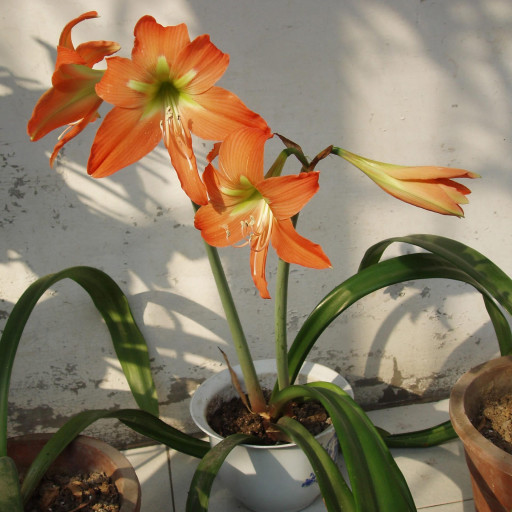
Plant Overview
Often called the Striped Barbados Lily or the Petropolis Amaryllis, this vibrant Brazilian native is a wild ancestor to many of the giant "Amaryllis" bulbs seen during the holidays. It carries an air of tropical elegance with its fiery, star-centered blooms that seem to glow against their lush green foliage. In Victorian "floriography," these flowers were often associated with pride and radiant beauty.
🔍 How to Identify
- 🌸 The Bloom: Funnel-shaped flowers that are typically a warm salmon-orange or brick red. Each petal features a distinct pale green or white "star" stripe radiating from the center.
- 🍃 The Foliage: Long, strap-like leaves that are bright green and relatively narrow. Unlike some hybrids, the leaves often appear alongside or shortly after the flowers.
- 🌱 The Stature: It is generally more delicate and smaller than modern Dutch hybrids, usually reaching about 12 to 18 inches in height.
🏡 In Your Garden
- ☀️ Sun Snob: While it loves bright light to trigger blooming, it is sensitive to intense, direct afternoon sun which can bleach the delicate orange pigments in the petals.
- 🪴 The Potting Secret: This lily actually prefers to be "pot-bound." It blooms most reliably when its roots are slightly crowded, so avoid moving it to a massive container too quickly.
- 💧 The Sleep Cycle: To see flowers year after year, it needs a "dry rest." Reducing water in the late autumn mimics the Brazilian dry season, signaling the bulb to store energy for its next big show.
⚠️ Safety & Toxicity
- 🚫 Status: Toxic to humans and pets.
- 🐾 Details: Like most members of the Amaryllis family, the bulbs and leaves contain lycorine. If ingested by cats, dogs, or curious children, it can cause upset stomachs, drooling, and tremors. It is best displayed on a high shelf or mantelpiece.
✨ Fun Fact
The name Hippeastrum literally translates to "Knight’s Star." It was named by botanist William Herbert in the 1800s, who supposedly thought the emerging flower buds resembled the ears of a horse!

Detailed Care Instructions
| Humidity | Dry |
| Lighting | Part Sun |
| Difficulty | Medium |
| Hibernation | Warm Period |
| Temperature | 18°C - 26°C |
| Hardiness Zones | 8 - 11 |
To grow a Hippeastrum Striatum plant, you can follow these steps:
- Choose a suitable planting container: Select a pot or container that has drainage holes to prevent waterlogging. Ensure it is wide enough to accommodate the bulb comfortably.
- Prepare the potting mix: Use a well-draining potting mix, such as a combination of equal parts peat moss, perlite, and vermiculite. This will provide good aeration and drainage for the plant.
- Planting the bulb: Place the bulb in the potting mix with the pointed end facing upwards. Leave about a third of the bulb exposed above the soil level. Gently press the soil around the bulb, making sure it is secure but not compacted.
- Watering: Water the bulb thoroughly after planting until the excess water drains out of the pot. Keep the soil slightly moist, but avoid overwatering, as it can cause rotting.
- Light and temperature: Place the pot in a bright, indirect sunlight location. Hippeastrum Striatum plants prefer temperatures between 60-75°F (15-24°C). Protect them from hot, direct sunlight, as it can scorch the leaves.
- Humidity and air circulation: Moderate humidity levels are ideal for Hippeastrum Striatum plants. Ensure good air circulation around the plant, but avoid placing it in drafty areas.
- Fertilizing: Once the plant starts actively growing, usually after the bulb produces leaves, you can apply a balanced houseplant fertilizer every 2-4 weeks during the growing season.
- Reblooming: After the flowering period, usually in spring, you can encourage reblooming by providing a resting period. Reduce watering and stop fertilizing to allow the plant to go dormant. Store the bulb in a cool, dry place (around 55°F/13°C) for 8-10 weeks before starting the growth cycle again.
- Maintenance: Remove any faded or yellowing leaves regularly to keep the plant tidy. You can also gently wipe the leaves with a damp cloth to remove dust and enhance their appearance.
With proper care and maintenance, your Hippeastrum Striatum plant should grow and produce beautiful flowers.

Place in a window with dappled sun or a spot in the middle of a room. Or directly in a window facing west or east.

The optimal method for providing water to Hippeastrum Striatum plants involves keeping the soil in which the plant is growing consistently damp, but not allowing it to become oversaturated. One effective way of accomplishing this is to water the plant lightly but frequently, rather than giving it a heavy watering less frequently. Additionally, it's important to ensure that the plant's soil drainage is adequate, so that water can escape the soil easily and not become trapped around the roots of the plant. If possible, water the plant early in the day to allow for maximum absorption and to avoid water sitting on the surface of the soil overnight, which can lead to mold growth. Finally, be sure to monitor the plant's leaves and other signs of its health, as too much or too little water can cause it to become stressed or even die.
To fertilize this plant, use a balanced water-soluble fertilizer with an N-P-K ratio of 10-10-10 or 20-20-20. Dilute the fertilizer according to the package instructions and apply it once a month during the growing season. Be sure to water the plant thoroughly before and after fertilizer application to prevent root burn. Avoid fertilizing during the dormant season.
Hippeastrum Striatum requires a well-draining soil mixture that is rich in organic matter. It is recommended that perlite or coarse sand be added to improve drainage. The soil pH should be slightly acidic, around 6.0-6.5, and it should be kept consistently moist but not waterlogged. It is also important to provide adequate drainage and avoid over-watering to prevent root rot. A slow-release fertilizer can be added to the soil during planting and additional fertilization can be done throughout the growing season.
To propagate this plant, one can begin by obtaining a mature bulb. The bulb should be removed carefully from the soil and cleaned to remove any excess soil or debris. Once the bulb has been cleaned, it should be inspected for any signs of damage or disease. If the bulb is healthy, it can be cut into sections with a sharp, sterile knife. Each section should have at least one or two buds or sprouts. These sections can be placed into pots filled with well-draining soil. The pots should be kept in a warm, humid location, with plenty of light, but not direct sunlight. It is important to keep the soil moist, but not waterlogged. With the proper care, the cuttings should begin to sprout within a few weeks. Once the new plants reach a suitable size, they can be transplanted into larger pots or planted directly into the ground.
Common pests of the striped barbados lily include Spider mites, aphids, thrips. Make a habit of checking your striped barbados lily frequently for pests so that any infestations can be caught and managed early.








