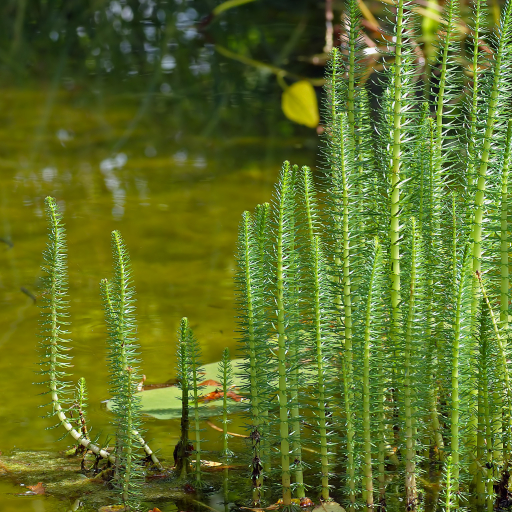
Plant Overview
Known as the "Common Mare’s-tail," this ancient aquatic perennial looks like a miniature forest of prehistoric pine trees rising from the water’s edge. Found across the cool temperate regions of the Northern Hemisphere, it is a favorite for pond enthusiasts who want to add architectural structure and a touch of the primitive to their water features. Despite its name, it is not related to the "Horsetail" (Equisetum), though they share a strikingly similar "bottle-brush" silhouette.
🔍 How to Identify
- 🌿 The "Bottle Brush" Look: Above the water, it displays stiff, unbranched, upright stems with tight whorls of 6 to 12 narrow, needle-like leaves.
- 💧 Underwater Transformation: It is a master of disguise; submerged leaves are much longer, softer, and more translucent than the stiff, waxy leaves found above the surface.
- 🌱 Inconspicuous Blooms: It doesn't produce flashy petals. Instead, it grows tiny, green, petal-less flowers tucked discreetly where the leaves meet the stem (the leaf axils).
🏡 In Your Garden
- 🌊 The Oxygenation Specialist: This plant is an incredible oxygenator. By absorbing excess nutrients and pumping oxygen into the water, it helps keep your pond clear and discourages the growth of unsightly algae.
- 🚜 Containment is Key: Because it spreads via vigorous creeping rhizomes (underground roots), it can become aggressive in a natural pond setting. To keep it from colonizing the entire shoreline, it is best planted in submerged mesh baskets to restrict its "wandering" nature.
⚠️ Safety & Toxicity
- ✅ Safe Status: Hippuris vulgaris is generally considered non-toxic to humans, cats, dogs, and horses.
- 🦆 Wildlife Friendly: It provides excellent cover for fish and tadpoles, and its seeds are often a snack for visiting waterfowl. There are no known skin irritants associated with handling this plant.
✨ Fun Fact
The Common Mare’s-tail is a champion of adaptation! It exhibits "heterophylly," meaning it can completely change its leaf anatomy and cellular structure depending on whether it is growing in the air or submerged—a survival trick that has allowed it to thrive in fluctuating water levels for millions of years.

Detailed Care Instructions
To grow Hippuris vulgaris, also known as mare's tail or swampwort, follow these steps:
- Location: Choose a suitable location for growing the plant. Hippuris vulgaris prefers wet or marshy areas, such as the edges of ponds, lakes, or streams. It requires a consistently moist environment.
- Soil: Prepare the soil by removing any debris, rocks, or weeds. The ideal soil for Hippuris vulgaris is a mixture of organic-rich soil and sand that retains moisture well but doesn't become waterlogged.
- Planting: Hippuris vulgaris can be grown directly from seeds or by transplanting existing plants. For seeds, scatter them over the prepared soil but avoid burying them. If transplanting, dig a hole slightly larger than the root ball, place the plant into the hole, and gently backfill with soil.
- Watering: Maintain a consistently moist environment for the plant. Ensure the soil is always damp, but not waterlogged. Regular watering may be necessary, especially during dry periods.
- Sunlight: While Hippuris vulgaris can tolerate full sun to partial shade, it usually thrives in areas with partial shade. Provide some shade during the hottest part of the day, especially if the climate is particularly dry or hot.
- Maintenance: Remove any weeds or unwanted plants that may compete with Hippuris vulgaris for nutrients. Also, regularly check and remove any dead or damaged foliage. This plant is known for its invasive behavior, so regular monitoring and control measures may be necessary to prevent it from overgrowing.
- Propagation: Propagate Hippuris vulgaris through division. As the plant grows and matures, it produces lateral runners. To propagate, carefully cut or dig up a portion of the plant, ensuring it includes roots, and replant it in a suitable location.
- Winter Care: In colder regions, Hippuris vulgaris may go dormant during winter. During this period, it may lose its above-ground foliage. Ensure the dormant plant is not exposed to freezing temperatures, and protect it with a layer of mulch or move it to a protected area if possible.
By following these guidelines, you can successfully grow Hippuris vulgaris in a suitable location and enjoy its unique appearance in your garden.

Place in a bright room that is sun drenched almost all day. Or directly in a south-facing window.

Hippuris Vulgaris is an aquatic plant that requires proper watering for its survival. Here are some tips on how to water this plant:
1. Choose the right planting location: Hippuris Vulgaris should be planted in an area that provides enough sunlight and is near a water source, such as a pond or a creek. The soil should be rich in nutrients and well-drained.
2. Monitor the water levels: Hippuris Vulgaris requires constant moisture to thrive. The water level should be checked regularly to ensure that it covers the plant's roots. The plant should not be left in standing water for extended periods as it can cause root rot.
3. Water with care: When watering, make sure not to pour water directly onto the plant's leaves as it can damage them. Instead, fill a watering can or a bucket with water and slowly pour it around the base of the plant.
4. Watch the water quality: The water quality is crucial for Hippuris Vulgaris's growth. It is recommended to use clean, freshwater and avoid using water that is laden with pollutants or chemicals.
5. Consider adding fertilizers: To encourage growth, you can add fertilizers that are rich in nitrogen and phosphorus to the plant's water.
By following these tips, you can ensure that your Hippuris Vulgaris plant receives adequate water and grows healthy and strong.
To fertilize the plant, use a balanced liquid fertilizer with equal amounts of nitrogen, phosphorus, and potassium. Apply the fertilizer once every two weeks during the growing season, i.e. from spring to summer. Using a dilute concentration of the fertilizer in water, wet the soil evenly around the base of the plant. Be sure to avoid getting the fertilizer on the foliage as it can burn the plant.
Hippuris Vulgaris requires a specific type of soil to grow and thrive. The soil should be well-drained, moist, and high in organic matter. It should also have a slightly acidic to neutral pH level. The plant prefers sandy or loamy soils, but can also grow in clay soils with added organic matter. The roots of this plant are shallow, so it is important to avoid compacted or heavy soils. A layer of mulch can provide additional nutrients and help retain moisture in the soil. Overall, the ideal soil for Hippuris Vulgaris should be nutrient-rich, well-draining, and slightly acidic to neutral in pH.
Hippuris vulgaris can be propagated through several methods, including division, stem cuttings, and seed propagation.
Division involves separating the plant into smaller sections with roots and replanting them in new locations or containers. This method is best done in early spring before new growth emerges.
Stem cuttings can also be used to propagate Hippuris vulgaris. Cut a section of the stem and remove the leaves from the lower half. Plant the cutting in soil or in water until it develops roots. Once the roots have developed, the cutting can be transplanted to a new location.
Seed propagation involves collecting the seeds from mature plants and planting them in soil or hydroponic setups. The seeds require a period of cold stratification before they will germinate, so it is best to sow them in the fall and allow them to overwinter before they start to grow in the spring.
Regardless of the method chosen, it is important to provide the new plants with plenty of water and nutrients to help them establish healthy root systems and grow successfully.








