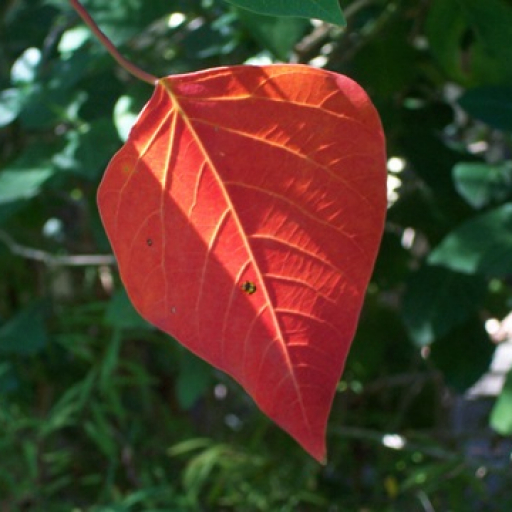
Plant Overview
Often called the Bleeding Heart Tree or Queensland Poplar, this Australian native is a master of the "autumn look" in a subtropical setting. It is a famous pioneer species, meaning it is one of the first trees to spring up after a forest clearing, acting as a natural nursery for slower-growing plants. Its heart-shaped leaves don't just stay green; they transition into a brilliant crimson before falling, giving the tree its poetic name.
🔍 How to Identify
- 🍃 The Leaf Shape: Distinctly heart-shaped (cordate) with a smooth texture, bearing a striking resemblance to the Northern Hemisphere Poplar tree.
- 🔴 The "Bleeding" Effect: While the canopy is primarily a lush emerald, older leaves turn a fiery, vivid red throughout the year, creating a beautiful spotted contrast.
- 🌿 Long Petioles: The leaves sit on unusually long, slender stalks, which allows them to flutter and dance even in the slightest breeze.
🏡 In Your Garden
- 🌱 The Quick Canopy: Because it grows exceptionally fast, it is a favorite for gardeners looking to create a "quick" privacy screen or provide immediate shade for more delicate undergrowth.
- 🌦️ Microclimate Needs: It thrives in rich, moist soil and prefers a spot protected from harsh winds and heavy frost. It is quite a "thirsty" plant and will show its drama by drooping its leaves if the soil dries out too much.
⚠️ Safety & Toxicity
- 🧴 Irritant Sap: As a member of the Euphorbiaceae family, the tree contains a milky white latex sap. This sap can cause skin irritation or rashes upon contact for some people.
- 🐾 General Precaution: The sap is an irritant to the eyes and mouth. It is best to keep this tree away from areas where pets or children might break the stems, and always wear gloves when pruning.
✨ Fun Fact
The Bleeding Heart Tree is a biological "restoration hero." In the wild, its seeds can lay dormant in the soil for years, waiting for a tree to fall and let light in; once the sun hits the ground, they germinate rapidly to help heal the forest floor!

Detailed Care Instructions
To grow Homalanthus populifolius, also known as the bleeding heart tree, you can follow these steps:
- Obtain seeds or saplings: You can purchase seeds or saplings from a local nursery or online. Make sure to obtain the seeds or saplings from a reliable source.
- Choose the right location: Homalanthus populifolius thrives in full sun to partial shade. Select a location in your garden that receives at least 4-6 hours of sunlight each day. Ensure the soil is well-draining.
- Prepare the soil: Homalanthus populifolius prefers slightly acidic soil with a pH level between 6.0 and 7.0. Amend the soil with organic matter, such as compost, to improve its texture and drainage.
- Sow seeds or plant saplings: If starting from seeds, sow them in spring or early summer. Plant the seeds at a depth of 1/8 inch and space them approximately 12 inches apart. If using saplings, dig a hole slightly larger than the root ball and place the sapling in the hole, filling it with soil and gently firming it around the base.
- Water regularly: Keep the soil moist but not waterlogged. Water the plant deeply at least once a week, especially during hot and dry periods. Mulching around the base of the plant can help retain moisture and regulate soil temperature.
- Prune and shape: Once your Homalanthus populifolius plant has established itself, you can prune it to maintain its shape and size. Pruning is typically done in late winter or early spring before new growth begins.
- Fertilize: Apply a balanced and slow-release fertilizer in early spring and again in mid-summer to promote healthy growth. Follow the manufacturer's instructions for proper application.
- Protect from frost: If you live in an area prone to frost, protect your Homalanthus populifolius plant by covering it with a frost cloth or bringing it indoors during cold spells.
Remember to monitor the plant for any signs of pests or diseases, and take appropriate measures to prevent or treat them. With proper care, your Homalanthus populifolius should grow into a beautiful and healthy tree.

Place in a window with dappled sun or a spot in the middle of a room. Or directly in a window facing west or east.

To water this plant, first ensure that the soil is dry to the touch before watering. It is best to water deeply, allowing the water to soak into the soil and reach the roots. Avoid letting the plant sit in standing water as this can lead to root rot. Ideally, water the plant in the early morning or late afternoon to avoid evaporation and water stress during the hottest part of the day. Additionally, be sure to adjust the amount and frequency of watering according to the plant's current environment, growth stage, and soil conditions.
To fertilize this plant, use a balanced N-P-K fertilizer during the growing season (spring and summer) once every two weeks. In the offseason, use a slow-release fertilizer. Avoid over-fertilizing as it can cause leaf burn or damage the roots. Water the plant before fertilizing to prevent fertilizer burn.
The ideal soil for this plant should be well-draining and rich in organic matter. It should have a slightly acidic to neutral pH level, ranging between 6.0 and 7.5. The soil texture should be sandy loam or loamy, which will provide good aeration to the roots.
When planting this plant, it is important to ensure that the soil is thoroughly moistened and that there is proper drainage to prevent waterlogging, which can lead to root rot.
To improve the quality of the soil, it is recommended to add compost or well-rotted manure before planting. Additionally, fertilizers can be applied during the growing season to enhance the growth and development of the plant.
Overall, the soil should be well-prepared and well-maintained to ensure the Homalanthus Populifolius plant thrives and produces healthy foliage and flowers.
To propagate this plant, you can take stem cuttings from a mature, healthy plant. It is best to take cuttings in the spring or early summer when the plant is actively growing. Choose a stem that is at least 4 inches long, and make a clean cut with a sharp, sterilized knife just below a node.
Remove the leaves from the bottom half of the cutting, and dip the cut end in rooting hormone powder to encourage root growth. Place the cutting in a pot filled with well-draining potting soil, and water it thoroughly. Cover the pot with a plastic bag or plastic wrap to increase humidity and keep the cutting from drying out.
Place the cutting in a bright, indirect light, and keep the soil moist by misting it regularly or watering it from the bottom. After a few weeks, you should start to see new growth as the cutting develops roots. Once the cutting has rooted and begun to grow, you can transplant it into its own pot or into the garden.








