Plant Overview
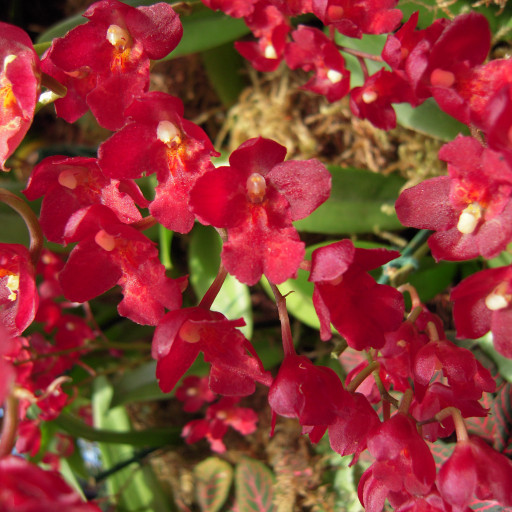
Often called the "Miniature Firecracker," the Howeara is a darling of the orchid world. This man-made hybrid was specifically bred to stay small while producing an explosion of color, making it the perfect "apartment orchid." Most famously known for the 'Lava Burst' variety, this plant captures the wild essence of the tropics in a package that fits in the palm of your hand.
🔍 How to Identify
- 🔥 The Blooms: Features long, arching flower spikes that carry dozens of tiny, star-shaped blossoms. They are most commonly seen in fiery shades of blood-orange, crimson, and golden-yellow.
- 🌿 The Foliage: Unlike many bulky orchids, Howeara has thin, fan-shaped leaves that look like ornamental grass. These grow from small, flattened "pseudobulbs" at the base.
- 📏 Size: A true miniature! Even at full maturity, the plant rarely exceeds 6–8 inches in height, excluding the flower spikes.
🏡 In Your Garden (or Windowsill)
- 🌬️ Air & Moisture: Because Howeara has very fine, hair-like roots, it is prone to drying out faster than its larger cousins. It thrives in a "chunky" bark mix that allows air to reach the roots while being watered frequently enough to stay slightly damp.
- 🌤️ Light Nuance: It loves bright, filtered light—think of the dappled sun under a tree canopy. If the leaves turn dark green, it needs more light; if they start to look purple or red, it might be getting a bit too much "sunburn."
⚠️ Safety & Toxicity
- ✅ Non-Toxic: Good news for pet parents! Howeara orchids are generally considered non-toxic to cats, dogs, and horses.
- 👶 Handling: While safe, the thin leaves can be somewhat stiff and sharp at the tips. Keep it on a high shelf to prevent curious toddlers from accidentally toppling the light pot or pulling on the delicate flower spikes.
✨ Fun Fact
The Howeara is a botanical "mutt" with a pedigree! It is an intergeneric hybrid, meaning it was created by crossing three distinct orchid genera: Leochilus, Oncidium, and Rodriguezia. This complex ancestry is what gives it its unique ability to bloom multiple times a year!

Detailed Care Instructions
To grow a Howeara plant, you can follow these steps:
- Choose the right location: Howeara plants prefer bright but indirect sunlight. Place them in a spot where they can receive filtered or diffused light throughout the day.
- Provide the right temperature and humidity: Howeara plants thrive in warm temperatures ranging from 65-80°F (18-27°C). Maintain a relative humidity of around 50-70%, which can be achieved by placing the plant on a tray filled with water or using a humidifier.
- Watering: Keep the potting mix lightly moist but not waterlogged. Water the plant when the top inch of soil feels dry. Ensure that the pot has good drainage to prevent waterlogging.
- Potting mix: Howeara plants prefer well-draining potting mix. You can use a mix of orchid bark, perlite, and sphagnum moss to provide good aeration and drainage.
- Fertilization: Feed the plants using a balanced orchid fertilizer diluted to half strength every 2-4 weeks during the growing season (spring-summer). Avoid fertilizing during the dormant period.
- Repotting: Repot the plant every 2-3 years or when the pot becomes crowded. Use fresh potting mix and a slightly larger pot if necessary.
- Pruning: Remove any dead or damaged leaves or stems to keep the plant healthy and tidy.
- Pests and diseases: Monitor for signs of pests like aphids, spider mites, or mealybugs. If you notice any infestation, treat the plant with an appropriate insecticide or wipe the leaves with a diluted soapy water solution. Ensure good air circulation to prevent diseases like root rot.
Remember to research the specific care requirements of the Howeara variety you have, as there may be slight variations depending on the species or hybrid.

Place in a window with dappled sun or a spot in the middle of a room. Or directly in a window facing west or east.

To water this particular plant, it is important to ensure that the soil remains consistently moist. This can be achieved by watering the plant thoroughly, allowing excess water to drain away, and then ensuring that the top inch of soil remains damp before watering again. It is important not to allow the plant to sit in water as this can cause root rot. Additionally, the plant should be watered more frequently during times of active growth and less frequently during periods of dormancy. Lastly, it is important to use room temperature water as water that is too warm or too cold can shock the plant.
The recommended fertilizing instructions for fertilizing this plant are to use a balanced fertilizer with equal amounts of nitrogen, phosphorus, and potassium. Fertilize every two weeks during the growing season from March to September, and reduce fertilization in the winter months. Dilute the fertilizer to half strength and apply it to moist soil. Be sure to avoid getting the fertilizer on the leaves or flowers to prevent burning. Additionally, it is recommended to flush out excess salts in the soil by watering it well once a month with distilled water or rainwater.
The ideal soil for this type of plant is a well-draining soil mix. It should contain a mixture of ingredients such as perlite, vermiculite, or sand to ensure good drainage. The soil pH should be slightly acidic, around 6.0-6.5. The soil should also be rich in nutrients to promote healthy growth. Compost or organic matter such as peat moss can be added to the soil mix to increase its nutrient content. It's important to avoid using heavy soil mixtures that can retain too much water as this can lead to root rot. Additionally, it's recommended to repot the plant every 1-2 years to ensure it has adequate space for its roots to spread and access fresh soil.
To propagate this plant, you will need to wait until it has produced a keiki, which is a new plant that forms on the mother plant. Once the keiki has put out roots and is about one inch long, you can cut it off the mother plant with a sterile sharp knife or scissors. Then, you can pot the keiki in its own container with well-draining potting soil.
To encourage root growth, you can water the new plant regularly but avoid overwatering to prevent rotting. Place the new plant in a bright, indirect light location and protect it from direct sunlight.
In a few months, the new plant will establish itself and start to grow independently. You can then treat it as you would any other plant.
Common pests of the howeara include Scale insect, mealybugs, spider mites, thrips. Make a habit of checking your howeara frequently for pests so that any infestations can be caught and managed early.







