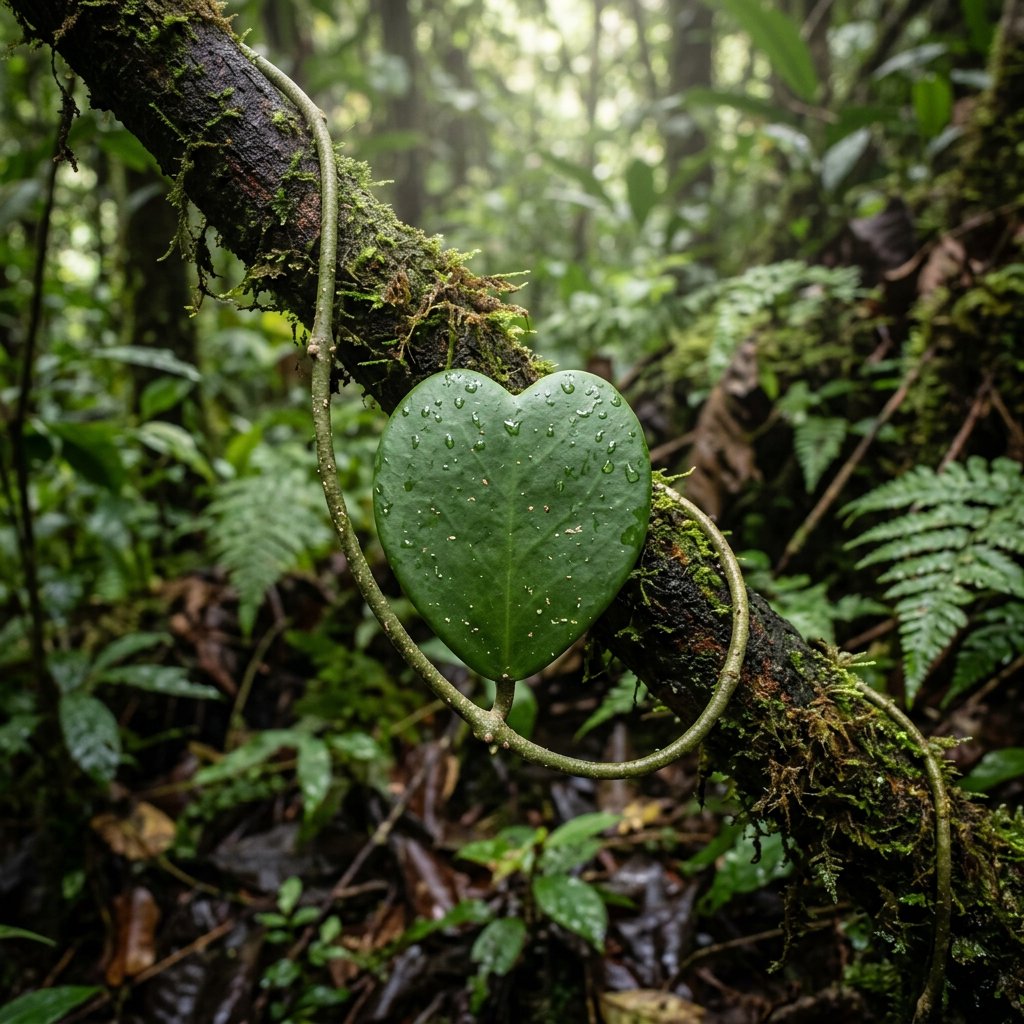
Plant Overview
Often called the "Sweetheart Plant" or "Valentine Hoya," this charming succulent-like vine is famous for its perfectly heart-shaped leaves. Native to the tropical forests of Southeast Asia, it has become a global symbol of love and a staple for indoor gardeners. While it is commonly sold as a single rooted leaf in a tiny pot, in the wild, it is a vigorous climber that can wrap itself gracefully around forest canopies.
🔍 How to Identify
- 💚 Heart-Shaped Foliage: The most iconic feature is the thick, fleshy leaves that are almost perfectly symmetrical hearts, usually measuring 2–5 inches wide.
- 🌿 Vining Habit: Mature plants develop thick, semi-woody stems that use "adventitious roots" to grip onto trellises or neighboring trees.
- 🌸 Waxy Blooms: It produces "umbels" (rounded clusters) of up to 25 star-shaped flowers. These blossoms are creamy-white with a deep red or purple center and look as if they were carved from wax.
🏡 In Your Home
- 🪴 The "Zombie" Leaf: Be careful when buying a single leaf in a pot; these are often "blind cuttings" without a node. While they stay green and beautiful for years, they will never grow into a full vine without a piece of the original stem attached.
- 💧 Succulent Logic: Because the leaves are so thick, they store massive amounts of water. It thrives on neglect and prefers its soil to dry out completely between waterings—too much water is the fastest way to kill this romantic plant.
- ☀️ Light & Patience: This is a slow-growing species. To see a new leaf or a flower, you must provide very bright, indirect light. In low light, the plant will simply "stall" and stop growing entirely.
⚠️ Safety & Toxicity
- 🐾 Pet Safe: Unlike many other common houseplants, the Hoya kerrii is non-toxic to cats and dogs, making it a perfect choice for pet-filled homes.
- 🧪 Milky Sap: If a leaf is broken, the plant leaks a white, sticky latex. While not dangerous, it can be messy and may cause minor skin irritation for individuals with specific latex allergies.
✨ Fun Fact
The flowers of the Hoya kerrii produce so much nectar that it often drips from the petals. This nectar is brownish-red and can actually stain light-colored curtains or carpets if the plant is hanging nearby!

Detailed Care Instructions
| Color | Pink, White |
| Soil Ph | Acidic, Neutral |
| Humidity | Normal |
| Lighting | Part Sun |
| Soil Type | Well-Draining |
| Bloom Time | Spring, Summer |
| Difficulty | Easy |
| Plant Type | Vine, Succulent |
| Hibernation | Cold Period |
| Mature Size | 13 Ft. Long |
| Native Area | Asia |
| Temperature | 18°C - 25°C |
| Sun Exposure | Full |
| Hardiness Zones | 11 |
To grow a Hoya Kerrii plant, commonly known as sweetheart or Valentine's Hoya, you can follow these steps:
- Select a healthy plant: Purchase a Hoya Kerrii plant either online or from a local nursery. Ensure that it has healthy leaves and stems.
- Choose an appropriate pot and soil: Select a well-draining pot that has drainage holes. Hoya Kerrii thrives in well-draining soil, so use a mix of potting soil, orchid bark, perlite, or pumice to create a loose and aerated mixture.
- Plant the cutting: Hoya Kerrii is commonly grown from leaf cuttings. Select a mature leaf with a stem attached and insert it into the soil, burying the stem until it is secure. Ensure that at least two nodes are below the soil surface.
- Provide proper light: Place the Hoya Kerrii plant in bright indirect light. It can tolerate some direct sunlight, but avoid intense afternoon sun, as it may scorch the leaves.
- Maintain optimal temperature and humidity: Hoya Kerrii prefers temperatures between 60-80°F (15-27°C). It can tolerate slightly cooler temperatures, but avoid drastic temperature fluctuations. Maintain a humidity level of around 50% by using a humidifier or placing the plant on a tray filled with pebbles and water.
- Watering routine: Water the Hoya Kerrii thoroughly when the top inch of soil feels dry. Allow excess water to drain out from the bottom of the pot to prevent root rot. During winter or in cooler months, reduce watering frequency.
- Fertilize regularly: Feed the plant with a balanced, diluted liquid fertilizer during the growing season (spring and summer) to provide necessary nutrients. Follow the instructions on the fertilizer packaging to avoid over-fertilizing.
- Pruning and shaping: As the plant grows, you can shape and prune it by cutting back excessive growth. This will help maintain a desired shape and encourage bushier growth.
- Propagate for more plants: Hoya Kerrii can also be propagated by stem cuttings instead of leaf cuttings. Take a healthy stem cutting with at least two nodes and plant it in well-draining soil. Follow the same care routine as mentioned above.
Remember, Hoya Kerrii is a slow-growing plant, so be patient. With proper care and attention, your Hoya Kerrii will thrive and grow into a beautiful specimen.

Place in a window with dappled sun or a spot in the middle of a room. Or directly in a window facing west or east.

To water this plant, ensure that the soil is dry to the touch before watering. When watering, water thoroughly until water drains through the bottom of the container. Avoid letting the plant sit in standing water, as this can lead to root rot. Water less frequently during the plant's dormant period in the winter months.
To fertilize this plant, use a fertilizer high in phosphorus during the growing season. Dilute the fertilizer to half strength and apply every other watering. Avoid fertilizing during the dormant season and always follow the instructions on the fertilizer packaging.
Hoya Kerrii plant prefers a well-draining, loose and fertile soil that has sufficient drainage capacity and airiness. It is recommended to use soil that has a good balance of organic matter and mineral nutrients. The soil should not be too heavy or too light and should have a pH level ranging from slightly acidic to neutral. A combination of peat moss, perlite, and fine sand can be a suitable mix for Hoya Kerrii plant. However, it is important to note that the soil mix should not be too water-retentive, as this can lead to root rot. It is recommended to add a layer of gravel or stones at the bottom of the container for additional drainage.
Propagation of this plant can be done through stem cuttings or leaf cuttings, both of which require some care and attention. For stem cuttings, select a healthy stem without any damage or diseases, and cut it into sections that are around 4-6 inches long. Remove any leaves or flowers from the bottom of the stem, and plant it in a well-draining potting mix. Keep the soil consistently moist, and provide indirect light. For leaf cuttings, select a healthy leaf and cut it at the base of the stem. Let it dry and callus over for a few days, and then plant it in a well-draining potting mix, with the cut end buried slightly. Keep the soil consistently moist and provide indirect light. Both methods can take several weeks to months to root and establish themselves, so be patient and maintain consistent care.
Common pests of the sweetheart plant include Scale insect, mealybugs, spider mites. Make a habit of checking your sweetheart plant frequently for pests so that any infestations can be caught and managed early.








