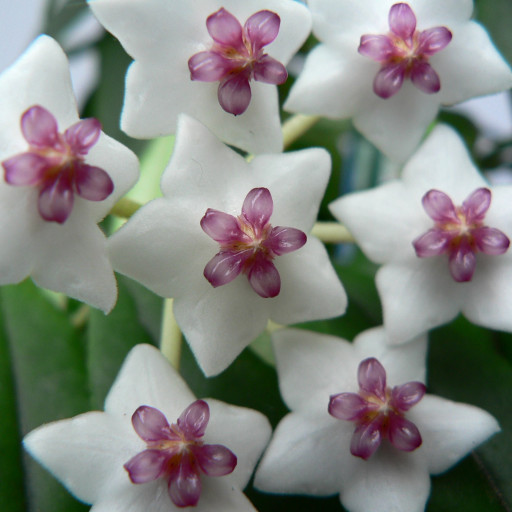
Plant Overview
Often called the "Miniature Wax Plant" or "Beautiful Hoya," this Himalayan native is a crowning jewel for any indoor hanging garden. Unlike its larger, more robust cousins, Hoya lanceolata (specifically the popular subspecies bella) offers a delicate, cascading waterfall of pointed leaves and porcelain-like blooms. In its natural habitat, it lives as an epiphyte, clinging to mossy tree branches where it soaks up filtered mountain sunlight and high humidity.
🔍 How to Identify
- 🍃 The Foliage: Small, dark green, lance-shaped (sword-like) leaves that grow in neat, opposite pairs along slender, trailing stems.
- 🌸 The "Wax" Flowers: Clusters of star-shaped, crystalline white flowers, each featuring a striking amethyst-purple or pink "corona" (center).
- 🍯 The Nectar: When in bloom, you may notice tiny, glistening drops of sweet nectar hanging from the center of the flowers, which look like polished glass.
🏡 In Your Garden
- 🪴 The Epiphytic Edge: Because this plant naturally grows on trees, it despises "wet feet." It requires a very chunky, airy potting mix (think orchid bark and perlite) to ensure the roots can breathe.
- 💧 Thirst Signals: Unlike the thicker-leaved Hoya carnosa, this species has thinner leaves and less water storage. If the leaves lose their shine or feel slightly limp, it’s a signal that the plant is craving a drink—don’t let it bone-dry for too long!
- ☀️ Light Logic: It thrives in bright, indirect light; too much direct sun will scorch the delicate leaves, while too little light will prevent those famous fragrant flowers from forming.
⚠️ Safety & Toxicity
- ✅ Status: Non-toxic and pet-friendly.
- 💧 The Sap: Like most Hoyas, it produces a milky white latex sap when cut. While not poisonous, this sap can be quite sticky and may cause mild skin irritation for people with latex sensitivities.
✨ Fun Fact
The fragrance of the Hoya lanceolata is most intense at night! It releases a heavy, sweet scent reminiscent of honey and vanilla to attract nocturnal moths, its primary pollinators in the wild.

Detailed Care Instructions
To grow Hoya Lanceolata plant, here are some steps you can follow:
- Choose the right location: Hoya plants prefer bright indirect sunlight. Place them near a north or east-facing window where they can receive bright but filtered light.
- Use well-draining soil: Hoya Lanceolata plants require a well-draining soil mix that retains some moisture but doesn't become saturated. A mix comprising equal parts of potting soil, perlite, and orchid bark works well.
- Select a pot: Choose a pot with drainage holes to prevent waterlogging. The pot should be slightly larger than the current root ball to allow the plant to grow.
- Watering: Hoya plants prefer to dry out slightly between waterings. Water thoroughly and then allow the top few inches of soil to dry out before watering again. Be careful not to overwater as it can cause root rot.
- Humidity: Hoya plants are tropical plants and enjoy moderate to high humidity levels. You can increase humidity around the plant by placing a water-filled tray near it or using a room humidifier.
- Fertilization: Feed the plant with a balanced liquid fertilizer diluted to half strength. Fertilize once a month during the spring and summer growing season.
- Pruning: Hoya plants can be pruned to control their size and shape. Prune back leggy or overgrown stems to promote bushier growth.
- Support: Hoya Lanceolata plants are climbing plants and appreciate support for their vining growth habit. You can use a trellis, moss pole, or other decorative supports for the plant to climb on.
- Propagation: Hoyas can be propagated through stem cuttings, which root easily in water or moist soil. Take stem cuttings with at least two nodes and remove the lower leaves. Place the cutting in water or soil, and it will develop roots over time.
- Pests and diseases: Keep an eye out for common houseplant pests such as spider mites, mealybugs, and aphids. Treat infestations promptly with appropriate insecticides, insecticidal soaps, or neem oil.
Remember to research specific care requirements for Hoya Lanceolata, as they may vary slightly from the general guidelines.

Place in a window with dappled sun or a spot in the middle of a room. Or directly in a window facing west or east.

To water this particular plant, you should first allow the soil to dry out between waterings. When the top 1-2 inches of soil looks dry to the touch, it is time to water the plant. Use room temperature water and make sure to saturate the entire root ball, allowing the excess water to drain from the bottom of the pot. Do not allow the plant to sit in standing water, as this can cause root rot. It is important to not overwater this plant, as it prefers to be on the dry side. In general, the frequency of watering will depend on factors such as the size of the pot, the humidity levels, and the temperature of the environment.
To fertilize Hoya Lanceolata, use a water soluble fertilizer with balanced N-P-K ratios every two weeks during the growing season. Dilute the fertilizer to half strength to avoid burning the roots. Avoid fertilizing when the plant is not actively growing or during winter dormancy. Apply fertilizer to moist soil and water thoroughly.
For Hoya Lanceolata plant, it is recommended to use organic soil containing a mixture of peat moss, perlite, and vermiculite. This soil mixture provides good drainage and aeration for the plant's roots while also retaining moisture. It is important to use a well-draining soil as Hoya Lanceolata does not tolerate wet soil conditions. Additionally, a slightly acidic soil with a pH range of 5.5-6.5 is ideal for the plant's growth. Fertilization can be done with a balanced liquid fertilizer during the growing season to provide the plant with essential nutrients. It is also advisable to repot the plant every two years to promote healthy growth and prevent root-bound conditions.
To propagate this plant, select a healthy vine with several leaves. Cut the vine just below a node, which is where a leaf stem meets the main stem. Remove any leaves on the lower one-third of the stem. Dip the cut end of the stem in powdered rooting hormone. Place the stem in a pot filled with moist potting soil, and cover it with a plastic bag to create a humid environment. Keep the soil moist, but not waterlogged, and provide bright, indirect sunlight. After several weeks, once the plant has rooted, remove the plastic bag and allow the plant to acclimate to the surrounding air. Transplant the new plant to a larger pot with fresh potting soil and continue to care for it as you would an established plant.
Common pests of the hoya bella include Scale insect, mealybugs, spider mites. Make a habit of checking your hoya bella frequently for pests so that any infestations can be caught and managed early.








