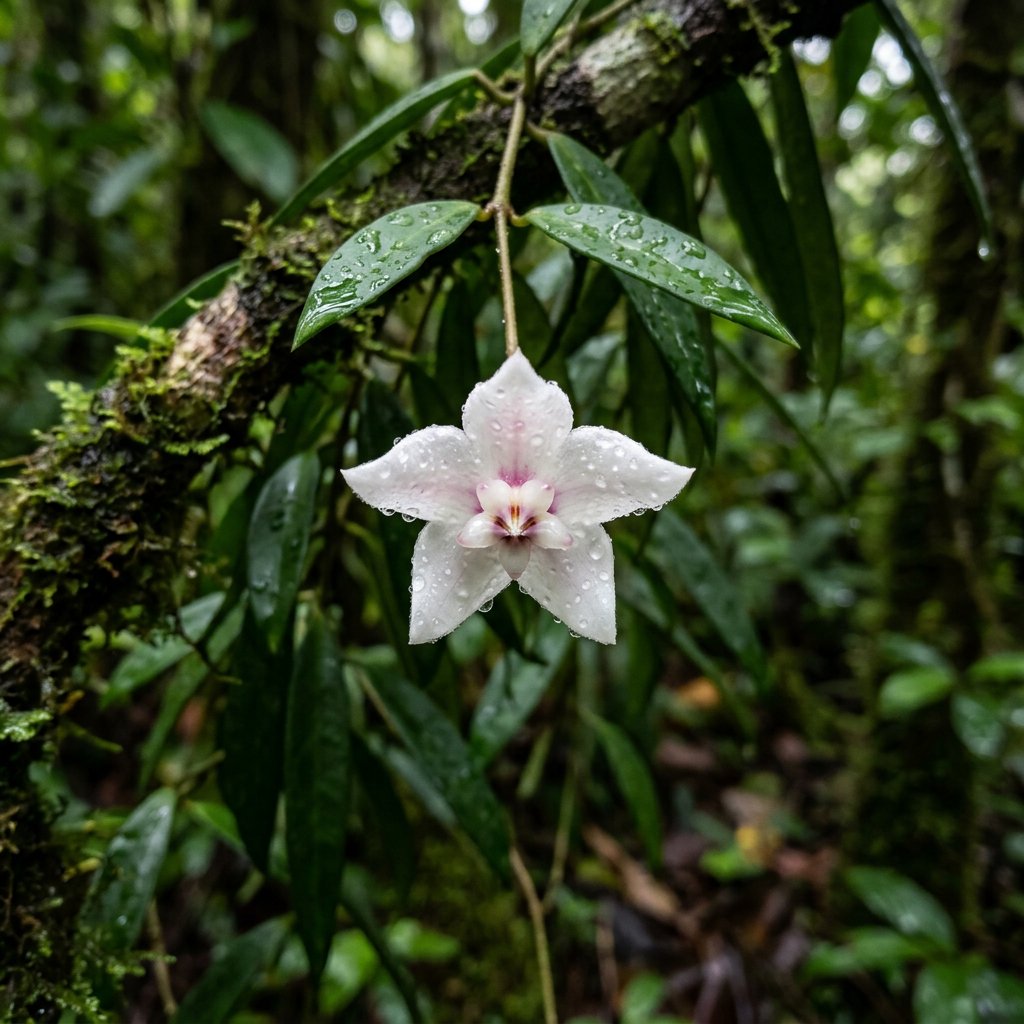
Plant Overview
Often called the "Few-flowered Hoya," this slender beauty is the minimalist's dream in the Apocynaceae family. Unlike its bushy, broad-leaved cousins, Hoya pauciflora features elegant, grass-like foliage that hides a secret: it produces some of the most stunning and fragrant individual flowers in the genus. Hailing from the misty, high-altitude mountains of South India and Sri Lanka, it brings a touch of sophisticated, cool-climate grace to any indoor collection.
🔍 How to Identify
- 🍃 The Foliage: Look for long, very narrow, needle-like leaves that are dark green and slightly succulent. They look more like thick blades of grass than a traditional tropical leaf.
- 🌸 The Bloom: The flowers are solitary (or in very small groups), appearing as large, waxy white stars with a striking deep-red or purple "crown" (corona) in the center.
- 👃 The Scent: If you catch a whiff of spicy, sweet perfume at night, you’ve found it—the fragrance is often compared to a blend of jasmine and warm vanilla.
🏡 In Your Garden
- ⛰️ High-Altitude Needs: Because it originates from mountain forests, this Hoya actually prefers slightly cooler temperatures than its lowland relatives. It thrives when there is a noticeable drop in temperature at night.
- 💧 Humidity over Wetness: It loves high humidity but has finer roots than the common Hoya carnosa. It prefers a well-draining, airy orchid-style mix and doesn't like to sit in bone-dry soil for weeks at a time.
- 🪴 Mounting vs. Potting: While it grows beautifully in a hanging basket, its trailing, thin vines make it an excellent candidate for mounting on cork bark to mimic its natural epiphytic lifestyle.
⚠️ Safety & Toxicity
- 🐾 Pet Friendly: Great news for animal lovers—this Hoya is generally considered non-toxic to cats and dogs.
- 🧪 Latex Sap: Like most members of the milkweed family, it contains a milky white sap. While not deadly, this sap can cause mild skin irritation for some people or stomach upset if ingested in large quantities by pets.
- 🧤 Safe Handling: It is best to wear gloves when pruning if you have a latex allergy or sensitive skin to avoid the sticky residue.
✨ Fun Fact
The name pauciflora literally translates from Latin to "few flowers." While most Hoyas compete to see who can grow the biggest "umbrella" cluster of blooms, this species focuses all its energy into just one or two magnificent, oversized flowers at a time!

Detailed Care Instructions

Place in a window with dappled sun or a spot in the middle of a room. Or directly in a window facing west or east.

Hoya Pauciflora plant requires a consistent regimen of watering to maintain optimal growth and health. When watering, it is critical to keep the soil slightly moist but never saturated. This can be achieved by watering the plant thoroughly from the top and allowing any excess water to drain away. It is advisable to water the Hoya Pauciflora plant once per week in the growing season and less frequently in the winter months.
It is also important to consider the type of soil in which the plant is growing. The soil should be well-draining, allowing water to flow through easily, without accumulating and leading to root rot. Additionally, it is beneficial to inspect the drainage holes in the bottom of the plant's container to ensure they are not clogged, blocking water flow.
If the Hoya Pauciflora plant is growing in a dry climate, it may require more frequent watering than in a humid environment. Similarly, if the plant is growing in a larger container, it may need more water than a smaller pot.
Finally, it is essential to avoid overwatering the plant, which can lead to root rot and other water-related issues. Always wait until the soil is dry to the touch before watering again.
Without the need of fertilizer, these plants can thrive and bloom. If a plant requires fertilization, it will display indicators of nutrient insufficiency, such as yellowing leaves. It is safe to apply slightly diluted fertilizers in these circumstances. Over fertilizing, on the other hand, should be avoided because excess nutrients might cause plant mortality. Slow-release fertilizers are therefore advised for these plants.
You may use All Purpose Plant Food or Flower Fertilizer or Green Plant Food for your Hoya Pauciflora
The ideal soil for Hoya Pauciflora plant is a well-draining soil mix that is high in nutrients. The soil should be loose and airy to enable the roots to stretch and breathe. It should contain a rich amount of organic matter, such as compost or aged manure, to provide the necessary nutrients. The soil pH should ideally be between 5.5 and 7.5, which is slightly acidic to neutral. The soil should be evenly moist, but not waterlogged, to prevent root rot and promote healthy growth. To ensure good drainage, the soil should contain coarse, gritty material, such as perlite or sand. It is also important to use a pot with adequate drainage holes to prevent water from sitting in the bottom of the container and potentially harming the roots.
Common pests of the hoya pauciflora include Scale insect, mealybugs, spider mites. Make a habit of checking your hoya pauciflora frequently for pests so that any infestations can be caught and managed early.







