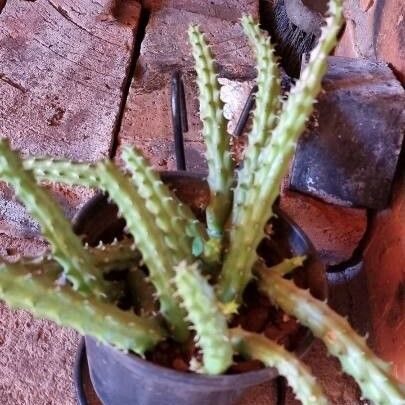
Plant Overview
The Huernia schneideriana, famously known as the Red Dragon Flower, is a rugged yet rewarding succulent that hails from the rocky terrains of East Africa. Unlike its flashier, giant-flowered cousins, this plant is cherished for its ease of care and its "alien" blossoms—velvety, deep-burgundy bells that hide tucked beneath the stems. It is the perfect "oddity" plant for collectors who love architectural shapes and unique floral displays.
🔍 How to Identify
- 🌵 The Stems: These are fleshy, grayish-green, and roughly cylindrical. They feature 5 to 7 distinct ridges lined with soft, tooth-like bumps called "tubercles" that look prickly but are actually quite soft to the touch.
- 🔔 The Flower: Small, bell-shaped blossoms with five pointed tips. The interior is a rich, velvety maroon or chocolate-red, often appearing almost black in the center, resembling a tiny, dark dragon’s throat.
- 🌱 Growth Habit: It has a sprawling or trailing habit. As it grows, the stems clumping together and eventually spill over the sides of containers like green, prehistoric tentacles.
🏡 In Your Garden
- 🏜️ Drainage is Vital: The Red Dragon Flower is highly susceptible to "wet feet." Because its roots are shallow and delicate, you must use a very gritty, cactus-heavy potting mix. If the soil stays damp for more than a day or two, the base of the stems may turn to mush.
- ☀️ The Sun Blush: This plant is a great communicator. In ideal bright light, it remains a healthy green; however, if it receives intense sun, the stems will "stress" into a beautiful purplish-bronze hue. This is a natural defense and adds a stunning aesthetic to the plant.
- 💧 Seasonal Sips: Unlike desert cacti, Huernias enjoy regular watering during the hot summer growing season. However, they should be kept almost entirely dry during the winter to mimic their natural dormant period in the African wild.
⚠️ Safety & Toxicity
- ✅ Status: Generally considered non-toxic to humans and common household pets like cats and dogs.
- 💧 Sap Irritation: Like many members of the Apocynaceae family, the plant contains a clear sap. While it isn't deadly, it can cause mild skin irritation for those with sensitive skin. It is always wise to wash your hands after taking cuttings or repotting.
✨ Fun Fact
🪰 The Fly Trick: Even though this specific species doesn't have the "rotting meat" stench of its larger relatives, it still uses the same evolutionary trick. Its dark, fleshy, and wrinkled flowers are designed to mimic a small wound on an animal to attract pollinating flies!

Detailed Care Instructions
| Color | Red |
| Soil Ph | 6 |
| Lighting | Part Sun |
| Soil Type | Cactus Potting Mix |
| Bloom Time | Spring And Summer |
| Plant Type | Perennial |
| Mature Size | Six Inches Spread, Six To Eight Inches Height |
| Native Area | Southern Africa |
| Sun Exposure | Full Sun To Part Shade |
| Hardiness Zones | 9B-11 |
To grow Huernia schneideriana, also known as Red Dragon Flower, you will need to follow these steps:
- Obtain a healthy plant: Purchase a Huernia schneideriana plant from a reputable nursery or online seller. Make sure the plant is healthy, with no sign of diseases or pests.
- Choose the right location: Huernia schneideriana thrives in bright, indirect sunlight. Find a spot in your home or garden where the plant receives partial sunlight or bright, indirect light throughout the day.
- Prepare the soil: Use well-draining soil with a sandy texture. Huernia schneideriana prefers soil that is slightly alkaline. You can make the soil suitable by adding perlite or sand to improve drainage.
- Planting: Transplant your Huernia schneideriana into a pot or directly into your garden bed. Ensure that the pot or planting area has drainage holes to prevent waterlogging.
- Watering: Water the plant sparingly. Allow the soil to dry out between waterings to prevent root rot. Overwatering can be detrimental to this succulent plant, so it's better to underwater than overwater.
- Fertilizing: Huernia schneideriana doesn't require frequent fertilization. Fertilize the plant once or twice a year during the growing season using a balanced, diluted liquid fertilizer.
- Temperature and humidity: Huernia schneideriana prefers moderate to warm temperatures, ideally between 60°F (15°C) and 85°F (29°C). Maintain a humidity level of around 40-60% for optimal growth.
- Pruning: Prune any dead or damaged stems or leaves to promote healthy growth and maintain the plant's overall appearance.
- Propagation: Huernia schneideriana can be propagated through stem cuttings. Take a healthy stem cutting and let it callus over for a few days. Then, plant it in a well-draining soil mix, and water sparingly until new growth appears.
- Pests and diseases: Monitor your plants regularly for any signs of pests like mealybugs or aphids. Treat any infestations promptly with appropriate insecticides or organic remedies.
With proper care and attention, your Huernia schneideriana plant should grow and flourish, producing unique and beautiful red dragon-shaped flowers.

Place in a window with dappled sun or a spot in the middle of a room. Or directly in a window facing west or east.

Huernia Schneideriana is a succulent plant that requires infrequent watering and well-draining soil. When watering, it is important to allow the soil to dry out completely between waterings to prevent root rot. Watering should be done sparingly, typically every 2-3 weeks during the growing season and even less during the dormant season. It is important to avoid getting water on the leaves or stems, as this can cause damage or rot. Water should be applied directly to the soil, and excess water should be allowed to drain away. It is best to water in the morning or early evening to avoid evaporation and to help prevent fungal growth. Additionally, it is important to avoid overwatering and to make sure the plant receives proper drainage to prevent the accumulation of standing water.
To fertilize Huernia Schneideriana, use a balanced, water-soluble fertilizer diluted to half strength. Apply the fertilizer every other watering during the growing season, which is typically from spring to fall. Reduce the frequency of fertilization during the winter months when the plant is dormant. Avoid fertilizing newly repotted plants for at least two months to avoid root burn. Always follow the manufacturer's instructions for the specific fertilizer being used.
The ideal soil for this plant is one that is well-draining and has good aeration to prevent waterlogging. It should also be nutrient-rich to support the plant's growth and development. A recommended soil mixture is a combination of coarse sand, perlite, and organic matter such as peat moss or compost. The coarse sand helps with drainage and aeration, while the perlite provides additional drainage and prevents compacting. The organic matter adds nutrients to the soil and improves its water-holding capacity. It is important to avoid using soils that are too dense or heavy, which can suffocate the plant's roots and cause root rot.
Huernia Schneideriana is a species of plant that can be propagated through a variety of different methods. One method is by taking stem cuttings from a mature, healthy plant. To do this, select a stem that is at least 3 inches long and has several leaves attached. Using a clean, sharp pair of scissors or shears, cut the stem close to the base of the plant.
Next, remove any leaves from the bottom 1-2 inches of the stem. Dip the cut end of the stem into a rooting hormone powder, which can be found at most gardening stores, to encourage the growth of roots.
Fill a small pot or container with a well-draining soil mix, such as a cactus mix, and make a small hole in the center. Insert the stem into the soil, making sure that the bottom 1-2 inches are covered, and gently press the soil around the stem to anchor it in place.
Water the cutting lightly to moisten the soil, then cover it with a clear plastic bag or dome to create a humid environment that will promote root growth. Place the pot in a warm and bright location, but avoid direct sunlight.
Check the cutting regularly and water it as needed to keep the soil moist but not waterlogged. After a few weeks, gently tug on the stem to see if it has rooted yet. If it resists pulling, roots have developed and the plastic cover can be removed.
Continue to care for the new plant as it grows, monitoring its water and light needs and potting it up into larger containers as it outgrows its current home.
Common pests of the red dragon flower include Scale insect, mealybugs, spider mites, thrips. Make a habit of checking your red dragon flower frequently for pests so that any infestations can be caught and managed early.








