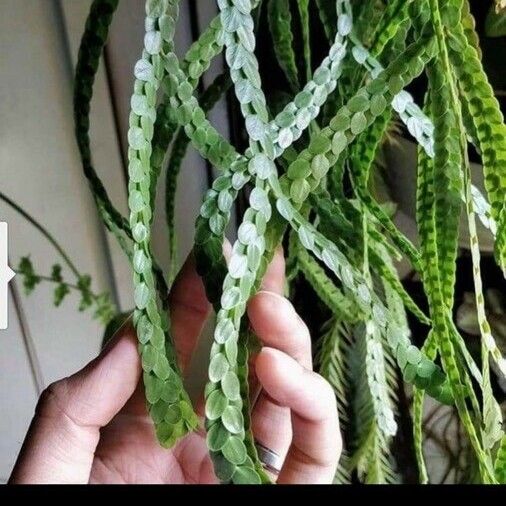
Plant Overview
Often called the Coin-leaf Tassel Fern or the Necklace Fern, this prehistoric beauty isn't actually a fern at all—it is a "club moss," an ancient lineage of plants that has survived for millions of years. Native to the humid rainforests of Southeast Asia, it grows as an epiphyte, meaning it spends its life tucked into the nooks of high tree branches. Its cascading stems look like intricate pieces of emerald jewelry, making it a showstopper for any indoor jungle.
🔍 How to Identify
- 🌿 Leaf Shape: Tiny, round, and slightly succulent leaves that resemble green coins or beads. They grow tightly packed along thin, wiry stems.
- 🧶 Growth Habit: The plant produces long, pendulous stems that can trail several feet downward, creating a dense, weeping curtain of green.
- 🌾 Fertile Tassels: At the tips of mature branches, the plant develops long, slender, light-green "tassels" (strobili). These are not flowers, but the structures that hold its reproductive spores.
🏡 In Your Garden
- ☁️ High-Humidity Specialist: Because it originates in tropical canopies, this plant thrives in high humidity (60% or higher). It is a perfect candidate for a large terrarium or a bright, steamy bathroom.
- 🪵 No Soil Allowed: In the wild, its roots breathe air. If you plant it in heavy potting soil, the roots will likely rot. Use an "airy" substrate like orchid bark, coarse perlite, and long-fiber sphagnum moss to keep it happy.
- 💧 Watering Logic: It prefers to stay consistently moist but never waterlogged. It hates "wet feet," so ensure your hanging basket or pot has excellent drainage to mimic the drying winds of the rainforest.
⚠️ Safety & Toxicity
- 🐾 Pet Friendly: Huperzia nummulariifolia is generally considered non-toxic to cats and dogs, making it a safe choice for pet-filled households.
- 👶 Handle with Care: While not poisonous, the plant is physically delicate. Its stems can snap easily if tugged by curious children or pets. Additionally, while the spores are not toxic, they can be a minor respiratory irritant to very sensitive individuals if handled roughly during the "tasseling" stage.
✨ Fun Fact
The ancestors of the Tassel Fern were not always this small! During the Carboniferous period (about 300 million years ago), relatives of the Huperzia grew as massive, scale-covered trees that reached over 100 feet tall. Today’s Tassel Fern is a miniature, elegant descendant of those prehistoric giants.

Detailed Care Instructions

Place in a window with dappled sun or a spot in the middle of a room. Or directly in a window facing west or east.

The presence of a dry surface layer of soil does not indicate that the plant requires water. Instead, stick your finger 1-2" (3-5 cm) deep in the soil to feel dampness or moisture content. If the soil seems dry, it's time to water your greens. If the soil is still moist, however, it is better not to water your plant and instead wait a day or two. Overwatering or waterlogging raises the risk of root rot. So if the soil takes longer than a week to dry, check the light conditions because it's likely that the plant isn't getting enough light. It's fine if the upper layer of soil is dry between waterings, but the deeper soil layer should always have some moisture.
These plant needs regular fertilizing during growing seasons. Fertilizing your plants in dormant state during the winter, might result in scorching or browning of the leaf tips. If mature plants display signs of nutrient insufficiency, fertilizer administration is necessary to restore the plant to its previous state.
You may use All Purpose Plant Food or Green Plant Food for your Tassel Fern
Common pests of the tassel fern include Scale insect, mealybugs, spider mites, fungus gnats, aphids, thrips. Make a habit of checking your tassel fern frequently for pests so that any infestations can be caught and managed early.








