Plant Overview
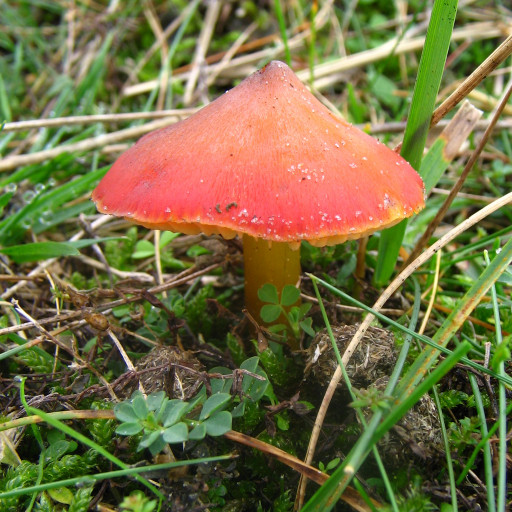
Often called the "Witch's Hat" or the "Conical Waxcap," this striking mushroom looks like a miniature, brightly colored wizard’s cap sprouting from the grass. It is famous for its "magical" transformation: it starts as a vibrant scarlet or orange jewel and ends its life looking like a charred piece of coal. It is a hallmark of ancient, untouched grasslands and brings a touch of Halloween to the wild.
🔍 How to Identify
- 🎩 The Cap: Sharply conical (pointy), often bright red, orange, or yellow with a waxy or slimy texture that feels sticky to the touch.
- 🖤 Color Change: The entire mushroom turns jet black as it matures or whenever it is bruised or handled. This is its most distinctive identification feature.
- 📏 The Stem: Fibrous and hollow, usually yellow or orange, often appearing slightly twisted or grooved.
- 👐 The Gills: Pale yellow to white, crowded together, and "free" (not reaching the stem), eventually turning black with age.
🌲 Habitat & Ecology
- 🌱 Unimproved Grasslands: You’ll find them in old lawns, cemeteries, or mossy meadows. They are "indicator species," meaning they only grow in soil that has not been treated with modern artificial fertilizers.
- 🍄 The Symbiotic Mystery: While many mushrooms eat decaying matter, the Witch's Hat is believed to have a complex, hidden relationship with mosses and grasses, though scientists are still debating exactly how they "feed."
⚠️ Safety & Toxicity
- 🚫 WARNING: The Witch's Hat is widely classified as inedible or mildly toxic. Do not consume.
- 🤢 Symptoms: Ingestion can lead to severe gastrointestinal distress, including nausea, vomiting, and stomach cramps.
- 🐕 Pets & Kids: Because of its bright, "candy-like" colors, it can attract children and curious pets. It should be treated as a "look but don't touch" species.
✨ Fun Fact
In old European folklore, the sudden blackening of the Witch's Hat was seen as an omen. It was believed that if you stepped on one or picked it, you were inviting the "touch of a witch" into your home, represented by the soot-like stains left on your fingers.

Detailed Care Instructions
To grow Hygrocybe Conica plants, you can follow these steps:
- Choose a suitable location: Hygrocybe Conica prefers a shady to partially shady spot with well-draining soil. It is important to provide it with indirect or filtered sunlight as direct sunlight can be too harsh for the plant.
- Prepare the soil: The soil should be rich in organic matter and well-draining. You can amend the soil with compost or peat moss to improve its fertility and drainage.
- Propagation: Hygrocybe Conica can be propagated through spores or by division. Spores can be collected from mature mushrooms and sowed in a prepared soil bed. Alternatively, you can also purchase pre-sown spore kits or mycelium plugs to speed up the process. For division, carefully separate the clumps of the plant and replant them in the desired location.
- Watering: Hygrocybe Conica plants require regular watering to maintain adequate moisture in the soil. Keep the soil evenly moist, but avoid overwatering as it can lead to root rot. Watering when the surface of the soil feels dry to the touch is a good rule of thumb.
- Mulching: Applying a layer of organic mulch, such as wood chips or straw, around the base of the plants can help regulate soil moisture and temperature. Mulching also helps suppress weed growth and provides nutrients as it decomposes.
- Fertilizing: Hygrocybe Conica plants generally do not require heavy fertilization. However, if the growth seems weak or if you observe any nutrient deficiencies, you can apply a balanced organic fertilizer following the manufacturer's instructions.
- Maintenance: Regularly remove any dead or decaying plant material to prevent the spread of diseases or pests. Additionally, keep an eye out for any signs of pests or diseases and take appropriate measures like using organic pest control methods if necessary.
Remember to consult local gardening resources or experts for specific guidance on growing Hygrocybe Conica plants in your area, as environmental conditions can vary.
Hygrocybe Conica plant should be watered regularly to maintain sufficient soil moisture. When watering, it is important to avoid overwatering as it can lead to waterlogged soil and root rot. Thus, it is recommended to check the soil moisture level before giving water. This can be done by inserting a finger or a moisture meter into the soil. If the top inch of soil feels dry, it is time to water the plant.
When watering, the soil should be thoroughly moistened, but not flooded. This can be achieved by watering slowly and evenly, allowing the water to penetrate the soil. In addition, it is advisable to use tepid water as cold water can shock the plant's roots. It is also important to avoid getting the leaves wet to prevent the growth of fungus or bacterial diseases.
During the cooler months, the Hygrocybe Conica plant may require less frequent watering, as the soil tends to retain moisture longer. On the other hand, during warmer months and in areas with high humidity, the plant may require more frequent watering to keep the soil from drying out.
In summary, watering the Hygrocybe Conica plant requires checking the soil moisture level, avoiding overwatering, watering slowly and evenly, using tepid water, and avoiding getting the leaves wet.
To fertilize this plant, sprinkle a slow-release fertilizer on the soil around its base, following the package instructions for proper application rates. Water the soil well before and after fertilization. Avoid over-fertilizing the plant, as this can lead to nutrient burn and damage. Additionally, consider supplementing the soil with organic matter, such as compost or well-rotted manure, to provide additional nutrients to the plant over time.
The Hygrocybe Conica plant requires a well-aerated soil that has good drainage. It is best to use a soil that has a pH of 5.0 to 7.5, which is slightly acidic to neutral. The soil should be rich in nutrients, so adding organic matter such as compost or leaf mold is recommended. Avoid using heavy soil that retains water, as this can result in root rot. It is also important to ensure that the soil is not compacted, as this can limit root growth and reduce the plant's ability to absorb nutrients. Regularly adding fertilizer can help to maintain healthy soil conditions and promote strong growth.
Hygrocybe Conica is a mushroom species that can be propagated through spore dispersal. The spores are released from the cap of the mushroom and can be collected and spread over a substrate to encourage growth. The substrate can be a mix of organic materials such as sawdust, compost, and grain. Once the spores have grown into mycelium, they can be transferred to a new substrate to continue growing. Alternatively, a small piece of mycelium (known as a culture) can be taken from the parent mushroom and transplanted to a new substrate to start a new colony. This method is called vegetative propagation and can be done in a laboratory setting. Proper sterile techniques are necessary to prevent contamination and ensure successful propagation.







