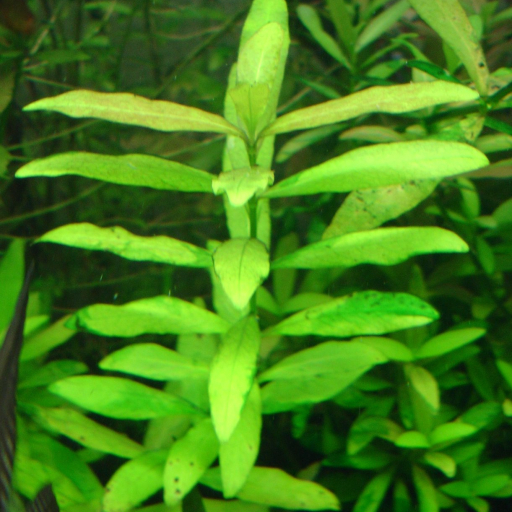
Plant Overview
Often called the "Indian Swampweed," Hygrophila polysperma is widely considered the ultimate gateway species for the aquarium hobby. Native to the freshwater ecosystems of Southeast Asia, this plant has earned a legendary reputation for being virtually "indestructible." While it creates a lush, emerald backdrop for fish, its ability to grow in almost any condition makes it both a favorite for beginners and a concern for environmentalists.
🔍 How to Identify
- 🌿 Leaf Architecture: The leaves are lance-shaped (elliptical) and grow in opposite pairs along a brittle, green stem. They typically reach about 1.5 to 2 inches in length.
- 🎨 Color Morphing: While the plant is naturally a vibrant lime green, the top leaves can shift to a beautiful bronzy-pink or reddish hue when exposed to intense light and high iron levels.
- 📏 Growth Pattern: It is a rapid vertical grower. If it reaches the surface, it will begin to grow "emersed" (above water), where its leaves become tougher, darker, and slightly hairy.
🏡 In Your Garden
- ✂️ The Pruning Paradox: This plant grows so fast that it requires regular "haircuts" to prevent it from shading out other plants. Because it is a stem plant, you can simply "top" it—cut the top half off and stick it back into the substrate to create a new plant.
- 🧪 The Nutrient Sponge: It is a champion at water purification. It aggressively consumes nitrates and phosphates, acting as a natural filter that helps prevent algae blooms in your aquarium.
- 🪵 Substrate Nuance: While it can survive floating, it thrives best when rooted in a nutrient-rich substrate. It has a delicate root system that dislikes being moved once established, so try to pick a permanent spot.
⚠️ Safety & Toxicity
- ✅ Safe for Pets: This plant is completely non-toxic. It is safe for aquarium inhabitants, and many herbivorous fish, like Goldfish or Silver Dollars, may even enjoy it as a snack.
- 🚫 Ecological Warning: Due to its extreme hardiness, it is classified as a "Federal Noxious Weed" in several U.S. states. You must never dispose of trimmings in local drains, ponds, or rivers, as even a tiny fragment can start an infestation that chokes out native wildlife.
✨ Fun Fact
In the aquarium trade, a popular cultivar called "Rosanervig" (or Sunset) features distinct white veins. This look is actually caused by a specific virus that prevents chlorophyll from forming in the veins—don't worry, though; the virus is harmless to your fish and other plants!

Detailed Care Instructions
To grow Hygrophila Polysperma plants, follow these steps:
- Gather the necessary materials: Hygrophila Polysperma plants, a clean aquarium or fish tank, aquarium substrate or gravel, liquid aquarium fertilizer, aquarium lighting or a full spectrum light bulb, and an aquarium heater (optional but recommended).
- Prepare the aquarium: Clean the aquarium thoroughly and rinse the substrate or gravel to remove any dust or debris. Place the substrate or gravel in the aquarium, forming a layer about 1-2 inches thick.
- Plant the Hygrophila Polysperma: Trim the roots of the Hygrophila Polysperma plants if needed. Plant the plants gently into the substrate or gravel, making sure the roots are embedded securely. Space the plants apart to allow for growth.
- Provide proper lighting: Hygrophila Polysperma plants require moderate to high lighting conditions to grow well. If using aquarium lighting, ensure it is of sufficient intensity and duration (around 8-10 hours a day). If using a full spectrum light bulb, position it above the aquarium at a suitable distance based on the manufacturer's instructions.
- Add liquid fertilizer: Regularly add liquid fertilizers formulated for aquarium plants according to the manufacturer's instructions. This will provide the necessary nutrients for the Hygrophila Polysperma to thrive.
- Maintain water parameters: Hygrophila Polysperma plants prefer slightly acidic or neutral water conditions (pH around 6.5-7.5) and a temperature between 72-82°F (22-28°C). If needed, use an aquarium heater to maintain the temperature within this range.
- Regularly trim and prune: As the Hygrophila Polysperma plants grow, they may require occasional trimming and pruning to maintain their shape and promote healthy growth. Use clean scissors or pruning shears to avoid introducing any potential contaminants into the aquarium.
- Monitor and adjust: Regularly monitor the water parameters, including temperature, pH, and nitrate levels, to ensure they remain within suitable ranges. Adjust water conditions as needed to provide an optimal environment for the plants.
By following these steps and providing proper care, your Hygrophila Polysperma plants should grow and thrive in your aquarium.

Place in a window with dappled sun or a spot in the middle of a room. Or directly in a window facing west or east.

When watering this plant, it is important to make sure that the soil is consistently moist but not waterlogged. Avoid allowing the soil to completely dry out between waterings, as this can cause damage to the plant's roots. When watering, aim to saturate the soil evenly throughout the pot or container. It may also be beneficial to use a drip tray or saucer underneath the pot to catch any excess water and prevent it from sitting in the soil. Additionally, be sure to use room temperature or slightly warm water, as cold water can shock the plant's system and lead to stress or damage.
To fertilize this plant, provide it with a balanced liquid fertilizer formulated for aquatic plants. Apply the fertilizer according to the manufacturer's instructions, taking care not to over-fertilize as this can be harmful to the plant. Additionally, ensure that the plant receives adequate light and carbon dioxide to promote healthy growth and absorption of nutrients. Regular water changes and maintenance of water quality are also important for the plant's overall health.
The ideal soil for the Hygrophila Polysperma plant should be rich in nutrients and have good water retention capabilities. It should have a slightly acidic to neutral pH level of 6.0-7.5. The soil should be well-draining to prevent waterlogging and root rot. A combination of clayey and loamy soil is recommended for the plant to grow well. The soil should also be free of any harmful contaminants or pathogens that can affect the plant's growth and health. Additionally, it is beneficial to add organic matter such as compost, peat moss, or aged manure to the soil to provide additional nutrients and improve soil texture.
To propagate this plant, first identify a healthy stem that has a few leaves attached. Cut off a section of the stem just below a node (where the leaf attaches to the stem). Remove any leaves from the bottom one-third of the stem, as this will be the part that is buried in the substrate. Place the stem cutting in the substrate and gently press it down so it is secured in place. Make sure the stem cutting is receiving adequate light and nutrients, and over time it will develop new roots and grow into a new plant.








