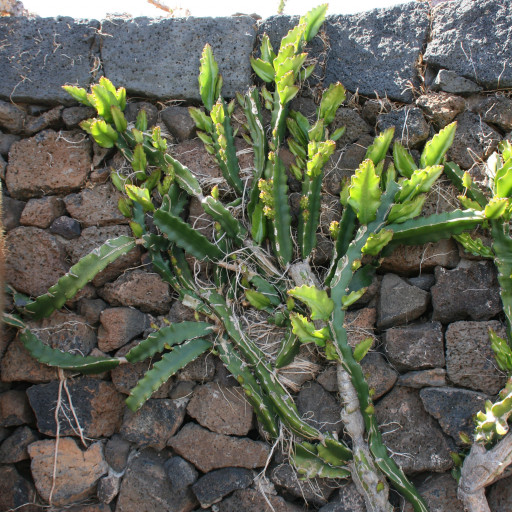
Plant Overview
The Hylocereus undatus, most famous for producing the "Dragon Fruit," is a dramatic climbing cactus that feels like it stepped out of a prehistoric jungle. Often called the "Queen of the Night," it produces some of the largest flowers in the botanical world, which bloom for only a single evening under the moonlight. While it is prized globally for its neon-pink, scale-covered fruit, it is also a stunning ornamental plant for those with enough space to let its serpentine stems roam.
🔍 How to Identify
- 🌵 Stem Structure: Unlike traditional rounded cacti, this species features long, fleshy, three-sided (triangular) stems that are often segmented and have wavy, scalloped margins.
- 🌸 Ghostly Blooms: The flowers are magnificent, reaching up to 14 inches long; they are creamy white, intensely fragrant, and shaped like a large, ornate trumpet.
- 🍓 The Dragon’s Egg: The fruit is unmistakable—bright magenta or pink skin adorned with fleshy greenish "scales" (bracts), containing a sweet white flesh speckled with tiny, edible black seeds.
🏡 In Your Garden
- 🧗 The Need for Support: Because it is an "epiphytic" climber, it won’t stand up on its own. In a home garden, it requires a heavy-duty trellis or a sturdy wooden post with a "T-top" to spill over as it matures.
- 💧 Tropical Temperament: While it is a cactus, it hails from tropical forests rather than dry deserts. It hates "wet feet" and needs well-draining soil, but it requires more frequent watering than its desert cousins, especially during the flowering season.
- ☀️ Sun Protection: In extremely hot, arid climates, the stems can actually get "sunburned." It thrives in bright, indirect light or morning sun, but prefers a bit of dappled shade during the harshest afternoon hours to keep the ribs from turning yellow.
⚠️ Safety & Toxicity
- ✅ Pet & Human Friendly: The fruit is a nutritious superfood for humans and is considered non-toxic to cats, dogs, and horses according to the ASPCA.
- 🌵 Physical Hazards: While the spines are small and sparse compared to other cacti, they are still sharp. The "areoles" (small bumps) along the ribs can cause skin irritation or small punctures if handled without gloves.
✨ Fun Fact
The Dragon Fruit plant is a master of "nightlife." Because its massive flowers open only after dark and wither by dawn, it relies almost entirely on nocturnal pollinators like hawkmoths and nectar-feeding bats to transform its flowers into fruit!

Detailed Care Instructions
| Color | White |
| Soil Ph | Acid, Neutral |
| Humidity | Dry |
| Lighting | Part Sun |
| Toxicity | Non-Toxic |
| Soil Type | Well-Drained |
| Bloom Time | Spring, Summer |
| Difficulty | Easy |
| Plant Type | Cactus |
| Hibernation | Cold Period |
| Mature Size | Up To 20' Long |
| Native Area | Tropical America |
| Temperature | 15°C - 30°C |
| Sun Exposure | Full Sun, Partial Shade |
| Hardiness Zones | 10-12 |
To grow a Hylocereus Undatus plant, also known as a dragon fruit plant, you can follow these steps:
- Obtain a mature dragon fruit plant: You can either buy a small plant or obtain cuttings or seeds from an existing mature plant.
- Choose a suitable location: Dragon fruit plants require a sunny and warm location, preferably with temperatures between 65°F to 90°F (18°C to 32°C). A location with partial shade can also work.
- Prepare the soil: Dragon fruit plants prefer well-draining soil that is slightly acidic with a pH level of 6.0 to 7.0. If your soil is heavy or clayey, you can mix it with sand or perlite to improve drainage.
- Planting the cutting or seeds:
- For a cutting: Plant the cutting about 2 to 3 inches deep in the soil. Ensure that at least one node is submerged in the soil. Nodes are small, raised bumps on the stem from where roots will sprout.
- For seeds: Sow the seeds about 1/4 inch deep in the soil, and make sure to keep them moist until they germinate.
- For a cutting: Plant the cutting about 2 to 3 inches deep in the soil. Ensure that at least one node is submerged in the soil. Nodes are small, raised bumps on the stem from where roots will sprout.
- Support the plant: Hylocereus Undatus plants need support to grow vertically. You can install a trellis or fence, or use a large pot with a stable stake for support. The plant will use aerial roots to attach itself to the support structure.
- Watering: Keep the soil moderately moist, but avoid over-watering as it can cause root rot. Water your plant when the top inch of soil is dry. During winter, you can reduce watering frequency.
- Fertilizer: Use a balanced, organic fertilizer once a month during the growing season (spring and summer). You can also use a fertilizer specifically formulated for cacti and succulents.
- Pruning and maintenance: Prune the plant to remove dead or damaged stems and to control its size. Dragon fruit plants can grow quite large, so regular pruning can help maintain a manageable size.
- Harvesting: Dragon fruits usually ripen about 30-50 days after flowering. The fruit will change color and become slightly soft when it's ready to be harvested. Gently twist off the fruit or cut it with a clean knife.
- Propagation: You can propagate Hylocereus Undatus plants by taking stem cuttings. Let the cutting dry out for a few days, then plant it using the same method mentioned earlier.
Remember to provide proper care and protection from frost during winter months if you live in a colder climate.

Place in a window with dappled sun or a spot in the middle of a room. Or directly in a window facing west or east.

Hylocereus Undatus is a tropical plant that requires proper watering for healthy growth. As a general rule, it is important to provide regular watering to keep the soil moist but not waterlogged.
To water this plant, it is recommended to first check the soil moisture level before giving water. Poke your finger into the soil up to your second knuckle to check if it feels dry or moist. If it feels dry, it's time to water your plant.
Use a watering can or hose with a gentle stream to water around the base of the plant, making sure to water the entire root zone. Avoid getting water on the foliage as this can cause leaf damage or fungal diseases.
Water thoroughly until the water seeps out from the drainage holes at the bottom of your plant's container. Be careful not to over-water your plant, as this can lead to root rot and other problems.
In addition to regular watering, it is also important to provide adequate drainage and to monitor the soil moisture level during hot and dry weather. With proper care, your Hylocereus Undatus plant will thrive and produce beautiful blooms.
To fertilize this plant, make sure to use a balanced fertilizer with an equal N-P-K (nitrogen, phosphorus, and potassium) ratio. Apply the fertilizer once a month during the growing season, which usually lasts from spring to fall. Water the plant thoroughly before and after fertilizing, and be careful not to over-fertilize, as this can lead to burning and damage to the plant. Additionally, you can also add a layer of compost or well-rotted manure around the base of the plant once a year to provide extra nutrients and improve soil health.
The ideal soil for this plant is well-draining, slightly acidic, and nutrient-rich. It should be a mix of loam, sand, and organic matter such as compost or peat moss. A pH level of 6.0-7.0 is most suitable for optimal growth. Avoid using heavy or clay soils as they can retain too much moisture and cause root rot. The soil should also have adequate aeration and drainage to prevent waterlogging. Adding perlite or vermiculite to the mix can help improve drainage. Additionally, regular fertilization with a balanced fertilizer can promote healthy growth and fruit production.
Hylocereus Undatus is a cactus species that can be propagated through cuttings. To do so, select a healthy stem that is at least six inches long and free from any visible damages or diseases. Using a sharp, sterilized knife or scissors, cut the stem just below a node or the point where a leaf or bud is attached.
Allow the cutting to dry and callus over for a few days to a week. Once the cut end has hardened and formed a callus, it is ready to be planted. Prepare a pot with well-draining soil, such as a cactus mix, and insert the stem cutting about an inch deep. Water the cutting sparingly, only when the soil is completely dry.
Place the pot in a bright, indirect light and keep it at a warm temperature between 70-85°F. Avoid direct sunlight and extreme heat or cold, as this can damage the cutting. With proper care and attention, the cutting should take root within a few weeks and begin to grow new leaves and stems.
Common pests of the dragon fruit include Scale insect, mealybugs, spider mites, thrips. Make a habit of checking your dragon fruit frequently for pests so that any infestations can be caught and managed early.








