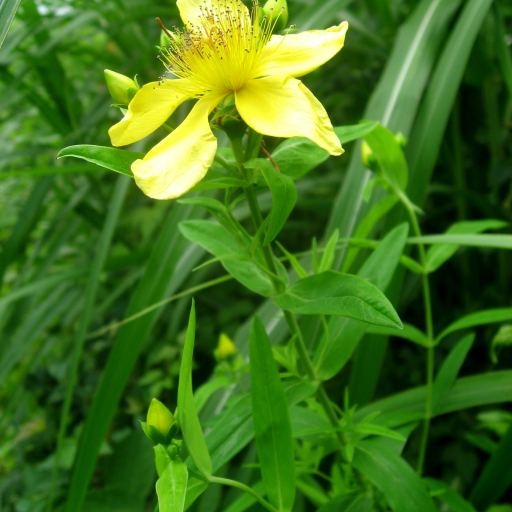
Plant Overview
Known as the Great St. John’s Wort, this statuesque perennial is the "big brother" of the more common ground-cover varieties. Native to both East Asia and North America, it towers over other wildflowers with dramatic, golden-yellow blooms that look like tiny sunbursts exploding in the mid-summer heat. It is a favorite for those looking to add vertical interest and a touch of wild elegance to damp areas of the landscape.
🔍 How to Identify
- 🌼 Golden Sunbursts: Large, five-petaled yellow flowers featuring a distinctive, explosive cluster of hundreds of long, thread-like stamens in the center.
- 📏 Stately Stature: Unlike its low-growing cousins, this species is strictly upright, often reaching heights of 3 to 5 feet on sturdy, reddish-tinted stems.
- 🍃 Clasping Leaves: The smooth, lance-shaped leaves grow in opposite pairs and "clasp" the stem directly without a stalk, creating a very symmetrical, architectural look.
🏡 In Your Garden
- 💧 The Moisture Link: While many Hypericum species are drought-tolerant, the Great St. John's Wort naturally thrives in floodplains and meadows. In a garden setting, it needs consistently moist soil and will struggle in "baked" or dry clay.
- ⚓ Taproot Stability: This plant invests heavily in a deep taproot. This makes it very hardy once established, but it also means it hates being moved. Choose its "forever home" carefully to avoid transplant shock.
⚠️ Safety & Toxicity
- 🐾 Toxic to Pets: Like most members of its genus, it contains hypericin. If ingested by dogs, cats, or horses, it can cause vomiting, diarrhea, and significant photosensitivity (skin becomes ultra-sensitive to sunlight).
- 🧤 Skin Irritation: Some individuals may experience mild skin redness or "phytophototoxicity" after handling the sap and then being exposed to the sun. It is wise to wear gloves when pruning.
✨ Fun Fact
📜 The name "St. John's Wort" stems from an old European tradition where the plant was harvested on June 24th (St. John’s Day) to be hung over doorways. It was believed that the bright yellow flowers could protect a household from "thunder-burns" and wandering evil spirits.

Detailed Care Instructions
To grow Hypericum Ascyron, also known as Great St. John's Wort, follow these steps:
- Choose a suitable location: Hypericum Ascyron thrives in full sun to partial shade. Select a location with well-draining soil that is rich in organic matter.
- Prepare the soil: Ensure the soil is loose and fertile. Add compost or well-rotted manure to improve the soil quality and drainage.
- Planting: Sow the seeds directly in the garden during the spring or fall, as the plant prefers cooler temperatures. Alternatively, you can start seeds indoors 8-10 weeks before the last frost date and transplant them outside when the soil is warm and all risk of frost has passed.
- Seed depth: Plant the seeds 1/8 to 1/4 inch deep in the soil. Keep the soil evenly moist until germination occurs, which usually takes 2-4 weeks.
- Watering: Provide regular watering to keep the soil consistently moist but not waterlogged. Hypericum Ascyron prefers moist soil but can tolerate short periods of drought once established.
- Mulching: Apply a layer of organic mulch, such as shredded bark or straw, around the base of the plants to retain moisture and suppress weed growth.
- Fertilization: Apply a balanced, slow-release fertilizer in the early spring when the plant starts to show new growth. Follow the package instructions for dosage.
- Pruning: In late winter or early spring, cut back the plant to encourage new growth and maintain its shape. Remove any dead or damaged plant material.
- Pests and diseases: Hypericum Ascyron generally has few pest or disease issues. However, keep an eye out for aphids, leafhoppers, or slugs. If necessary, treat with appropriate organic pest control methods.
- Winter protection: Mulching around the base of the plants can help protect the roots during harsh winters. In colder climates, a layer of straw or leaves can be added on top of the plant to provide extra protection.
By following these steps, you should be able to grow Hypericum Ascyron successfully. Remember to be patient, as it may take a couple of years for the plant to reach its full size and bloom.

Place in a bright room that is sun drenched almost all day. Or directly in a south-facing window.

Hypericum Ascyron plant prefers a moist environment and needs regular watering to thrive. Before watering the plant, it is essential to check the soil's moisture level. Insert a finger into the soil, and if it feels dry up to the first knuckle, it's time to water the plant.
When watering, use a watering can or hose with a gentle flow to avoid disturbing the plant's roots. Water the soil around the base of the plant, avoiding the leaves and stem as much as possible. Ensure that the water penetrates deep into the soil, providing enough moisture for the roots to absorb.
In summer, it is best to water the plant once or twice a week, depending on the temperature, humidity, and soil moisture level. In winter, reduce the frequency of watering and check the soil's moisture level regularly to avoid overwatering.
Avoid watering the plant too much, as this can lead to root rot and other fungal diseases. Ensure that the soil has excellent drainage, and remove any excess water that accumulates in the saucer or pot.
Additionally, it is essential to maintain the right humidity level for the Hypericum Ascyron plant. Mist the plant's leaves regularly with clean water, especially in dry weather conditions, to keep the leaves hydrated.
Overall, providing adequate water and humidity is essential to keep the Hypericum Ascyron plant healthy and thriving.
First, ensure that the soil in which the plant is growing is well-drained, fertile, and moist. Apply a slow-release fertilizer formulated for flowering plants during the growing season, such as a 10-10-10 or 20-20-20 blend, at a rate of 1 tablespoon per square foot of soil. Apply the fertilizer evenly around the base of the plant and water well. Avoid over-fertilizing as this can lead to excessive growth and reduced flowering. In the fall, apply a high-phosphorus fertilizer to encourage root growth and winter hardiness.
Hypericum Ascyron prefers well-drained soils that are rich in organic matter. The soil pH level should be within the range of 5.5 to 7.5. Adding organic compost or well-rotted manure to the soil before planting can improve soil structure and fertility. The soil should also be moist but not waterlogged, as excessive moisture can lead to root rot. It is important to ensure that the soil is not compacted as this can inhibit root growth. Due to its preference for well-drained soil, Hypericum Ascyron is best grown in raised beds or containers if the soil in the garden is prone to waterlogging.
To propagate this plant, take stem cuttings in the early spring or late fall. Make sure the cuttings are about 6 inches long and have several leaves on them. Remove the lower set of leaves and dip the cut end of the stem into rooting hormone. Place the stem cutting into a container filled with damp, well-draining soil and cover it with a plastic bag. Place the container in a brightly lit area with temperatures around 65-75°F. Keep the soil moist but not waterlogged.
After about 4-6 weeks, roots should start to form. Once the plants have developed strong roots, they can be transplanted into larger containers or into the garden. Make sure to acclimate the plants to outdoor conditions gradually by exposing them to increasing amounts of sunlight and wind over a week or two.








