Plant Overview
Often referred to as the Majorcan St. John’s Wort, this rare Mediterranean gem brings a slice of the sun-drenched Balearic Islands to your doorstep. While most St. John’s Wort varieties are grown for their flowers, this species is a favorite among plant collectors for its strange, architectural foliage that looks like it was intricately crimped by hand. It is a tough, woody survivor that thrives where other plants might wither under the heat.
🔍 How to Identify
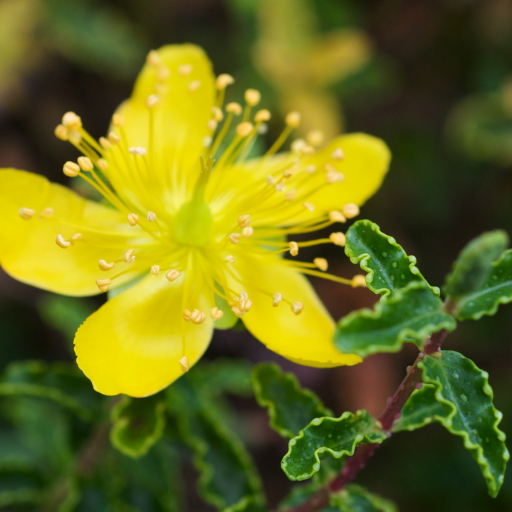
- 🌿 "Warty" Foliage: The most distinctive feature is the small, oval leaves with wavy, ruffled edges. If you look closely, the leaf margins are covered in tiny white glands that look like miniature warts or blisters.
- 🌼 Sunburst Blooms: It produces bright, golden-yellow flowers with five petals and a dramatic "explosion" of long, delicate stamens in the center that look like golden eyelashes.
- 🪵 Reddish Stems: The young stems often have a beautiful reddish tint, which eventually turns into a gnarled, woody bark as the shrub matures into its compact, rounded shape.
🏡 In Your Garden
- 🏜️ The Drainage Rule: Because this plant evolved on rocky limestone cliffs, it hates "wet feet." It requires extremely well-draining soil—think gravelly or sandy mixes—to prevent root rot during the winter months.
- ☀️ Sun and Wind: It is incredibly salt-tolerant and wind-resistant, making it a perfect choice for coastal gardens. It performs best in full sun, which keeps its unique leaf growth tight and vibrant.
⚠️ Safety & Toxicity
- 🐾 Mildly Toxic to Pets: Like many members of the Hypericum genus, this plant contains hypericin. If ingested, it can cause "photosensitization" in cats, dogs, and horses, making their skin painfully sensitive to sunlight.
- 🧤 Skin Sensitivity: While not deadly, the sap may cause mild skin irritation or dermatitis in people with sensitive skin. It is best to wear gloves when pruning.
✨ Fun Fact
- 🏝️ A True Local: This plant is "endemic" to the Balearic Islands, meaning it occurs naturally nowhere else on Earth. Its waxy, crinkled leaves are a clever evolutionary adaptation to help the plant retain moisture and deflect the intense Mediterranean UV rays.

Detailed Care Instructions
| Humidity | Normal |
| Lighting | Full Sun |
| Difficulty | Medium |
| Hibernation | Cold Period |
| Hardiness Zones | 8A - 11B |
To grow Hypericum Balearicum plants, you can follow these steps:
- Choose a suitable location: Hypericum Balearicum plants prefer full sunlight or partial shade. Select an area in your garden that receives at least 4-6 hours of direct sunlight each day.
- Prepare the soil: Hypericum Balearicum plants thrive in well-draining soil. Amend the soil with organic matter, such as compost or well-rotted manure, to improve drainage and provide nutrients.
- Planting: Dig a hole in the prepared soil that is slightly larger than the plant's root ball. Place the plant in the hole, ensuring that the top of the root ball is level with the soil surface. Backfill the hole with soil, gently pressing it down around the roots.
- Watering: After planting, water the Hypericum Balearicum thoroughly to settle the soil. Keep the soil consistently moist but not overly saturated. Water deeply, allowing the soil to dry between waterings.
- Mulching: Apply a layer of organic mulch around the plant to help retain moisture, suppress weed growth, and regulate soil temperature. Keep the mulch a few inches away from the base of the plant to avoid rotting.
- Fertilizing: Hypericum Balearicum generally does not require heavy fertilization. However, you can apply a balanced, slow-release fertilizer in early spring to provide necessary nutrients for healthy growth.
- Pruning: Prune any dead, damaged, or diseased branches throughout the year. Additionally, you can lightly prune the plant in early spring to promote bushier growth and maintain its shape.
- Pests and diseases: Hypericum Balearicum is relatively resistant to pests and diseases. However, keep an eye out for common garden pests like aphids or spider mites. If necessary, treat them with organic insecticidal soap or neem oil.
- Winter care: Hypericum Balearicum is hardy and can tolerate some frost. However, if you live in an area with severe winters, you may want to protect the plant with a layer of mulch or cover it with a frost cloth during periods of extreme cold.
- Propagation: Hypericum Balearicum can be propagated through seeds or by taking stem cuttings during the growing season. Follow the appropriate propagation method and provide the necessary care for successful establishment.
By following these guidelines, you should be able to successfully grow Hypericum Balearicum plants in your garden.

Place in a bright room that is sun drenched almost all day. Or directly in a south-facing window.

The plant in question requires regular watering to survive. It is important to monitor the soil moisture level and ensure that it does not dry out completely between waterings. When watering, aim to provide enough water to thoroughly soak the soil but avoid overwatering as this can lead to root rot. This plant thrives in well-draining soil, so it is important to ensure that excess water is able to drain away. When watering, it is best to use room temperature water to avoid shocking the plant's roots. Additionally, this plant prefers to be watered from the bottom rather than the top. To do this, place the pot in a tray of water and allow the soil to absorb the water from the bottom up. Finally, it is important to adjust watering frequency based on the plant's needs, which may change based on the temperature and humidity levels in its environment.
To fertilize the Hypericum Balearicum plant, apply a balanced fertilizer that contains equal amounts of nitrogen, phosphorus, and potassium. Use a slow-release granular fertilizer in early spring, and then use a liquid fertilizer every two to three weeks during the growing season. Dilute the liquid fertilizer according to the instructions on the label before applying it to the soil. It is important not to over-fertilize the plant, as this can lead to excessive growth and decreased flowering.
To grow Hypericum Balearicum plants, it is recommended to use a well-draining soil that is rich in organic matter. The ideal pH range for the soil should be between 5.0 to 7.0. The soil should be moist but not waterlogged as these plants do not tolerate wet soil. It is important to ensure that the soil is not compacted as this can hinder root growth.
Adding compost or well-rotted manure to the soil can improve soil fertility and provide a steady supply of nutrients for the plant. Additionally, adding a slow-release fertilizer can also benefit the plant's growth.
If planting in a container, it is essential to use a high-quality potting mix that is specifically designed for growing plants in containers. The soil should have good aeration and drainage to prevent waterlogging.
Overall, Hypericum Balearicum plants prefer well-draining soil that is rich in organic matter and kept moist but not waterlogged.
The most efficient way to propagate this plant is through stem cuttings. Select a healthy stem that is about 4-6 inches long, and remove all leaves except for the top two pairs. Dip the cut end of the stem in rooting hormone powder and plant it in a mixture of moistened perlite and peat moss. Cover the cutting with a clear plastic bag to maintain humidity and place it in a bright, indirect light location. Keep the soil moist but not soggy and mist the cutting occasionally to prevent it from drying out. After a few weeks, the cutting will start to develop roots, and you can transplant it into a new container with well-draining soil. Make sure it receives bright, filtered light and water it regularly until it establishes itself.








