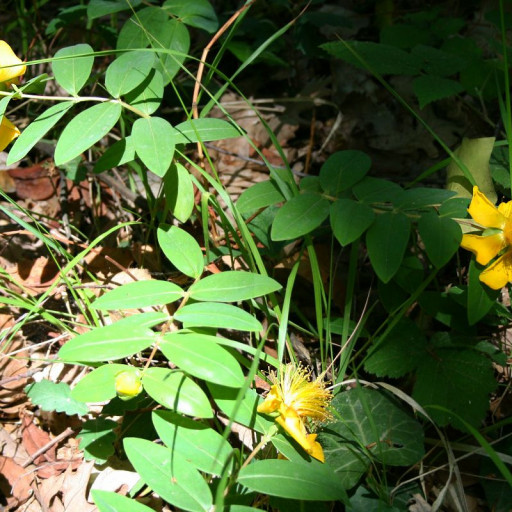
Plant Overview
Known affectionately as "Aaron’s Beard" or the "Creeping St. John’s Wort," this low-growing shrub is a superstar of the garden floor. Native to the sun-dappled woodlands of Turkey and Bulgaria, it creates a lush, golden carpet that thrives even in the difficult "dry shade" under large trees. Its primary nickname comes from the explosion of thread-like stamens that burst from the center of the flower like a shimmering, golden beard.
🔍 How to Identify
- 🌼 Golden Blossoms: Striking, 2-to-3-inch wide bright yellow flowers with five waxy petals that appear from mid-summer to early autumn.
- 🧔 The "Beard": A dense central puff of hundreds of long, delicate yellow stamens tipped with tiny reddish dots (anthers).
- 🍃 Sturdy Foliage: Deep green, oval-shaped leaves that grow in tidy, opposite pairs along the stems; they often take on a reddish tint in winter.
🏡 In Your Garden
- 🌳 The Shade Specialist: This is one of the few flowering groundcovers that can handle heavy competition from tree roots and still produce a sea of yellow blooms.
- 🧱 Natural Erosion Control: Because it spreads via underground runners (rhizomes), it is a perfect candidate for stabilizing steep banks or filling in rocky slopes where soil is thin.
- ✂️ Spring Refresh: It is incredibly resilient; if the foliage looks tattered after a hard winter, you can mow or shear it to the ground in early spring, and it will bounce back thicker than before.
⚠️ Safety & Toxicity
- 🐾 Mildly Toxic: This plant contains hypericin, a compound that can cause "photosensitivity" in animals if ingested in large quantities.
- ☀️ Sensitive Skin: While generally safe for humans to touch, some sensitive individuals may experience mild skin irritation. If your pets (especially fair-skinned dogs or cats) graze on it, they may become more prone to sunburn or skin inflammation.
✨ Fun Fact
In medieval Europe, various species of Hypericum were traditionally gathered and hung over doorways on St. John’s Eve (Midsummer) to ward off evil spirits, witches, and even lightning strikes!

Detailed Care Instructions
Here are some steps to help you grow Hypericum Calycinum, also known as St. John's Wort or Aaron's Beard:
- Choose the right location: Hypericum Calycinum plants prefer a sunny or partially shaded spot in your garden. Ensure that the soil is well-draining as excessive moisture can lead to root rot.
- Prepare the soil: Before planting, make sure the soil is loose and fertile. Add organic matter like compost or well-rotted manure to improve the soil's texture and fertility.
- Planting: Dig a hole slightly larger than the root ball of the Hypericum Calycinum plant. Gently place the plant in the hole and backfill with soil. Ensure that the crown of the plant is level with the soil surface.
- Watering: Water the plant thoroughly after planting to help it establish roots. Afterward, water regularly, especially during dry spells. However, avoid over-watering as it can lead to root rot.
- Mulching: Apply a layer of organic mulch around the plant to retain moisture, suppress weeds, and improve soil quality. Mulch also helps to protect the shallow roots of the Hypericum Calycinum plant.
- Pruning: Hypericum Calycinum plants benefit from annual pruning. The best time to prune is in late winter or early spring before new growth begins. Trim back any dead or damaged branches and shape the plant as desired.
- Fertilizing: Hypericum Calycinum plants generally do not require heavy fertilization. However, applying a balanced, slow-release fertilizer in early spring can encourage healthy growth.
- Pests and diseases: Hypericum Calycinum plants are generally resistant to pests and diseases. However, occasional issues may include aphids, leaf miners, or powdery mildew. Monitor the plant regularly and address any pest or disease problems promptly.
- Propagation: Hypericum Calycinum plants can be propagated through division or by taking stem cuttings. Division can be done in spring or early fall, while stem cuttings are best taken in summer.
By following these steps, you should be able to successfully grow Hypericum Calycinum plants in your garden.

Place in a window with dappled sun or a spot in the middle of a room. Or directly in a window facing west or east.

Hypericum Calycinum plant requires regular watering, particularly during dry spells. The soil should be kept moist, but not waterlogged, as this can lead to root rot. To water the plant, gently apply water around the base of the plant, taking care to avoid getting water on the leaves. It is best to water early in the morning or late in the evening when the temperatures are cooler and the water is less likely to evaporate quickly. It is important to monitor the plant closely and adjust watering frequency as needed, keeping in mind that weather conditions and soil type can influence the plant's water needs.
- Choose a balanced fertilizer with equal amounts of nitrogen, phosphorus, and potassium.
- Apply the fertilizer in early spring just before new growth emerges.
- Spread the granules evenly around the base of the plant, avoiding direct contact with the stems or leaves.
- Water thoroughly after fertilizing to help the nutrients penetrate the soil.
- Repeat the fertilization process every two to four weeks during the growing season, depending on the plant's needs and the strength of the fertilizer.
- Stop fertilizing in early fall to allow the plant to prepare for winter dormancy.
Hypericum Calycinum thrives in soils that are well-draining and rich in nutrients. The ideal soil has a pH between 5.5 and 7.0 and is slightly acidic. The plant prefers loamy soil that is moist but not waterlogged. It is important to avoid heavy clay or sandy soils that do not retain moisture well. The soil can be amended with organic matter such as compost or peat moss to improve its texture and fertility. Additionally, adding a slow-release fertiliser to the soil before planting will help ensure the plant gets the appropriate nutrients it needs to grow healthy and strong.
Hypericum Calycinum is a perennial plant that can be propagated through cuttings. To propagate this plant, select a healthy stem with several leaves and cut it just below a node - the area where a leaf attaches to the stem. Remove the leaves from the lower part of the stem, leaving two or three at the top. Dip the end of the stem in rooting hormone, if desired, and plant it in a pot filled with well-draining soil. Keep the soil moist but not waterlogged and place the pot in a bright, indirect light. In a few weeks to a few months, the cutting should have developed roots and can be transplanted into a larger container or planted in the ground.








