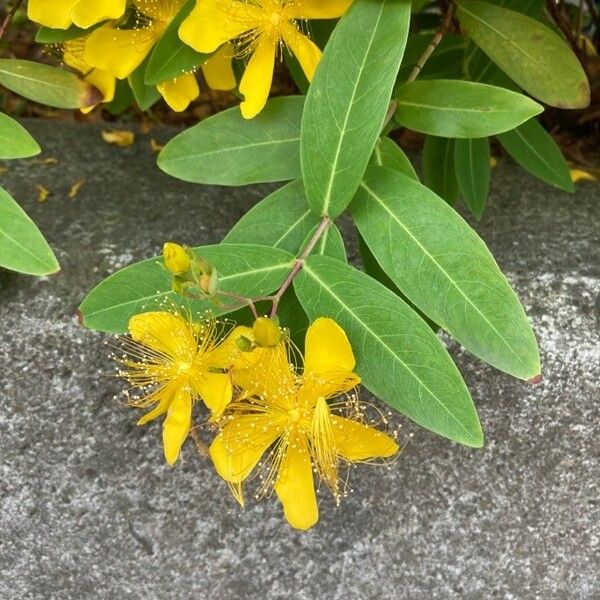
Plant Overview
Often called the Chinese St. John's Wort, this golden-hued beauty is a staple of East Asian landscapes. With its explosion of yellow petals and fountain-like stamens, it looks like a miniature firework frozen in time. It is a resilient, semi-evergreen shrub that brings a sunny, cheerful disposition to any garden corner.
🔍 How to Identify
- 🌼 Golden Blooms: Bright yellow, five-petaled flowers that usually appear in clusters during the mid-to-late summer months.
- 🎆 Fountain Stamens: The most distinctive feature—a dense bundle of exceptionally long, delicate yellow stamens that burst from the center like golden whiskers.
- 🍃 Elliptic Foliage: Smooth, waxy, deep-green leaves that grow in opposite pairs along gracefully arching, reddish-brown stems.
🏡 In Your Garden
- ☀️ Sun Seeker: While it thrives and flowers most best in full sun, it is surprisingly tolerant of dappled shade, making it a versatile choice for those "in-between" garden spots.
- ✂️ Hardy Habit: It features a dense, mounding growth habit that is incredibly forgiving. If the plant looks a bit leggy after winter, a hard pruning in early spring will encourage a flush of fresh, vigorous new growth.
⚠️ Safety & Toxicity
- 🐾 Pet Caution: Like many members of the Hypericum genus, this plant contains hypericin. If ingested in significant amounts by cats, dogs, or horses, it can cause vomiting and severe photosensitivity (skin sensitivity to sunlight).
- 🖐️ Skin Contact: While generally safe to handle, the sap can occasionally cause mild skin irritation for people with highly sensitive skin during heavy pruning sessions.
✨ Fun Fact
The name Hypericum is derived from the Greek words hyper (above) and eikon (picture). This refers to the ancient tradition of hanging the flowers over religious icons or doorways to ward off evil spirits during the midsummer festival of St. John.

Detailed Care Instructions
To grow Hypericum Monogynum, also known as St. John's Wort or St. Peter's Wort, follow these steps:
- Location: Choose a spot in your garden that receives full or partial sunlight. Hypericum Monogynum can tolerate shade but will bloom better with some sun exposure.
- Soil: The plant prefers well-draining soil that is rich in organic matter. Ensure that the soil pH is between 5.5 and 7.5. If the soil is heavy clay or sandy, amend it with compost or organic matter to improve its texture and fertility.
- Planting: Hypericum Monogynum can be planted from seeds, cuttings, or purchased young plants. If starting from seeds, germinate them indoors first. Sow the seeds in pots filled with seed-starting mix and keep them moist. Once they have grown a few inches tall, transplant them outdoors.
For cuttings, take 4- to 6-inch stem cuttings from a mature plant. Strip off the leaves from the lower half of the cutting and dip the end in a rooting hormone. Plant the cutting in a pot filled with a well-draining growing medium. Place the pot in a warm, bright location until the cutting roots, then transplant it to its final location.
If starting from young plants, dig a hole slightly larger than the container size and place it in the hole. Fill the hole with soil, firming it gently around the plant.
- Watering: Keep the soil consistently moist but not waterlogged, especially during the plant's first growing season. Thereafter, water when the top inch of soil feels dry. Deep, infrequent watering is preferable to frequent shallow watering.
- Mulching: Apply a layer of organic mulch around the base of the plant to help conserve moisture, suppress weed growth, and maintain a more stable soil temperature.
- Fertilizing: Hypericum Monogynum doesn't typically require heavy fertilizer application. However, you can apply a balanced fertilizer in early spring before new growth emerges to provide nutrients. Follow the package instructions for application rates.
- Pruning: Prune the plant in early spring to remove any dead or damaged branches. This will help maintain its shape and stimulate new growth. Alternatively, you can prune it after flowering to encourage a second flush of blooms.
- Pests and diseases: Hypericum Monogynum is relatively resistant to pests and diseases. However, it's always good practice to monitor the plant regularly for signs of damage or infestation. If necessary, treat with appropriate organic or chemical controls.
By following these guidelines, you should be able to successfully grow Hypericum Monogynum in your garden.

Place in a bright room that is sun drenched almost all day. Or directly in a south-facing window.

Hypericum Monogynum is a plant that requires proper watering to thrive and grow healthy. Here are some guidelines on how to water this plant without using its common names:
1. Determine the soil moisture level: Before watering, check the soil moisture level by inserting your finger into the soil up to the second knuckle. If the soil feels dry at this depth, it is time to water.
2. Watering frequency: Water the plant once a week during the growing season. During the winter months, reduce the watering frequency to once every two weeks.
3. Water amount: Provide enough water to soak the soil to a depth of at least 6 inches. Avoid overwatering, as this can lead to root rot.
4. Watering method: Water the plant at its base, using a watering can or a hose with a gentle spray nozzle. Avoid getting water on the leaves as this can cause fungal diseases.
5. Watering time: Water the plant in the early morning or late evening when the sun is not shining brightly. This will allow the water to be absorbed by the plant, without evaporating quickly.
By following these watering guidelines, you can ensure the proper growth and health of your Hypericum Monogynum plant.
To fertilize this plant, it is recommended to use a balanced, slow-release fertilizer, applying in early spring or late fall. Follow label instructions for the appropriate amount to use based on the size of the plant. It is best to avoid excessive or frequent fertilization, as this can lead to overgrowth and decreased plant health. Water the plant before and after fertilizing to ensure proper uptake of nutrients.
For growing the plant scientifically known as Hypericum Monogynum, it is recommended to use well-draining soil that is rich in organic matter. The pH level of the soil should be slightly acidic to neutral, between 6.0-7.0, for optimal growth.
One can prepare the soil by mixing peat moss, perlite or vermiculite, and compost in equal proportions. The mixture should be sterilized before use to ensure that there are no harmful pathogens present in the soil.
It is important to ensure that the soil is moist but not waterlogged. Overwatering can lead to root rot and other fungal diseases. To maintain optimal soil conditions, one must water the plant regularly and allow the soil to partially dry out between watering sessions.
The plant also requires regular fertilization to provide the necessary nutrients for growth. Using a balanced fertilizer with a ratio of 10-10-10 or 15-15-15, once every two weeks during the growing season, will help to maintain healthy foliage and promote blooming.
In summary, for successful cultivation of Hypericum Monogynum, one should use well-draining, slightly acidic to neutral soil that is rich in organic matter. Regular watering, fertilization, and soil maintenance will help to ensure optimal growth and health of the plant.
Hypericum Monogynum can be propagated through vegetative propagation methods like stem cuttings. For this, take stem cuttings from the parent plant in late spring or early summer, when the plant is actively growing.
Choose healthy stem cuttings with at least 2-3 nodes. Remove the lower leaves and dip the cut end of the stem in rooting hormone powder. Plant the stem cuttings in well-draining, moist soil and keep them in a shaded area.
Water the soil regularly to keep the soil moist, but not waterlogged. After a few weeks, the roots should start to form and the stem cutting should start to grow new leaves. Once the stem cuttings have developed a strong root system and a few leaves, they can be planted in their permanent location.
It is important to note that Hypericum Monogynum is a plant that naturally grows in specific regions, and it may not be legal or ethical to collect plants or propagate them from the wild. Therefore, it is advised to only propagate this plant from a cultivated source or with permission from the relevant authorities.








