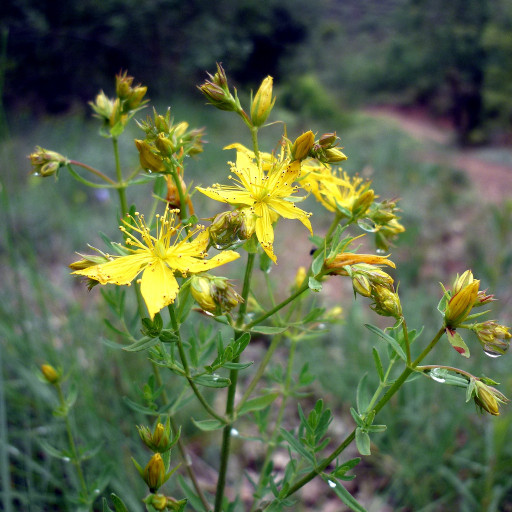
Plant Overview
Known widely as St. John’s Wort, Hypericum perforatum is a plant steeped in both sunshine and superstition. Traditionally believed to reach its peak bloom on St. John’s Day (June 24th), it was once hung over doorways to ward off evil spirits and "the blues." Today, it is celebrated as a hardy perennial that brings a burst of bright yellow to meadows and cottage gardens across the globe.
🔍 How to Identify
- 🌼 Sun-Star Flowers: The blooms are bright yellow with five petals and a dramatic "firework" explosion of long stamens in the center.
- 🍃 Perforated Leaves: If you hold a leaf up to the sun, it looks like it’s been pricked with tiny needles; these are actually translucent oil glands that give the plant its "perforatum" name.
- 🪵 Two-Edged Stems: The stems are often reddish and uniquely feature two raised lines or "ridges" running along opposite sides, making them feel slightly flat or winged.
🏡 In Your Garden
- ☀️ Sun-Loving Opportunist: This plant thrives in full sun and well-drained soil. It is incredibly resilient—some might even say "aggressive"—as it spreads through both seeds and underground runners (rhizomes).
- 🐝 Pollinator Hub: Its pollen-rich flowers are a favorite for honeybees and hoverflies. Because it is so hardy, it works best in "wild" sections of the garden where it can roam without crowding out more delicate species.
⚠️ Safety & Toxicity
- 💊 Medical Warning: While famous as a herbal supplement, St. John’s Wort is notorious for interacting with many prescription medications. Always consult a healthcare professional before use.
- 🐴 Photosensitivity: The plant contains hypericin, which can cause "bighead" or severe sunburn-like skin irritation in grazing livestock (like horses and sheep) if they eat large amounts and then stand in the sun.
✨ Fun Fact
If you crush a yellow flower bud between your fingers, it will stain your skin a deep, "bloody" red. In the Middle Ages, this red oil was known as the "Blood of St. John" and was used to treat wounds and bruises.

Detailed Care Instructions
| Color | Yellow |
| Soil Ph | Acidic, Neutral, Or Alkaline |
| Invasive | Weed |
| Lighting | Full Sun |
| Toxicity | Poisonous |
| Soil Type | Rich, Well-Drained, With Average Moisture Content |
| Bloom Time | June Through September |
| Plant Type | Herbaceous Plant With A Perennial Life Cycle |
| Mature Size | 1 To 3 Feet Tall And Not Quite As Wide; Upright Growing Habit |
| Native Area | Europe, Asia, And North Africa; Has Naturalized In North America |
| Sun Exposure | Full Sun To Partial Shade |
| Hardiness Zones | 3-8 |
To grow Hypericum perforatum, also known as St. John's wort, follow these steps:
- Select a suitable location: Choose a sunny spot in your garden or containers with well-draining soil. St. John's wort prefers full sun but can tolerate some light shade.
- Soil preparation: The plant prefers slightly acidic to neutral soil with good drainage. If your soil is heavy or compacted, amend it by adding organic matter like compost or well-rotted manure to improve drainage.
- Transplanting or seeding: You can start St. John's wort from seeds or transplants. If starting from seeds, sow them in the spring or fall, following the packet instructions. Alternatively, purchase young plants from a nursery or garden center and transplant them into the prepared soil.
- Watering: Keep the soil consistently moist during the plant's first year of growth. Once established, St. John's wort is relatively drought-tolerant and only requires occasional watering during prolonged dry periods.
- Mulching: Apply a layer of organic mulch, such as wood chips or straw, around the plant to retain moisture and suppress weeds. Leave some space around the stem to prevent rotting.
- Pruning: Prune the plant lightly after flowering to maintain its shape and remove any dead or damaged branches. This will also encourage bushier growth.
- Fertilizing: St. John's wort generally does not require heavy fertilization. However, you can apply a balanced slow-release fertilizer in spring or add compost annually to provide necessary nutrients.
- Pests and diseases: St. John's wort is generally resistant to pests and diseases. However, keep an eye out for aphids, leaf spot, or powdery mildew. If necessary, use organic insecticidal soap or copper-based fungicides to control these issues.
- Harvesting: The flowers and leaves of St. John's wort are traditionally harvested for medicinal purposes. Wait until the flowers have fully opened, typically in mid-summer, and then collect them. Dry the flowers in a cool, dark place and store them in an airtight container.
By following these guidelines, you can successfully grow Hypericum perforatum and enjoy its beautiful yellow flowers and potential medicinal benefits.

Place in a window with dappled sun or a spot in the middle of a room. Or directly in a window facing west or east.

To water this plant, it is important to use room temperature water and avoid using tap water as it may contain high levels of chlorine or other chemicals. The soil should be moist but not waterlogged, and it is best to water the plant deeply and infrequently rather than shallowly and frequently. It is important to allow the top layer of soil to dry out slightly before watering again. When watering, make sure to avoid getting water on the foliage or flowers, as this can cause damage or disease. It is also important to ensure that the plant is situated in a location with good drainage to prevent waterlogged soil.
- Choose a fertilizer that is balanced (equal amounts of nitrogen, phosphorus, and potassium) or high in phosphorus.
- Mix the fertilizer with water according to the package instructions.
- Apply the fertilizer to the soil around the base of the plant.
- Avoid getting fertilizer on the leaves or stems.
- Water the plant thoroughly after fertilizing.
- Fertilize every 4-6 weeks during the growing season.
Hypericum Perforatum plant prefers well-drained, loamy soil with a pH range of 5.5 to 8.0. The soil should be moderately fertile and rich in organic matter to ensure proper growth and development of the plant. A soil mix consisting of equal parts of peat, sand, and loam can be used for planting Hypericum perforatum. It is important to ensure good drainage as the plant does not do well in waterlogged soil. The soil should also be mildly acidic to slightly alkaline for optimal growth. Regular fertilization with a balanced fertilizer is recommended to keep the plant healthy and flourishing.
Hypericum Perforatum plant can be propagated easily through the process of stem cuttings. First, select a healthy and well-established plant to take the cuttings from. Then, using sterilized scissors or pruning shears, cut a piece of stem from the plant that is about 4-6 inches long. Make sure to cut the stem just below a node, which is where the leaves attach to the stem.
Remove any leaves or buds from the lower half of the stem, leaving only a few leaves near the top. Dip the cut end of the stem in rooting hormone powder, which will encourage the growth of roots.
Prepare a pot with well-draining soil and make a small hole in the center. Insert the cut end of the stem into the hole and press the soil firmly around it. Water the soil until it is moist but not waterlogged.
The pot should be placed in a bright and warm spot, but out of direct sunlight. Mist the cutting regularly to keep it moist and increase humidity around it. After a few weeks, roots should start to grow and the plant will begin to develop new leaves.
After a few months, the new plant can be transplanted into a bigger pot or into the garden. Be sure to keep the soil moist and protect the new plant from strong winds and hot temperatures.








