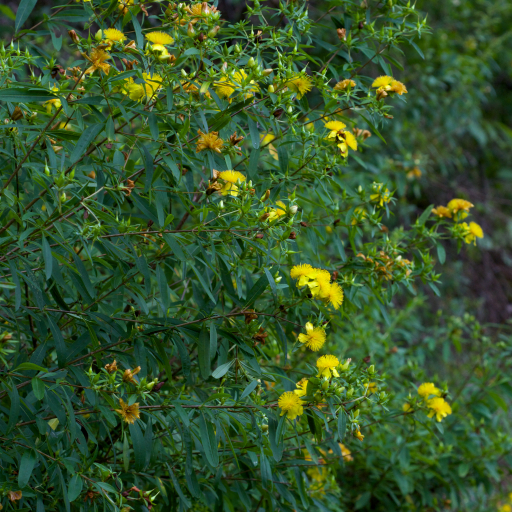
Plant Overview
Commonly known as the Shrubby St. John’s Wort, this North American native is a summer standout that lives up to its name, prolificum, by producing a mountain of golden blooms. Unlike the common weedy varieties, this is a tidy, woody shrub that acts as a structural anchor in the garden. It is often nicknamed the "Powder Puff Plant" because of its distinctively fuzzy-looking flower centers.
🔍 How to Identify
- 🌼 The Flowers: Bright yellow, five-petaled blossoms featuring a massive, exploding cluster of golden stamens in the center that look like a tiny firework.
- 🍃 The Foliage: Narrow, lance-shaped leaves with a cool, bluish-green hue. The leaves are arranged oppositely along the stems and remain attractive even when the plant isn't blooming.
- 🪵 The Bark: On older specimens, the reddish-brown bark on the lower stems begins to peel in thin, papery flakes, adding visual interest during the winter months.
🏡 In Your Garden
- 🌱 Root Resilience: This plant is a "tough love" favorite. It features a deep, woody root system that makes it incredibly drought-tolerant once established, meaning it can survive in rocky or sandy spots where other shrubs wither.
- 🐝 The Pollen Factory: While these flowers don't produce nectar, they are a massive source of protein-rich pollen. You will frequently see bumblebees performing "buzz pollination"—vibrating their flight muscles to shake the pollen loose from the dense central tufts.
⚠️ Safety & Toxicity
- 🐾 Status: Mildly toxic to pets and livestock.
- ☀️ Details: The plant contains hypericin, a compound that can cause "photosensitivity" in animals. If ingested in large amounts, it can make an animal's skin dangerously sensitive to sunlight, leading to severe sunburns or sores. Keep it away from grazing areas for horses or sheep.
✨ Fun Fact
The name Hypericum comes from the Greek words hyper (above) and eikon (picture). Traditionally, these flowers were hung above icons and doorways in homes to ward off evil spirits during the midsummer festival of St. John’s Day.

Detailed Care Instructions
To grow Hypericum Prolificum plants, you can follow these steps:
- Choose a suitable location: Hypericum Prolificum plants prefer full sun or partial shade. Select a spot in your garden that receives at least 6 hours of direct sunlight per day.
- Prepare the soil: Ensure that the soil is well-draining and rich in organic matter. You can add compost or well-rotted manure to improve soil fertility.
- Planting: Dig a hole that is slightly larger than the root ball of the plant. Place the Hypericum Prolificum plant into the hole, ensuring that the top of the root ball is level with the soil surface. Backfill the hole with soil and gently firm it around the plant.
- Watering: Water the plant thoroughly after planting to settle the soil and help the roots establish. It is important to keep the soil consistently moist but not waterlogged.
- Mulching: Apply a layer of organic mulch, such as wood chips or straw, around the base of the plant. This will help conserve moisture and suppress weed growth.
- Pruning: Prune Hypericum Prolificum plants in late winter or early spring to remove any dead or damaged branches. This will promote healthy growth and maintain a compact shape.
- Fertilizing: Apply a balanced, slow-release fertilizer in spring, following the manufacturer's instructions. Avoid excess fertilizer as it may result in a leggy growth.
- Maintenance: Hypericum Prolificum plants are generally low-maintenance. Regularly check for pests and diseases, and take appropriate measures if necessary. Monitor the soil moisture and water whenever the top inch of soil feels dry.
By following these guidelines, you should be able to successfully grow Hypericum Prolificum plants in your garden.

Place in a bright room that is sun drenched almost all day. Or directly in a south-facing window.

1. Determine the water requirements – Before watering, it is important to know the watering needs of Hypericum Prolificum. The amount and frequency of watering will depend on factors like the climate, soil type, and plant maturity.
2. Water deeply – When watering, make sure to provide enough water to reach the roots of the plant. Hypericum Prolificum has a deep root system, so it is important to water deeply to help the plant establish healthy roots.
3. Water in the morning or evening – It is best to water the plant early in the morning or in the evening when temperatures are cooler. This helps to reduce water evaporation and ensures that the water is used efficiently by the plant.
4. Water slowly – When watering, make sure to apply water slowly to allow the soil to absorb the water evenly. This also helps to prevent water runoff.
5. Avoid overwatering – Hypericum Prolificum does not like to sit in water, so it is important to avoid overwatering the plant. This can lead to root rot and other problems.
6. Mulch – Adding a layer of mulch around the plant can help to retain moisture in the soil, reduce evaporation, and regulate soil temperature. This helps to keep the plant healthy and reduce the amount of water needed.
To fertilize this plant, use a balanced, slow-release fertilizer in the spring before new growth emerges, following the package instructions for application rates. It is important not to over-fertilize, as excess nutrients can lead to weak growth or burning of the roots. Consider a top-dressing of organic compost as an alternative to synthetic fertilizers. Water the plant thoroughly after fertilizing, and avoid letting the soil dry out completely between watering. Regular fertilization throughout the growing season is not necessary, but a light feed in midsummer may benefit the plant.
Hypericum Prolificum plant needs well-draining soil that is rich in nutrients, particularly organic matter. The soil must be mildly acidic to neutral, with a pH range of 6.0 to 7.5. It is best to use a soil mixture that has a good balance of sand, loam, and peat moss to promote healthy root growth. Additionally, the soil should be able to retain moisture without becoming waterlogged. Adding perlite or vermiculite to the soil mixture can help improve drainage.
To propagate this plant, take stem cuttings in the spring or early summer. Make sure the cutting has at least one node and remove any leaves from the lower half of the stem. Dip the cut end in rooting hormone and plant the cutting in a well-draining soil mix. Keep the soil moist and place the cutting in a warm, bright location but avoid direct sunlight. It should root within a few weeks.








