Plant Overview
Meet the Iberis simplex, a delicate and charming member of the Candytuft family. Contrary to what its sweet name suggests, "Candytuft" isn't inspired by sugar, but rather by its ancient Mediterranean origins in the city of Candia (modern-day Crete). This low-growing beauty acts like a living lace doily, often found cascading over stone walls or brightening up the edges of gravel paths.
🔍 How to Identify
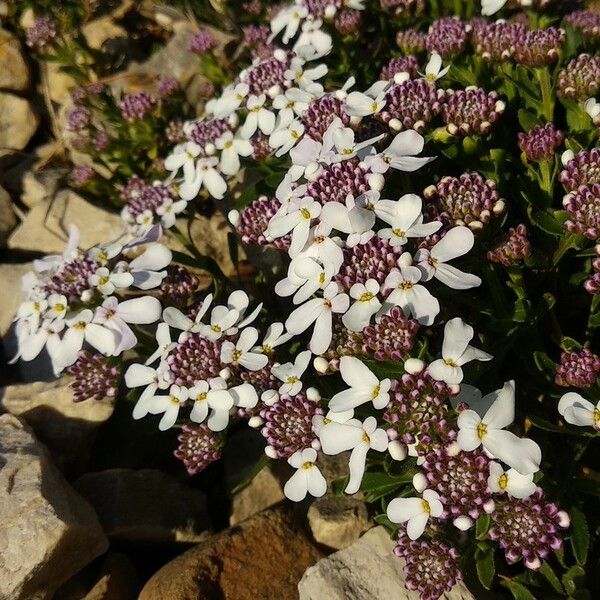
- 🌸 The Asymmetric Bloom: Each tiny flower has four petals, but they aren't even; the two outer petals are significantly longer than the inner ones, giving the clusters a distinctively "tufted" look.
- ☁️ Frothy Clusters: The flowers grow in dense, flat-topped groups (umbels) that can completely smother the foliage in a blanket of white or pale lilac during peak season.
- 🌿 Needle-like Foliage: The leaves are small, narrow, and dark green, providing a rich, textured backdrop that remains attractive even after the flowers have faded.
🏡 In Your Garden
- 🪨 Drainage is Vital: Coming from rocky, coastal regions, Iberis simplex hates "wet feet." It thrives in gritty, well-draining soil and is the perfect candidate for rock gardens, alpine troughs, or the gaps in a dry-stone wall.
- ✂️ The "Summer Haircut": To prevent the plant from becoming woody and sparse in the center, gardeners should shear it back lightly after the flowers finish blooming. This encourages a tight, mounded shape and healthier foliage for the next season.
⚠️ Safety & Toxicity
- 🟢 Status: Low Toxicity / Generally Safe.
- 🐾 Details: This plant is generally considered non-toxic to humans and most pets. However, as with many garden plants, if a curious dog or cat ingests a large amount, it may cause mild stomach upset or nausea. It is a safe, "worry-free" choice for family gardens.
✨ Fun Fact
While the genus name Iberis points to the Iberian Peninsula (Spain and Portugal), the common name "Candytuft" is a 16th-century linguistic evolution of "Candia," the old Venetian name for the island of Crete!

Detailed Care Instructions
To grow Iberis Simplex (Candytuft) plants, follow these steps:
- Choose a suitable location: Select a sunny spot in your garden or a container with at least 6 hours of direct sunlight each day.
- Prepare the soil: Ensure that the soil is well-draining, loose, and fertile. If the soil is heavy or clayey, amend it with organic matter like compost or well-rotted manure to improve drainage.
- Sow the seeds: Sow the Candytuft seeds directly into the prepared soil in spring after the danger of frost has passed. Scatter the seeds thinly on the soil surface and gently press them into the soil. Alternatively, you can start the seeds indoors six to eight weeks before the last frost and transplant the seedlings outdoors once they are about 2 inches tall.
- Watering: Keep the soil consistently moist until the seeds germinate, which usually takes 10-20 days. After that, water the plants deeply but infrequently, allowing the soil to dry out slightly between watering. Overwatering can lead to root rot.
- Fertilization: Apply a balanced, slow-release fertilizer or compost to the soil before planting the seeds. You can also provide an additional dose of liquid fertilizer halfway through the growing season to promote flowering.
- Pruning: After the flowers fade, it is advisable to prune the plants to encourage bushiness and additional blooming. Cut back the spent flower stems to just above a set of leaves.
- Mulching and weed control: Apply a layer of organic mulch around the plants to help retain moisture, suppress weed growth, and regulate soil temperature. However, avoid covering the plant stems with mulch as it can cause them to rot.
- Pests and diseases: Iberis Simplex is generally resistant to pests and diseases. However, keep an eye out for aphids, slugs, or snails. If any pest problems occur, treat them with appropriate organic insecticides.
- Winter care: Candytuft is semi-evergreen and can tolerate light frosts. In colder climates, you may want to apply a layer of mulch around the plants in late fall to help protect them throughout the winter.
By following these steps, you can successfully grow Iberis Simplex plants and enjoy their beautiful white or pink flowers during their blooming season.
To water this plant, it is important to first check the moisture level of the soil. Stick your finger into the soil up to the first knuckle. If it is dry at this depth, the plant needs to be watered. When watering, it is important to avoid getting water on the leaves and instead direct the water towards the base of the plant. Water deeply until the soil is moist but not waterlogged. It is important to not let the soil dry out completely, but also not to overwater and risk root rot. In hotter months or if the plant is grown in a container, it may require more frequent watering.
To fertilize this plant, you should first prepare the soil by loosening it around the base of the plant. Next, apply a balanced, slow-release fertilizer that is specifically formulated for flowering plants. You can also use a granular, time-release fertilizer that can be applied once at the beginning of the growing season. Be sure to follow the manufacturer's instructions for the amount of fertilizer to use, and water the plant well after fertilizing. It is also recommended to fertilize Iberis Simplex every 4-6 weeks during the growing season for optimal growth and flowering.
When planting Iberis simplex, it is important to use well-draining soil that is rich in nutrients. The soil should be slightly acidic with a pH ranging from 6.0 to 7.0. It is recommended to mix in compost or other organic matter to improve soil quality and to promote healthy growth. Iberis simplex prefers a soil that is moist but not waterlogged, so avoid soils that are heavy or compacted. Additionally, this plant thrives in full sun to partial shade, so choose a location that provides ample light.
To propagate this plant, first gather seeds from a mature plant. Sow the seeds in a pot or container filled with moist, well-draining soil. Cover the seeds lightly with soil and keep them in a warm, bright location. Keep the soil damp but not waterlogged.
After the seeds germinate, you can transplant them into individual containers or outdoor garden beds. Make sure they are spaced at least 6 inches apart to allow room for growth.
If you want to propagate the plant through cuttings, take a healthy stem cutting from the plant, making sure to include some leaves. Dip the cut end in rooting hormone, and plant it in a small container filled with soil. Keep the soil moist and warm, and in a few weeks, the cutting should root and start to grow.
Propagation through division can also be done by dividing an established plant in spring or fall. Carefully dig up the plant and separate the roots, making sure each section has some stems and leaves. Replant each section in its own container or garden bed and water well.








