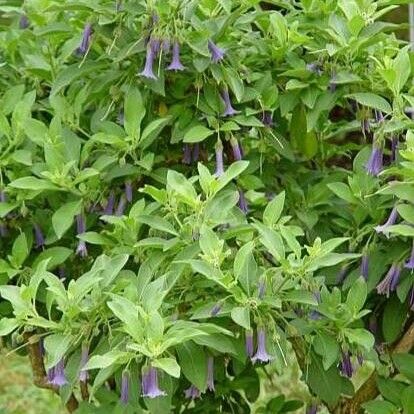
Plant Overview
Often called the "Blue Angel’s Trumpet" or "Violet Bush," Iochroma warscewiczii is a show-stopping shrub known for its cascading clusters of deep, royal blue to violet tubular flowers. Originating from the misty mountain forests of South America, this plant brings a touch of tropical drama and rare color to any landscape. It is a member of the nightshade family, sharing the same elegant, trumpet-like charm as its larger cousins, the Brugmansia.
🔍 How to Identify
- 🎺 The Flowers: Its most striking feature is the pendulous, 2-inch long tubular blossoms that hang in dense, heavy clusters of 10 to 20 flowers.
- 🍃 The Foliage: The leaves are large, elliptical, and covered in a fine, soft fuzz, giving them a slightly grayish-green, velvety appearance.
- 🌿 Growth Habit: This is a fast-growing, woody shrub that can reach heights of 6 to 10 feet, often displaying an arching, fountain-like shape as the weight of the blooms pulls the branches downward.
🏡 In Your Garden
- 🦋 Wildlife Magnet: If you want to see hummingbirds and butterflies, this is your plant; the long, nectar-rich tubes are perfectly designed for their beaks and tongues.
- 💧 Thirsty & Hungry: Unlike some of its hardier relatives, this plant prefers consistent moisture and "heavy feeding" with fertilizer to maintain its intense blooming cycles throughout the summer and fall.
- ✂️ Pruning Nuance: Because it grows so vigorously, it can become "leggy" or sparse at the bottom. Hard pruning in early spring encourages a bushier, more flower-packed shape.
⚠️ Safety & Toxicity
- 🚫 Toxic Status: Like many members of the Solanaceae (Nightshade) family, all parts of this plant contain tropane alkaloids and are toxic if ingested.
- 🐾 Pets & Children: Keep this plant out of reach of curious pets or toddlers. Ingestion can cause dilated pupils, confusion, and heart palpitations.
- 🧤 Skin Sensitivity: Some gardeners report mild skin irritation after pruning the sap-filled stems, so wearing gloves is a wise precaution.
✨ Fun Fact
While most flowers are pollinated by bees, the Iochroma has evolved a "lock and key" relationship with South American hummingbirds; the specific length and curvature of the flower tubes often match the beak shapes of local bird species!

Detailed Care Instructions







