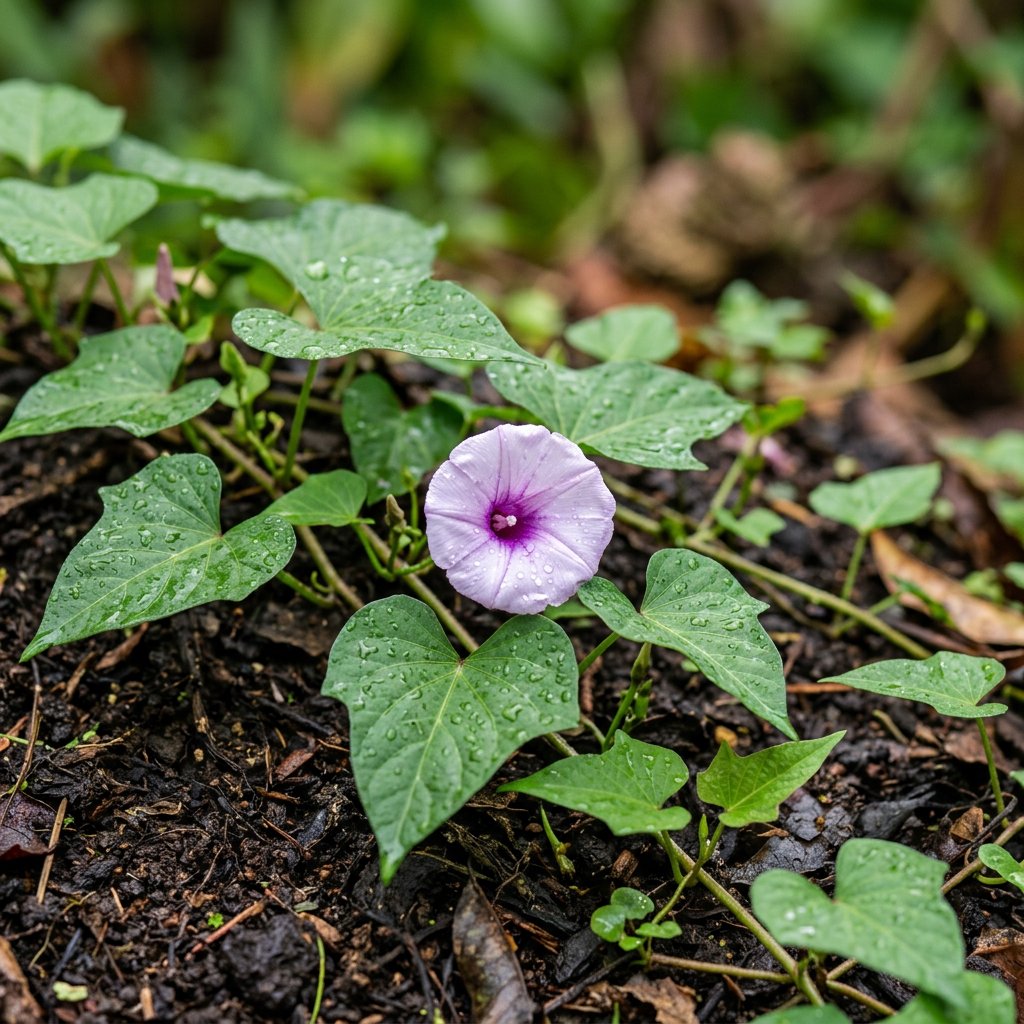
Plant Overview
Commonly known as the Sweet Potato, Ipomoea batatas is far more than just a Thanksgiving side dish. A member of the Morning Glory family, this vibrant creeper has traveled from the tropics of Central and South America to become a global staple. Whether you are growing it for its sugary, nutritious tubers or as a "Sweet Potato Vine" for its neon-green ornamental foliage, it brings a lush, jungle-like energy to any space.
🔍 How to Identify
- 🍃 Foliage: The leaves are typically heart-shaped (cordate) or deeply lobed like a hand. In ornamental varieties, colors range from lime green ("Marguerite") to deep burgundy or almost black ("Blackie").
- 🌱 Growth Habit: This is a vigorous, trailing perennial vine. It spreads rapidly across the ground using "runners" or spills elegantly over the edges of hanging baskets.
- 🌸 Blooms: While rare in domestic garden settings, it can produce funnel-shaped flowers with pale lavender to white petals and a darker purple throat, looking exactly like a classic Morning Glory.
🏡 In Your Garden
- ☀️ Sun & Heat: This plant is a true sun-worshipper. It thrives in high humidity and intense heat, making it the perfect "filler" for summer containers when other plants begin to wilt.
- 🪴 Soil Nuance: If you are growing it for the tubers, the soil must be loose and well-draining. Heavy clay soil acts like a corset, preventing the tubers from expanding into their characteristic round or oblong shapes.
- ✂️ Vigor Control: Be prepared for its speed. In a single season, a small starter plant can trail over 6 feet. Don't be afraid to prune it back; it is incredibly resilient and will respond with even thicker growth.
⚠️ Safety & Toxicity
- ✅ Status: Generally safe and edible.
- 🐾 Details: The tubers and leaves of Ipomoea batatas are edible for humans (and often used in Asian cuisine). While the foliage is generally non-toxic to cats and dogs, ingestion of large amounts of any raw plant matter can cause mild digestive upset in pets. Be cautious with the seeds, as seeds of the Ipomoea genus can be toxic if consumed in large quantities.
✨ Fun Fact
🍠 Despite the common confusion, the sweet potato is not related to the "Irish" potato (which is a Nightshade) or the Yam (which is a Lily). It is actually one of the oldest vegetables known to humanity, with archaeological evidence of its cultivation in Peru dating back over 10,000 years!

Detailed Care Instructions
| Color | Orange, White, Yellow |
| Soil Ph | 5.0-6.5 |
| Humidity | Normal |
| Lighting | Full Sun |
| Toxicity | Non-Toxic |
| Soil Type | Medium-Wet, Well-Drained |
| Bloom Time | Spring, Summer |
| Difficulty | Medium |
| Plant Type | Perennial, Usually Grown As Annual |
| Hibernation | Cold Period |
| Mature Size | 20 Feet Tall For Vines; 4-6 Inches Tall For Tubers |
| Native Area | North America, South America |
| Temperature | 18°C - 28°C |
| Sun Exposure | Full Sun, Partial Sun |
| Hardiness Zones | 2-11 |
To grow an Ipomoea batatas plant, also known as sweet potato vine, you can follow these steps:
- Choose a location: Select a spot where your plant will receive at least six hours of sunlight per day. Ipomoea batatas can also tolerate partial shade.
- Soil preparation: Prepare well-draining soil by mixing compost or organic matter into the existing soil. The soil should be loose and not compacted.
- Planting: You can grow Ipomoea batatas either from seeds or by using small plants, known as slips, which are planted just like cuttings. If using slips, place them in the soil, leaving about 6-8 inches between each plant. If planting from seeds, sow them about 1 inch deep and 6-8 inches apart.
- Watering: Keep the soil consistently moist but not waterlogged. Water the plant deeply once or twice a week, depending on the weather conditions. Adjust the frequency based on the moisture level of the soil.
- Fertilization: Apply a balanced, all-purpose fertilizer every 4-6 weeks during the growing season to help promote healthy growth. Follow the instructions on the fertilizer package for the correct dosage.
- Training and support: Ipomoea batatas can be trained to climb on a trellis or support structure. This is particularly useful if you want to grow the plant as a decorative vine. Guide the shoots towards the structure, tying them gently if needed.
- Pruning: Regularly trim back any excessive growth or unruly branches to maintain the desired shape and size of the plant.
- Pests and diseases: Inspect the plant regularly for common pests such as spider mites, aphids, or whiteflies. If any pests or diseases are spotted, treat them using organic or chemical solutions specifically designed for the respective pest or disease.
- Harvesting: You can harvest sweet potato tubers once the plant has reached maturity, which usually takes around 3-4 months. Carefully dig around the base of the plant to unearth the tubers.
By following these steps, you can successfully grow Ipomoea batatas plants and enjoy their attractive foliage and, if desired, harvest sweet potatoes.

Place in a bright room that is sun drenched almost all day. Or directly in a south-facing window.

The most important factor in watering this plant is to ensure that the soil is evenly moist, but not waterlogged. The frequency of watering will depend on the specific growing conditions, such as temperature, humidity, and soil type. It is recommended to regularly check the soil moisture level by inserting a finger into the soil and watering only when the top inch or so feels dry. Deep watering is preferable rather than light and frequent irrigation, as it encourages the roots to grow deeper and establishes a stronger plant structure. It is also advisable to water at the base of the plant rather than overhead, as this reduces the risk of foliage diseases. In addition, watering in the early morning or late evening helps to minimize water loss due to evaporation and to allow the plant to absorb water during its active growth phase.
- Use a balanced fertilizer with equal amounts of nitrogen, phosphorus, and potassium.
- Apply the fertilizer around the base of the plant, avoiding the leaves and stems.
- Water the plant immediately after fertilizing to help distribute the nutrients.
- Repeat the fertilization once a month during the growing season.
- Be careful not to over-fertilize, as this can lead to excessive foliage growth and less sweet potato production.
Ipomoea Batatas is a type of plant that thrives in well-draining soil that is rich in nutrients. The ideal soil for this plant should have a pH level of around 6.0 to 6.5, and it should be moderately fertile. Additionally, it should be airy and loose, allowing for proper root growth and easy drainage.
To achieve the optimal soil conditions, it is recommended to mix equal parts of peat moss, vermiculite, and perlite, along with a small amount of sand, to create a light and airy soil mixture. This type of soil will provide the necessary nutrients and water drainage while allowing the plant roots to grow and develop properly.
It is also important to note that Ipomoea Batatas prefers soil that is slightly acidic, so you may need to adjust the pH level of your soil mix accordingly. Regular fertilization with a balanced fertilizer will help to maintain the soil's nutrient level and support healthy plant growth and development.
Ipomoea Batatas plant can be propagated through various methods such as stem cuttings, root cuttings, and layering.
For stem cuttings, select a healthy stem that is about 4 to 6 inches long and has at least two or three nodes. Cut it using a sharp pair of scissors or pruning shears, making sure to include a section of the stem right below a node. Remove the leaves from the lower part of the stem, leaving only a few at the top. Dip the cutting in rooting hormone powder and plant it in a pot filled with a well-draining potting mix. Cover the pot with a plastic bag to create a humid environment and place it in a bright but indirect light. Keep the soil moist and within a few weeks, you should see roots developing.
For root cuttings, dig up the plant and cut a section of the root that is about 2 to 3 inches long and 1/4 inch wide. Plant it in a pot filled with moist potting mix and follow the same steps as for stem cuttings.
For layering, select a stem that is flexible and can be bent to touch the ground. Make a shallow cut on the stem where it touches the ground and pin it down using a metal pin or a rock. Cover the part of the stem that is touching the ground with soil and keep it moist. Within a few weeks, roots should develop and you can separate the new plant from the parent plant.
Propagation is best done in the spring or summer when the plant is actively growing. Make sure to keep the new plants in a warm and humid environment until they are established.
Common pests of the sweet potato vine include Spider mites, aphids, larvae. Make a habit of checking your sweet potato vine frequently for pests so that any infestations can be caught and managed early.








