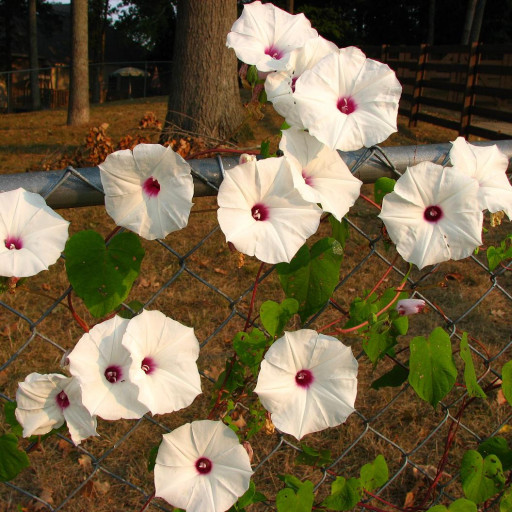
Plant Overview
Often called the "Man-of-the-Earth" because of its massive, human-sized underground tuber, Ipomoea pandurata is a resilient North American native. This trailing vine is a wild relative of the sweet potato, often found draped over fences or sprawling across sun-drenched meadows. Its large, creamy white blossoms provide a dramatic late-summer show that hides the secret "giant" buried deep beneath the soil.
🔍 How to Identify
- 🍃 The Leaves: Primarily heart-shaped, but they often "pinch" in the middle to resemble the shape of a violin or fiddle (giving it the Latin name pandurata).
- 🌸 The Flower: Large, funnel-shaped white blossoms that feature a distinct, deep ruby-red or purple "throat" at the center.
- 🌱 The Vine: A vigorous perennial that can trail along the ground or climb nearby structures, reaching lengths of 15 to 30 feet in a single season.
🏡 In Your Garden
- 🏗️ The Taproot: The most defining feature is the enormous, woody root which can weigh over 30 pounds and grow several feet deep. Because of this, the plant is extremely difficult to transplant once established; it essentially "claims" its spot for life.
- 🌞 Drought Specialist: Thanks to that massive root storage, this plant is a survivor. It can handle poor, sandy soil and long periods without rain, making it a "set it and forget it" plant for naturalized areas or wild gardens.
⚠️ Safety & Toxicity
- 🐾 Moderate Risk: While the tuber was historically eaten by Native Americans (after extensive roasting), the seeds contain alkaloids that are toxic to humans and pets.
- 🤢 The Details: Ingesting the seeds can cause significant gastrointestinal distress and, in some cases, hallucinations. Keep this vine away from curious dogs or areas where small children play.
✨ Fun Fact
Native American tribes referred to the root as "mecha-meck." Because the root so often takes on a shape resembling a human torso or limbs, it was used in traditional medicine as a "strengthening" tonic for the entire body.

Detailed Care Instructions
| Humidity | Dry |
| Lighting | Full Sun |
| Difficulty | Easy |
| Temperature | 22°C - 25°C |
| Hardiness Zones | 6 - 8 |
To grow an Ipomoea Pandurata plant, also known as wild potato vine or Manroot, you can follow these steps:
- Choose a suitable location: Select a spot in your garden that receives full sun to partial shade. The plant prefers well-draining soil, so ensure the soil is loose and fertile.
- Planting: Sow the seeds directly in the ground after the last frost date in your area. The seeds of Ipomoea Pandurata are large and resemble small potatoes. Plant the seeds about 1 inch deep and space them around 12 inches apart. You can also start the seeds indoors 4-6 weeks before the last frost date and transplant the seedlings outside once they are around 4-6 inches tall.
- Watering: Keep the soil consistently moist but not waterlogged. Avoid allowing the soil to dry out completely between waterings. Regular watering is especially important during the plant's early growth stages.
- Supporting the vines: Ipomoea Pandurata is a vine plant that can grow up to 20 feet long. Provide support for the vines to grow on, such as trellises, fences, or other structures. You can also let the vines climb over shrubs or other plants.
- Mulching: Apply a layer of organic mulch around the base of the plant to conserve soil moisture and suppress weed growth.
- Fertilizing: Feed the plant with a balanced, slow-release fertilizer during the growing season to provide necessary nutrients for healthy growth. Follow the instructions on the fertilizer packaging for proper application.
- Pruning: Regularly trim away dead or damaged parts of the plant to promote air circulation and prevent diseases. You can also prune back the vines to control their growth or shape the plant as desired.
- Harvesting: Ipomoea Pandurata produces large tuberous roots that can be harvested in the fall or winter when the foliage dies back. Carefully dig out the tubers and store them in a cool, dry place for later use or replanting.
By following these steps, you should be able to successfully grow an Ipomoea Pandurata plant in your garden.

Place in a bright room that is sun drenched almost all day. Or directly in a south-facing window.

To water this plant, it is important to first check the moisture level of the soil. Insert your finger about two inches into the soil, and if it feels dry, it is time to water. Water the plant slowly and deeply, allowing the water to soak into the soil. Avoid getting water on the leaves as it can promote fungal growth. Only water the plant when the soil is dry to avoid overwatering, which can lead to root rot. Additionally, it is important to consider the location of the plant and the amount of sunlight it is receiving. Plants in direct sunlight may require more frequent watering than those in a shaded area.
To fertilize this plant, apply a balanced fertilizer with equal amounts of nitrogen, phosphorus, and potassium. Mix the fertilizer with soil or apply as a top dressing around the plant's base. Water the plant after fertilizing to help distribute the nutrients into the soil. Repeat the process every two to three weeks during the growing season. Avoid over-fertilizing, as this can lead to plant burn and damage.
Ipomoea Pandurata plant requires a well-draining soil that is rich in organic matter. The soil should be slightly acidic with a pH range between 5.5 and 6.5. A good soil mix for this plant can be a combination of peat moss, compost, and perlite. It is important to avoid using heavy soils or ones that do not drain well as they can cause root rot and other soil-borne diseases. Additionally, it is recommended to add a slow-release fertilizer to the soil mix before planting to promote healthy growth and flowering.
To propagate this plant, you will need to first identify a healthy and mature parent plant. Take a stem cutting from the plant that is at least 5 inches long, making sure to avoid any damage to the parent plant.
Next, remove any leaves from the lower 2 inches of the stem cutting. Dip the cut end of the stem in rooting hormone powder to encourage root growth.
Place the stem cutting in a pot filled with moist soil, making sure the cut end is buried at least 1 inch deep and the leaves are not touching the soil. Cover the pot with a plastic bag to create a humid environment for the cutting.
Place the pot in a bright, but indirect sunlight location and keep the soil moist, but not waterlogged. After about 3-4 weeks, the cutting should begin to develop roots and new leaves.
Once the cutting has developed a strong root system and new leaves, it can be transplanted into a larger pot or into the ground in a permanent location.








