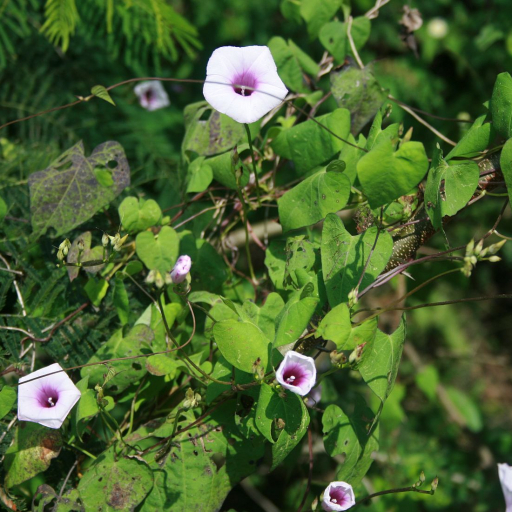
Plant Overview
Often called the "Three-forked Morning Glory," this vigorous vine is the closest wild relative to the common sweet potato. While it doesn't produce the large, edible tubers we enjoy at dinner, it is a botanical superstar used by scientists to improve the resilience of food crops. In the wild, it is a resilient climber known for its delicate, star-centered flowers and its ability to thrive in the heat of the Americas.
🔍 How to Identify
- 🍃 Lobed Foliage: The leaves are famously "trifid," meaning they are often split into three distinct, pointed lobes, though they can also appear heart-shaped on the same vine.
- 🌸 Trumpet Blooms: It produces small to medium funnel-shaped flowers, typically in shades of lavender, pink, or purple, often with a darker "eye" at the center.
- 🌀 Twining Habit: This is a true scrambler; its slender, hairless stems will spiral around fences, tall grasses, or any neighboring shrubs it can find.
🏡 In Your Garden
- 🌱 The Wild Relative: Unlike its domestic cousins, Ipomoea trifida is rarely grown for food. In a garden, it is often treated as an ornamental or a "wildling" that can quickly cover a trellis or an unsightly fence.
- ☀️ Sun Seeker: This plant thrives in full sun and well-drained soil. Because it is a wild species, it is much more drought-tolerant and pest-resistant than many "fancy" morning glory cultivars, making it very low-maintenance.
⚠️ Safety & Toxicity
- 🚫 Toxic if Ingested: Like many members of the Convolvulaceae family, the seeds of this plant contain alkaloids that can be harmful if eaten by humans or animals.
- 🐾 Pet Safety: Keep this vine away from curious dogs, cats, and horses. Ingestion can lead to digestive distress or, in large quantities, more serious neurological symptoms.
✨ Fun Fact
Despite its dainty appearance, this plant is considered the "living ancestor" of the sweet potato (Ipomoea batatas). Scientists study its DNA to help make modern sweet potatoes more resistant to climate change and disease!

Detailed Care Instructions
To grow Ipomoea trifida (AKA morning glory), follow these steps:
- Obtain seeds: Purchase Ipomoea trifida seeds from a reputable source or collect seeds from a mature plant.
- Prepare the soil: Morning glories prefer well-draining soil with a pH range of 6.0 to 7.5. Amend the soil with compost or organic matter to improve its fertility.
- Sow the seeds: In early spring, sow the seeds directly into the ground or start them indoors 4-6 weeks before the last frost date in your area. If starting indoors, plant the seeds in small pots or seed trays filled with seed starting mix.
- Planting the seeds: Place the seeds about ¼ inch deep in the soil and cover lightly with soil or vermiculite. Space the seeds at least 6 inches apart if planting directly in the ground.
- Provide proper lighting: Ipomoea trifida thrives in full sun, so choose a location that receives at least 6-8 hours of direct sunlight per day.
- Watering and drainage: Keep the soil evenly moist but not waterlogged. Avoid overwatering, as it can lead to root rot. Well-draining soil is crucial to prevent waterlogging.
- Supports and trellis: Ipomoea trifida is a climbing vine that requires support to grow upward. Install a trellis, fence, or any other vertical support for the plant to climb on.
- Pruning: Once the plant starts growing, you may need to prune it to control its spread and encourage bushier growth. Pinch off any excess growth or remove any dead leaves or stems.
- Fertilization: Apply a balanced, slow-release fertilizer or organic compost around the base of the plant every four to six weeks during the growing season to provide necessary nutrients.
- Weed control: Regularly check the area around the plants for any weeds and remove them promptly to prevent competition for nutrients.
- Monitor for pests and diseases: Keep an eye out for common pests like aphids, spider mites, or caterpillars. Use organic pest control methods or insecticidal soap if necessary. Diseases, such as fungal infections, can be avoided by ensuring proper air circulation and avoiding overwatering.
- Harvesting seeds: If you want to collect seeds, allow the flowers to fully bloom and develop seed pods. Once the pods turn brown and dry, harvest them and store them in a dry, cool place until the next growing season.
With proper care and attention, your Ipomoea trifida should grow into a beautiful and vigorous plant.

Place in a bright room that is sun drenched almost all day. Or directly in a south-facing window.

When providing water to this particular species of plant, it is important to consider the growing conditions that are best suited to it. As an annual vine that often grows in a tropical or subtropical environment, it requires consistent and adequate watering to thrive.
Before watering, check the soil to ensure it is not already moist, as over-watering can be detrimental to the health of the plant. When watering, it is recommended to use a watering can or hose with a gentle spray nozzle to avoid damaging the delicate foliage. Water the plant steadily and consistently until the soil is saturated.
It is also important to note that this plant is tolerant of some drought, but it should not remain dry for extended periods of time. To maintain good soil moisture levels, a layer of mulch can be added around the base of the plant to help retain moisture.
Regular watering is especially important during hot, dry weather or if the plant is grown in a container. Over-watering should be avoided, as too much moisture can lead to root rot and other issues. By monitoring the soil moisture level and providing consistent, appropriate watering, this plant can thrive and produce abundant blooms.
To fertilize this plant, apply a balanced all-purpose fertilizer with equal parts of nitrogen, phosphorus, and potassium. Fertilize once every four to six weeks during the growing season. Do not apply fertilizer during the dormant season. Water the plant thoroughly before and after fertilizing. Avoid over-fertilization, as it can lead to excessive growth and reduced flowering.
The recommended soil for the Ipomoea Trifida plant is a well-draining soil that is moist but not waterlogged. The soil should be slightly acidic with a pH level of between 6.0 and 6.5. The plant does not tolerate heavy clay soils and prefers a soil that is loamy or sandy. It is also important to ensure that the soil is rich in organic matter and nutrients. This can be achieved by adding compost or well-rotted manure to the soil before planting. Overall, the soil should be fertile and provide good drainage to prevent waterlogging and root rot.
To propagate this plant, you will need to gather seeds from the mature plant. Once harvested, the seeds should be soaked in warm water for around 24 hours before planting. Plant the seeds in a well-draining potting mix and keep the soil consistently moist. Place the pot in a warm, bright location and ensure that the temperature remains between 20 and 25°C. The seeds should germinate within a couple of weeks. As the plant grows, it can be transplanted into a larger container or directly into a garden bed.








