Plant Overview
Often called the Cardinal Climber, this stunning hybrid is a botanical masterpiece created by crossing the Cypress Vine with the Scarlet Morning Glory. It is widely adored by gardeners for its ability to transform a plain fence into a wall of fiery red trumpets in a single summer season. If you are looking to turn your backyard into a sanctuary, this vine acts as a natural "dinner bell" for hummingbirds and butterflies.
🔍 How to Identify
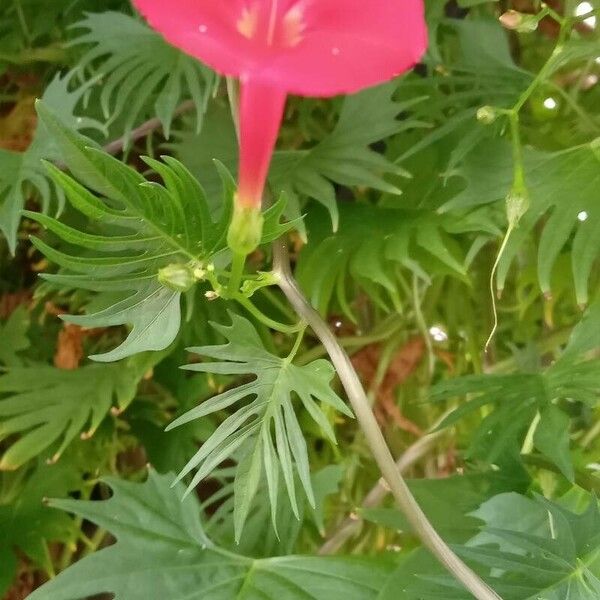
- 🌿 Feathery Foliage: Unlike the heart-shaped leaves of common morning glories, the Cardinal Climber has deeply lobed, triangular leaves that look almost like miniature palm fronds or delicate ferns.
- 🌺 Trumpet Blooms: It produces small, vibrant scarlet-red flowers. Each blossom has a long tube ending in a five-pointed star shape, often with a white or pale yellow "throat" at the center.
- 🧬 Twining Stems: The vines are slender and vigorous, typically reddish-green, and they climb by spiraling tightly around any vertical support they can find.
🏡 In Your Garden
- 🧗 The Need for Height: This plant is a born athlete that loves to climb. Because it uses its entire stem to twine rather than using tendrils, it performs best on thin supports like netting, twine, or wire trellises rather than thick wooden posts.
- 🌱 Transplant Sensitivity: The Cardinal Climber develops a delicate root system early on and famously "hates" being moved. For the best results, nick the hard seed coat and soak them overnight, then sow them directly into the garden soil once the weather is warm.
- ☀️ Sun Seeker: To get a massive "flush" of flowers, place it in the brightest spot available. While the vine will grow in partial shade, the flower production will be significantly lower.
⚠️ Safety & Toxicity
- 🚫 Toxic Seeds: The seeds of the Cardinal Climber contain alkaloids (similar to LSD) that are toxic if ingested.
- 🐾 Pets & Children: Keep the drying seed pods away from curious pets and toddlers. Ingestion can cause stomach upset, vomiting, and in significant amounts, neurological symptoms or hallucinations.
✨ Fun Fact
The Cardinal Climber is a "man-made" marvel! It was specifically bred in the early 1900s by Logan Sloper, who spent years crossing two different wild species to create a plant that had the delicate, airy leaves of the Cypress Vine but the larger, more brilliant red flowers of the Scarlet Morning Glory.

Detailed Care Instructions

Place in a bright room that is sun drenched almost all day. Or directly in a south-facing window.

The presence of a dry surface layer of soil does not indicate that the plant requires water. Instead, stick your finger 1-2" (3-5 cm) deep in the soil to feel dampness or moisture content. If the soil seems dry, it's time to water your greens. If the soil is still moist, however, it is better not to water your plant and instead wait a day or two. Overwatering or waterlogging raises the risk of root rot. So if the soil takes longer than a week to dry, check the light conditions because it's likely that the plant isn't getting enough light. It's fine if the upper layer of soil is dry between waterings, but the deeper soil layer should always have some moisture.
The relative humidity levels between 30 and 50 percent are ideal for these plants. They exhibit unpleasant symptoms when the moisture content in the environment is unfavorable. Avoid letting the air temperature rise too high or low and use a humidifier, whenever possible. Misting is also beneficial, although frequent watering is also necessary. The optimal relative humidity will promote plant growth.
Unfortunately, cardinal climber are susceptible to a host of common pests and diseases. Common cardinal climber diseases include Yellow leaves. Prompt pruning of any dead or diseased branches should keep these common diseases under control.
Common pests of the cardinal climber include Spider mites, aphids, thrips. Make a habit of checking your cardinal climber frequently for pests so that any infestations can be caught and managed early.
Common pests of the cardinal climber include Spider mites, aphids, thrips. Make a habit of checking your cardinal climber frequently for pests so that any infestations can be caught and managed early.








