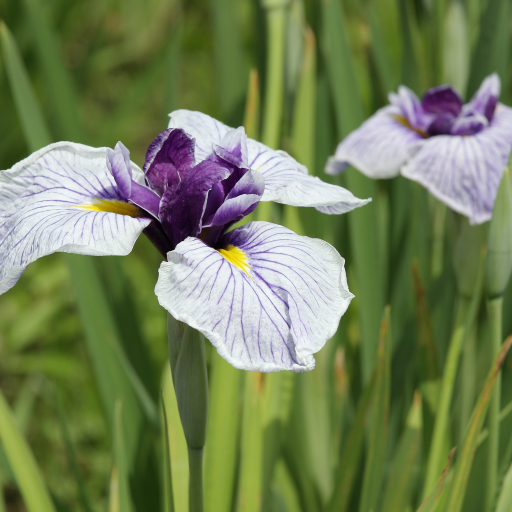
Plant Overview
Known as the "Hanashōbu" in its native Japan, the Iris ensata is the undisputed royalty of the water’s edge. Unlike the ruffled bearded irises of dry gardens, these elegant beauties produce massive, platter-like blooms that seem to float like colorful butterflies over tall, blade-like foliage. They are deeply woven into Japanese art and history, frequently appearing in traditional woodblock prints and poetry as symbols of grace and bravery.
🔍 How to Identify
- 🌸 The Bloom Shape: These flowers are uniquely flattened and horizontal. While other irises have upright "standards," the Japanese Water Iris has been bred to have wide, drooping "falls" that can reach the size of a dinner plate.
- 🌿 The Midrib Secret: You can distinguish this species from its cousins by its leaves. Every blade features a very prominent, raised central ridge (midrib) that you can easily feel with your fingers.
- 🎨 The "Signal": Each petal typically displays a vivid, dagger-shaped yellow "signal" at the base, which serves as a neon sign for bees looking for nectar.
🏡 In Your Garden
- 💧 Thirsty Foundations: These plants are true bog lovers. They crave "wet feet" during the spring and summer growing seasons, making them perfect for pond margins or soggy low spots where other plants might drown.
- 🧪 The Acid Test: These are "calcifuges," meaning they absolutely despise lime. If your soil is alkaline, the leaves will turn yellow (chlorosis). They require rich, acidic soil to produce their signature deep purples and blues.
- ✂️ Winter Rest: Unlike some water plants, they don't want to be submerged in standing water during the winter. They prefer to be damp but not drowned during their dormant phase to prevent the rhizomes from rotting.
⚠️ Safety & Toxicity
- 🐾 Toxic to Pets: The entire plant, especially the underground rhizomes, contains the compound iridin. If ingested by cats or dogs, it can cause vomiting, drooling, and lethargy.
- 🧤 Skin Sensitivity: The sap can be a skin irritant for some people. It is always wise to wear gloves when dividing the clumps or trimming the foliage to avoid "Iris dermatitis."
✨ Fun Fact
In Japan, Iris ensata is traditionally associated with the "Children's Day" festival. Because the long, sharp leaves resemble the shape of a Katana, it was historically believed that the plant could ward off evil spirits and instill the strength and courage of a Samurai in young children.

Detailed Care Instructions
To grow an Iris ensata plant, also known as Japanese iris or Hanashōbu, follow these steps:
- Choose a suitable location: Japanese iris prefers full sun or partial shade. Select a planting spot with moist, well-draining soil.
- Prepare the soil: Remove weeds and till the soil to a depth of 12-18 inches. Add organic matter, like compost or well-rotted manure, to enhance soil fertility and drainage.
- Planting: Dig a hole wide and deep enough to accommodate the rhizome. Place the rhizome horizontally in the hole and cover it with soil, just enough to secure it in place. Leave the top of the rhizome exposed.
- Watering: Water thoroughly after planting to settle the soil and eliminate air pockets. Keep the soil consistently moist throughout the growing season, providing at least an inch of water per week. However, make sure the soil is not waterlogged.
- Mulching: Apply a layer of organic mulch, like wood chips or straw, around the plants to help retain soil moisture and suppress weed growth. Keep the mulch a few inches away from the rhizomes to prevent rotting.
- Fertilizer: Apply a balanced slow-release fertilizer once in early spring when new growth begins. Follow the package instructions for the recommended dosage.
- Support: Use stakes or garden grids to provide support for taller varieties of Iris ensata, especially if wind or heavy rain may cause flopping.
- Dividing: Every 3-4 years, typically in late summer or early autumn, divide the rhizomes to prevent overcrowding. Dig up the rhizomes, separate healthy sections, and replant them with adequate spacing.
- Pest and disease control: Japanese iris is generally not prone to severe pest or disease problems. However, keep an eye out for pests like aphids or snails, and apply appropriate measures if necessary.
- Enjoy the blooms: Japanese iris typically blooms in late spring or early summer and produces stunning flowers with a wide variety of colors, including white, blue, purple, and pink. Observe and admire their beauty throughout the blooming period.
Remember to check the specific care requirements of the Iris ensata variety you have, as some cultivars may have specific needs.

Place in a bright room that is sun drenched almost all day. Or directly in a south-facing window.

Iris Ensata plant belongs to the genus Iris and requires adequate watering to thrive. To water this plant, first, check the moisture level of the soil. Insert your finger into the soil up to the second knuckle, and if it feels dry, it's time to water.
Take a watering can with a long and narrow spout and water at the base of the plant. Do not water from above as it can damage the delicate flowers of this plant. Water thoroughly until the water starts to drain out of the bottom of the pot.
Make sure to avoid over-watering as it can cause root rot and kill the plant. Water the Iris Ensata plant only when the soil feels dry, which is usually every 4-5 days in summer and less frequently during colder months.
In addition to regular watering, it's essential to provide good drainage to prevent waterlogging. Ensure that the pot has drainage holes, and use well-draining soil that allows excess water to drain away quickly.
Watering the Iris Ensata plant at regular intervals and maintaining proper drainage will ensure its healthy growth and abundant blooms.
To fertilize this flowering plant, begin by selecting a slow-release fertilizer that is high in phosphorus. In early spring, spread the fertilizer evenly around the base of the plant, taking care not to allow it to touch the stem. Water thoroughly to help the fertilizer mix into the soil. Repeat this process every four to six weeks throughout the growing season, taking care not to over-fertilize. Additionally, consider adding a layer of compost or organic matter to the soil around the plant in fall to help promote healthy growth and flowering the following year.
The ideal soil for Iris Ensata plant is a well-draining soil that is rich in humus. It should ideally contain a pH level of 6.0 to 7.5. The soil should be loamy, which means it should have a good balance of sand, silt, and clay. The plant prefers slightly acidic to neutral soil. If the soil is too alkaline, you can add amendments like peat moss or sulfur to lower the pH level. The soil should also be moist, but not excessively wet. You can add organic matter like compost or aged manure to improve the fertility of the soil. Ensure that the soil is free from weeds and debris to prevent any growth competition and not to disrupt the plant's rooting system.
To propagate this particular plant, you'll need to begin by harvesting the seeds. This can be done by allowing the seed pods to fully mature and dry on the plant, after which you can carefully remove the pods and extract the seeds.
Once you have the seeds, you'll need to prepare a soil mixture of well-draining potting soil and sand or perlite. Fill a small pot or seed tray with the soil mixture, and gently press each seed into the top of the soil. It's important to only lightly cover the seeds with soil, as they need light to germinate.
Next, water the soil gently to moisten it evenly, and cover the pot or tray with a plastic bag or dome to increase humidity. Place the pot or tray in a bright area but out of direct sunlight, and maintain the moisture level by misting the soil regularly.
After a few weeks, you should start to see small sprouts emerge from the soil. Once the seedlings have developed a few sets of leaves, you can carefully transplant them into individual pots with fresh soil.
During the first few months, it's important to provide consistent moisture and sunlight for the plant to establish its root system. With proper care, your new Iris Ensata plant should thrive and grow into a beautiful addition to your garden.








