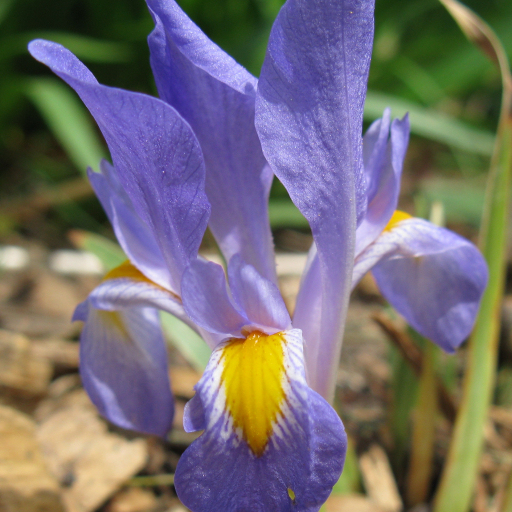
Plant Overview
Often called the Dwarf Violet Iris, this tiny woodland gem is one of the earliest heralds of spring in the Eastern United States. Unlike its towering garden cousins, this Iris stays low to the ground, offering a splash of royal purple before the forest canopy fully closes. It is a favorite for native plant enthusiasts who want to recreate the delicate beauty of an Appalachian hillside in their own backyard.
🔍 How to Identify
- 🌿 Slender Foliage: The leaves are narrow, sword-shaped, and grow in small, neat fans that rarely exceed 6–10 inches in height.
- 💜 Velvety Blooms: The flowers are a striking deep violet-blue, featuring a brilliant, glowing orange or yellow "signal" patch on the falls (lower petals).
- ✨ Beardless Petals: Unlike the common Bearded Iris found in many gardens, Iris verna has smooth, hairless petals, giving it a cleaner and more delicate appearance.
🏡 In Your Garden
- ⛰️ The Acid Test: This plant is quite particular about its home; it absolutely requires acidic, well-drained soil. It often grows naturally near pine trees or oaks where the needles and leaves keep the pH low.
- 🌳 Dappled Sunlight: In the wild, it thrives on the edges of forests. In a garden setting, it loves "bright shade"—plenty of light to trigger blooming, but protection from the scorching afternoon sun which can wither its thin leaves.
- 🤫 Low Maintenance: Once it finds a spot it likes, it prefers to be left alone. Its shallow rhizomes are sensitive, so avoid heavy mulching or frequent transplanting.
⚠️ Safety & Toxicity
- 🚫 Toxic if Ingested: Like most members of the Iris family, the rhizomes (underground stems) and foliage contain iridin, which can cause digestive distress.
- 🐾 Pet & Child Safety: Keep this plant away from curious nibblers. Ingestion can lead to nausea, vomiting, or skin irritation if the sap is handled excessively.
✨ Fun Fact
While many wild irises have no scent at all, Iris verna is famous among hikers for its surprisingly intense, sweet fragrance—some say it smells remarkably like violets or even expensive floral perfume!

Detailed Care Instructions
To grow Iris Verna (also known as Southern Blue Flag), follow these steps:
- Choose a suitable location: Iris Verna thrives in full sun to partial shade. Ensure the area has well-draining soil with a pH level between 6.5 and 7.5.
- Prepare the soil: Amend the soil with compost or organic matter to improve drainage and fertility. Remove any stones or debris that may impede root growth.
- Planting: Dig a hole that is wide and deep enough to accommodate the plant's root system. Place the rhizome (underground stem) in the hole, ensuring the pointed end faces upward. Cover the rhizome with soil, leaving the top exposed.
- Watering: Provide the plant with sufficient moisture after planting. Keep the soil consistently moist but not waterlogged. Deep watering once a week is usually enough, but adjust based on the weather or the soil's moisture retention capacity.
- Mulching: Mulch around the plant to control weeds, conserve moisture, and regulate soil temperature. Apply a 2-3 inch layer of organic mulch, such as straw or wood chips, around the base of the plant, leaving a small gap around the stem for air circulation.
- Fertilizing: Iris Verna generally does not require heavy feeding. However, in early spring, you can apply a balanced slow-release fertilizer according to the manufacturer's instructions. Avoid using high-nitrogen fertilizers as they can promote lush foliage growth at the expense of flowers.
- Pruning: Trim off any faded or dead flowers to maintain the plant's appearance. After the blooming season, you can cut the foliage back to about 6-8 inches from the ground to tidy up the plant and encourage healthy regrowth.
- Winter care: Iris Verna is hardy in USDA zones 5-9. In colder regions, ensure the plant is well established before winter, and consider applying a layer of mulch around the base in late fall to protect it from freeze-thaw cycles.
By following these steps, you should be able to successfully grow Iris Verna. Enjoy its beautiful blooms and appreciate its delicate charm!

Place in a window with dappled sun or a spot in the middle of a room. Or directly in a window facing west or east.

Iris Verna plant requires consistent watering to thrive, but it's important not to overwater it. It's recommended to water the plant once or twice a week, providing enough water to saturate the soil. It's important to ensure that the soil dries out slightly between waterings to prevent waterlogged roots.
Watering Iris Verna plant should be done at the base of the plant, avoiding the leaves and flowers. This helps prevent fungal diseases and allows the water to reach the roots directly.
Iris Verna plant prefers a well-draining soil, so it's important to ensure that the water does not pool around the roots. If the soil is heavy and compacted, it may be useful to mix in sand or perlite to improve drainage.
During the summer months, when the plant is actively growing, it may require more frequent watering than during the winter when it's dormant. It's important to monitor the soil moisture and adjust watering frequency accordingly.
Overall, providing consistent and adequate watering is essential for the health and vitality of Iris Verna plant.
For best results, fertilize the Iris Verna plant in early spring, just as new growth begins to emerge. Use a balanced, slow-release fertilizer with a ratio of 10-10-10 or 20-20-20. Apply the fertilizer to the soil around the plant, being careful not to get any on the leaves. Water the plant thoroughly after fertilizing. Repeat fertilization every 4-6 weeks during the growing season. Avoid fertilizing during the winter months when the plant is dormant.
The ideal soil for growing the plant mentioned has a pH level of 6.0 to 7.5 and is well-drained, meaning it does not hold water for too long. The soil should be rich in organic matter and nutrients. A mixture of loam, compost, and sand is a good option for the plant to thrive. The soil should not be too fertile or compacted, as this can hinder the growth and development of the plant. It should also never be allowed to become dry and hard. Adequate moisture is essential for this plant, so the soil must retain moisture but remain well-draining. A layer of mulch can help maintain adequate moisture levels and prevent soil from drying out too quickly.
Propagating this plant can be done through the division of the rhizomes, which are underground stems. To do this, wait until the plant has finished blooming and the foliage is beginning to die back. Carefully dig up the plant and separate the rhizomes into sections, making sure each section has roots attached. Plant the sections in a new location, making sure the soil is loose and well-drained. Water the newly planted sections regularly until new growth appears.








