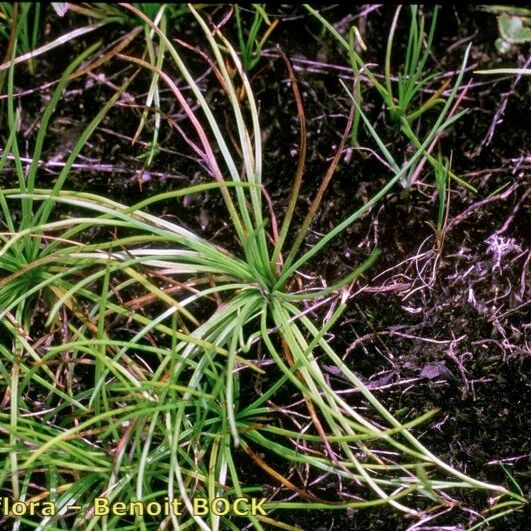
Plant Overview
Often overlooked as just another tuft of grass, the Land Quillwort (Isoetes histrix) is actually a "living fossil" with a lineage dating back millions of years. This cryptic plant is a master of disguise, thriving in the rugged coastal heaths of the Mediterranean and the Atlantic fringes. Unlike its aquatic cousins that live submerged in lakes, this species is a specialist of land that experiences dramatic seasonal shifts.
🔍 How to Identify
- 🌿 The Leaves: The foliage consists of thin, dark green, and wire-like blades. They look remarkably like young chives or fescue grass but are much stiffer and grow in a tight, fountain-like rosette.
- 🦴 The Spiny Base: The most defining feature is hidden at the soil line. The base of the plant features dark, persistent scales with two or three pointed "teeth." These look like tiny black horns or a miniature crown.
- 🌑 The Spores: As a lycopod (a relative of ferns), it produces no flowers or seeds. Instead, it hides its reproductive spores within the swollen, white bases of its leaves, which are only visible if the plant is carefully examined at the root level.
🌲 Habitat & Ecology
- 💧 The Moisture Paradox: This plant is a specialist of "winter-wet, summer-dry" environments. It requires a very specific cycle: it needs to be virtually submerged or very damp during the winter and spring, but it must be allowed to go dormant and bake in the dry sun during the summer.
- 🌾 Minimalist Competition: It is a poor competitor against aggressive grasses. In the wild, you will only find it in "marginal" areas—places where the soil is too thin, too acidic, or too seasonally harsh for other plants to survive. It literally carves out a life where others cannot.
⚠️ Safety & Toxicity
- ✅ Non-Toxic: There are no recorded instances of Isoetes histrix being toxic to humans, cats, or dogs.
- 🛡️ Conservation Status: While not poisonous, this plant is incredibly rare and protected in many parts of its range (such as the UK). It is highly sensitive to soil compaction and chemical runoff, so "look but don't touch" is the best policy for nature lovers.
✨ Fun Fact
The specific epithet histrix comes from the Greek word for porcupine. This refers to the spiny, black leaf-bases that remain after the greenery has withered away, making the underground bulb look like a tiny, prickly creature huddling in the soil!

Detailed Care Instructions

Place in a bright room that is sun drenched almost all day. Or directly in a south-facing window.

To properly water this plant, it is important to understand its natural habitat and irrigation needs. This plant typically grows in aquatic or semi-aquatic environments, such as bogs, marshes, or shallow water bodies. As such, it requires frequent watering to maintain its ideal moisture level.
When watering Isoetes Histrix, it is recommended to use clean, fresh water that is free of contaminants or pollutants. This can be achieved by using rainwater or distilled water, or by filtering tap water to remove impurities. The water should be added slowly and evenly to the soil around the base of the plant until the soil is moist but not soggy.
It is also important to avoid letting the plant sit in standing water or overly wet soil, as this can lead to root rot and other issues. If the soil is excessively wet or the plant is showing signs of stress, reduce the amount of water given and allow the soil to dry out partially before watering again.
In summary, watering Isoetes Histrix is best done with clean, fresh water applied slowly and evenly to the soil, while being mindful not to overwater or allow the plant to sit in standing water.
Isoetes Histrix requires a well-draining soil that is rich in organic matter with a balanced pH level. The soil should have good water-holding capacity, but also allow for adequate drainage to prevent waterlogging. To ensure optimal growth, it is recommended to use a high-quality soil mix with the appropriate nutrient content, such as a mixture of sand, peat moss, and perlite. Avoid using soils with high levels of clay and compacted soils, as they can impede root growth and drainage. Additionally, it is important to make sure the soil is not contaminated with any chemicals or pollutants, as Isoetes Histrix is sensitive to environmental toxins.








