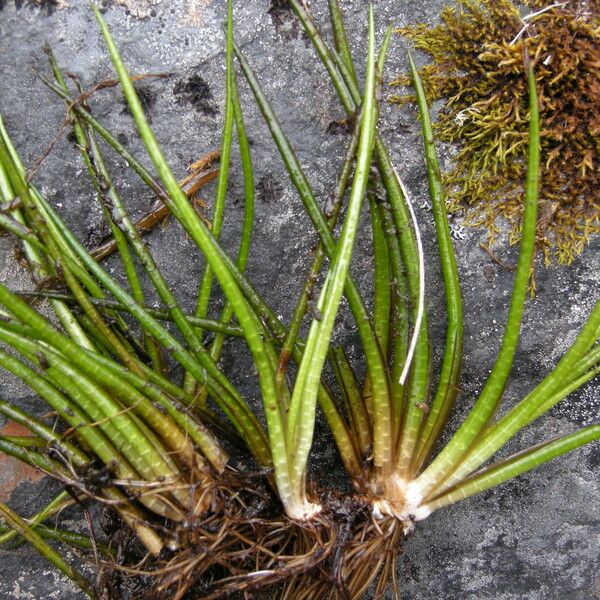
Plant Overview
Often called the Andean Quillwort, Isoetes lechleri is a quiet survivor of the high-altitude wetlands in South America. While it might look like a simple tuft of grass submerged in a mountain lake, it is actually a "living fossil," part of a lineage that dates back hundreds of millions of years. These plants are more closely related to the massive prehistoric clubmoss trees of the Carboniferous period than to the modern grasses they resemble.
🔍 How to Identify
- 🌿 The Foliage: It features long, narrow, quill-like leaves that grow in a dense, upright rosette. The leaves are typically dark green and slightly translucent.
- 🧬 The Base: A swollen, bulb-like base known as a "corm" anchors the plant. This base is where the plant stores its energy and houses its reproductive structures.
- 🔎 Hidden Spores: Unlike flowering plants, it doesn't produce seeds. If you look closely at the widened base of the outermost leaves, you may find small pockets containing microscopic spores.
🏔️ Habitat & Ecology
- 💧 High-Altitude Specialist: This species is a specialist of the Andean "paramos" and alpine lakes, often found at elevations between 3,000 and 4,500 meters. It thrives in cold, clear, and nutrient-poor water.
- 🧊 Resilient Nature: It is adapted to extreme temperature fluctuations. It can survive being frozen in ice during the Andean night and thawed by the intense equatorial sun by midday.
- 🌱 Submerged Life: It usually grows completely submerged or in saturated peat bogs. Because it grows so slowly, it is easily outcompeted by faster-growing invasive weeds if the water becomes too rich in nutrients.
⚠️ Safety & Toxicity
- ✅ Safe Status: Isoetes lechleri is considered non-toxic to humans, livestock, and domestic pets.
- 🛑 Environmental Sensitivity: While not "poisonous," these plants are highly sensitive to water pollution and runoff. Their presence is often used by scientists as a biological indicator of pristine, unpolluted water.
✨ Fun Fact
Most plants that use "CAM photosynthesis"—a process of breathing at night to save water—are desert succulents like cacti. However, Isoetes lechleri uses this same trick underwater! It "breathes" at night to capture carbon dioxide when it is more available in the lake water, a rare adaptation for an aquatic plant.

Detailed Care Instructions








