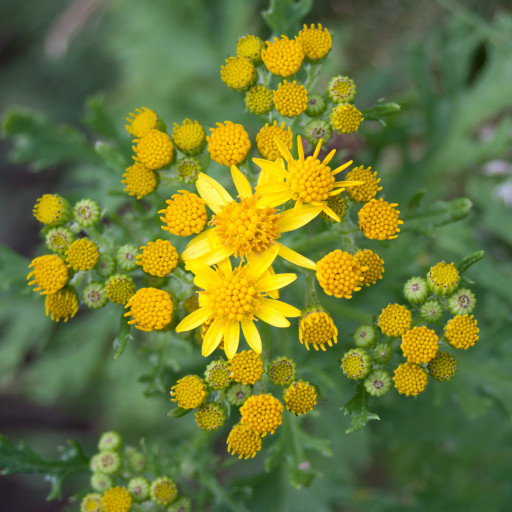
Plant Overview
Often called "Stinking Willie" or "Common Ragwort," Jacobaea vulgaris is a plant of deep contradictions. While many farmers and horse owners view it as a persistent and dangerous foe in the pasture, it is an ecological powerhouse for native pollinators. In Irish folklore, these tall, yellow-topped stalks were whispered to be the "fairy horses" that the hidden folk used to ride through the night.
🔍 How to Identify
- 🌼 Golden Clusters: Features dense, flat-topped clusters of bright yellow, daisy-like flowers, usually with 12 to 15 distinct ray petals.
- 🌿 Jagged Foliage: The leaves are deeply lobed and "pinnatifid," meaning they have a ruffled, toothy appearance that looks almost like a dark green lace.
- 📏 Upright Growth: It typically grows as a biennial; in its second year, it shoots up a sturdy, ribbed, and often reddish stem that can reach up to three feet in height.
🏡 In Your Garden
- 🦋 Pollinator Paradise: This plant is a vital nectar source for over 30 species of solitary bees and is the exclusive nursery for the striking Cinnabar moth.
- 🌱 Persistent Pioneer: It thrives in neglected soil, overgrazed pastures, and roadside verges. Because a single plant can produce up to 150,000 seeds that travel on the wind, it can quickly dominate a landscape if the soil is disturbed.
⚠️ Safety & Toxicity
- 🚫 Livestock Warning: Ragwort contains pyrrolizidine alkaloids, which are highly toxic to horses, cattle, and sheep. Ingestion leads to cumulative and irreversible liver damage.
- 🧤 Human Sensitivity: The sap can cause "Compositae dermatitis," a painful skin rash or irritation in sensitive individuals. Always wear gloves if you are pulling this plant by hand.
✨ Fun Fact
The Cinnabar moth caterpillar has evolved a brilliant survival strategy: it eats so much Ragwort that it absorbs the plant's toxins into its own body. Its bright orange and black stripes serve as a warning to birds that it is a very poisonous—and very bitter—snack!

Detailed Care Instructions
| Toxicity | Poisonous |
Jacobaea vulgaris, also known as ragwort, is a perennial plant that can grow in a variety of climates and soil conditions. Here are some steps to grow Jacobaea vulgaris:
- Seed collection: Collect seeds from mature plants during late summer or early autumn when the flowers have turned brown and released their seeds.
- Soil preparation: Prepare a well-draining soil mix with a pH level of 6.5 to 7.5. Remove any weeds or grass from the planting area.
- Seed sowing: Scatter the collected seeds over the prepared soil surface. Do not cover the seeds with soil as they require light to germinate.
- Watering: Water the seeds lightly after sowing to keep the soil moist. Avoid over-watering as it may cause rotting.
- Germination: Jacobaea vulgaris seeds usually take 2-4 weeks to germinate. During this time, ensure the soil remains consistently moist but not waterlogged.
- Transplanting: Once the seedlings have grown to a few inches tall, they can be gently transplanted to larger pots or directly into the ground. Space the plants 30-45 cm apart.
- Sunlight: Jacobaea vulgaris thrives in full sun to partial shade, so choose a suitable spot in your garden accordingly.
- Watering and maintenance: Water the plants regularly, especially during dry periods. Remove any competing weeds to avoid restricting the growth of Jacobaea vulgaris.
- Pruning and deadheading: Consider deadheading the faded flowers to encourage more blooms. Prune the plants in early spring to promote healthy growth and remove any dead or damaged material.
- Overwintering: Jacobaea vulgaris is a hardy plant, but younger plants may benefit from mulching over winter to protect their roots from cold temperatures.
Please note that Jacobaea vulgaris is considered an invasive species in some regions, so it is important to check the regulations in your area before growing it.

Place in a bright room that is sun drenched almost all day. Or directly in a south-facing window.

This plant should be watered regularly but not excessively. Before watering, check the top inch of soil to make sure that it is dry to the touch. Water deeply enough to saturate the roots without allowing water to sit in the bottom of the container or the soil to become waterlogged. Avoid watering during periods of heavy rainfall or when the weather is excessively humid. If the leaves begin to wilt or turn yellow, the plant may be getting too much or too little water. Adjust watering accordingly.
- Begin by selecting a suitable fertilizer for Jacobaea Vulgaris plant. Look for a balanced fertilizer that contains equal amounts of nitrogen, phosphorus, and potassium (NPK).
- Choose a slow-release fertilizer to provide a continuous supply of nutrients to the plant over an extended period of time. This will prevent over-fertilizing and help maintain a healthy growth rate.
- Follow the manufacturer's instructions regarding the amount of fertilizer to use. Usually, a general guideline is to apply approximately 1 tablespoon of fertilizer per square foot of plant area.
- Prior to applying the fertilizer, make sure the soil is moist. This will aid in the absorption of nutrients by the plant.
- Sprinkle the fertilizer evenly around the base of the Jacobaea Vulgaris plant, taking care not to let it come into direct contact with the leaves or stems.
- Gently work the fertilizer into the top layer of soil using a hand cultivator or rake. Avoid disturbing the plant's root system.
- Water the plant thoroughly after fertilizing to ensure the nutrients are absorbed into the soil. This will also help prevent any potential fertilizer burn if excessive amounts were applied.
- Monitor the plant's growth and adjust the fertilizing schedule accordingly. In general, it is recommended to fertilize Jacobaea Vulgaris plant once every two to four weeks during the growing season (spring and summer). Reduce or stop fertilizing during the plant's dormant winter period.
Remember to always read and follow the specific instructions provided by the fertilizer manufacturer, as different products may have slight variations in application rates and frequency.
The Jacobaea Vulgaris plant prefers well-draining soil with a neutral pH level, typically around 6.5 to 7.5. It thrives in soil that has a good balance of organic matter and is not too compacted. The best soil for this plant is a mixture of loamy soil, organic compost, and sand. It is important to ensure that the soil is not too moist, as overwatering can cause damage to the plant's roots. Additionally, occasional fertilization with a balanced fertilizer can help to ensure healthy growth.
To propagate the plant referred to as Jacobaea vulgaris, you can follow these steps:
- Select a healthy parent plant: Choose a mature Jacobaea vulgaris plant with vibrant foliage and sturdy stems to ensure successful propagation.
- Prepare the container: Fill a small container with well-draining soil. You can use a mixture of potting soil and perlite or sand to enhance drainage.
- Take stem cuttings: Using clean, sharp pruning shears, cut a 4-6 inch (10-15 cm) section of a healthy stem from the parent plant. Ensure that the cutting has at least two to three sets of leaves.
- Remove lower leaves: Trim off the lower set of leaves from the cutting, leaving a small section of the stem exposed.
- Optional: Apply rooting hormone: If desired, dip the cut end of the stem into a rooting hormone powder or gel to aid in root development. This step is optional but can increase the chances of successful propagation.
- Plant the cutting: Make a small hole in the soil with your finger or a pencil and gently place the cutting into the hole. Firmly press the soil around the base of the stem to secure it in place.
- Provide appropriate care: Place the container in a location with bright, indirect sunlight, as Jacobaea vulgaris thrives in partial shade. Ensure the soil remains consistently moist but not waterlogged. Mist the cutting and cover it with a clear plastic bag or a mini greenhouse to create a humid environment.
- Monitor and maintain: Periodically check the cutting for signs of growth and root development. Once roots have formed, typically within 2-4 weeks, you can remove the plastic covering and gradually expose the plant to regular conditions.
- Transplanting: Once the cutting has developed a substantial root system, you can transplant it into a larger pot or outdoor garden bed, depending on your preferences and climate.
Note: It is important to handle Jacobaea vulgaris with caution as it is a toxic plant. Wear gloves and wash your hands thoroughly after handling to avoid any potential adverse effects.








