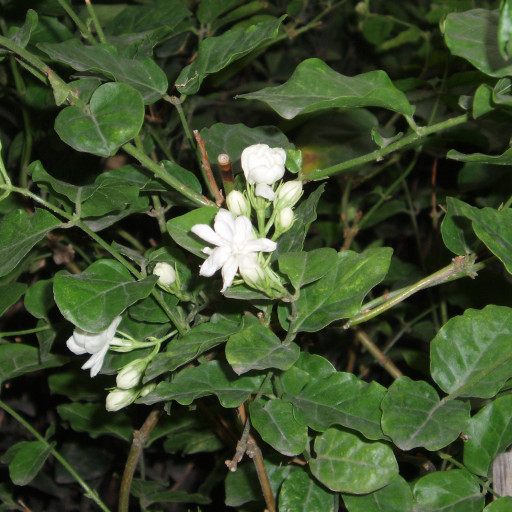
Plant Overview
Known widely as the Arabian Jasmine, this plant is a sensory powerhouse that has traveled from the humid tropics of Southeast Asia to gardens worldwide. It holds the prestigious title of the national flower for both the Philippines (where it is called Sampaguita) and Indonesia. Celebrated for its intoxicating, sweet fragrance, it is the primary blossom used to scent high-quality jasmine teas and perfumes.
🔍 How to Identify
- 🍃 Glossy Foliage: The leaves are deep green, oval-shaped, and grow in opposite pairs or whorls of three, featuring a smooth, waxy sheen that catches the sunlight.
- 🌸 Porcelain Blooms: The flowers are pure white, often appearing in small clusters; they have a thick, waxy texture and can be single-layered or multi-petaled "double" blooms that look like tiny roses.
- 🌿 Scrambling Habit: It grows as an evergreen shrub with long, flexible stems that love to "scramble" or lean against trellises, reaching up to 6–10 feet if left unpruned.
🏡 In Your Garden
- ☀️ The Sun-Scent Connection: While it tolerates partial shade, full sun is essential for the plant to produce the essential oils responsible for its famous fragrance.
- 💧 Humidity is Key: This jasmine hates "wet feet" but craves moist air. In dry climates, placing the pot on a pebble tray filled with water helps prevent the flower buds from drying out and dropping before they open.
⚠️ Safety & Toxicity
- ✅ Safe for Pets: Unlike many other plants sharing the name "Jasmine" (like the toxic Carolina Jasmine), Jasminum sambac is non-toxic to cats, dogs, and horses.
- ☕ Culinary Caution: While the flowers are used in tea, never consume blossoms from a plant purchased at a nursery or florist, as they are often treated with systemic pesticides not meant for ingestion.
✨ Fun Fact
- 🌙 The Midnight Bloom: The flowers typically open at night and close again in the morning. For tea production, the buds are picked in the early morning and layered with tea leaves at nightfall; as the flowers "yawn" open in the dark, they release their scent directly into the tea.

Detailed Care Instructions
| Color | White |
| Humidity | High |
| Lighting | Part Sun |
| Soil Type | Well-Drained Soil |
| Bloom Time | June To August |
| Difficulty | Hard |
| Plant Type | Evergreen Shrub |
| Hibernation | Cold Period |
| Mature Size | 6 To 10 Feet |
| Native Area | India And Southeast Asia |
| Temperature | 18°C - 24°C |
| Sun Exposure | Full Sun To Part Shade |
| Hardiness Zones | 9-11 |
To grow Jasminum Sambac, also known as Arabian jasmine or sampaguita, follow these steps:
- Climate and location: Choose a location that receives full or partial sunlight. Arabian jasmine thrives in tropical or subtropical climates with temperatures between 60-80°F (15-27°C).
- Soil: Use a well-draining soil mix that is rich in organic matter. A slightly acidic to neutral pH level of 6-7 is ideal.
- Planting: Select a healthy nursery plant or propagate from cuttings. Dig a hole slightly larger than the root ball and place the plant in the hole. Fill it with soil, and gently press the soil to remove air pockets around the plant. Space multiple plants about 6-8 feet apart.
- Watering: Keep the soil consistently moist, but avoid waterlogging. Water deeply once or twice a week during the growing season, and reduce watering during cooler months. Be mindful not to let the soil dry out completely.
- Fertilizer: Apply a balanced slow-release fertilizer or organic compost during the growing season, typically every 4-6 weeks. Follow the instructions on the fertilizer package or consult a local nursery for suitable products.
- Pruning: Prune Arabian jasmine after blooming, typically in early spring or late fall. Trim back 1/3 of the plant's growth to maintain its shape and promote new growth.
- Trellis or support: Arabian jasmine is a climbing vine, so provide a trellis, support structure, or place it near a fence or wall for the plant to cling to and grow upwards.
- Pests and diseases: Monitor for common pests like aphids, whiteflies, or spider mites. Treat infestations with organic insecticidal soap or neem oil. Avoid overwatering to prevent root rot or fungal diseases.
- Propagation: To propagate Arabian jasmine, take softwood cuttings in spring or semi-hardwood cuttings in summer. Remove the lower leaves, dip the cut end in rooting hormone, and plant in a well-draining soil mix. Keep the cutting moist and provide a warm, humid environment until it establishes roots.
- Enjoy the blooms: Arabian jasmine is renowned for its fragrant white flowers. Once the plant reaches maturity, usually after 2-3 years, it will produce an abundance of blooms that will fill the air with a delightful fragrance.
Remember to research any specific regional considerations for growing Arabian jasmine in your area.

Place in a window with dappled sun or a spot in the middle of a room. Or directly in a window facing west or east.

To keep the plant healthy, it needs to receive adequate water. One way to determine whether it requires watering is to check the soil's moisture level. The easiest way to check is by sticking your finger about an inch deep into the soil. If the soil feels dry, it is time to water the plant. Keep in mind that watering should be consistent, and the plant should not be overwatered as it may become root rot. Using a watering can or a bucket is recommended to avoid wetting the leaves. Additionally, it is better to water early in the morning or late in the evening to minimize water loss due to evaporation.
To fertilize this plant, use a balanced, slow-release fertilizer with equal parts nitrogen, phosphorus, and potassium. Apply the fertilizer once or twice a month during the growing season, which is typically spring and summer. Be cautious not to over-fertilize, as this can harm the plant. Also, make sure to water the plant well before and after fertilizing to avoid burning the roots.
The ideal soil for this plant needs to be well-draining, rich in nutrients, and have a slightly acidic pH level. It should also be loose and friable in texture, allowing for proper aeration and moisture retention. Organic matter such as compost or peat moss can be added to the soil to improve its quality. Additionally, it is important to avoid using heavy clay soils or those with poor drainage as this can lead to root rot and other problems.
Jasminum Sambac can be propagated through stem cuttings taken from the parent plant. The best time to take cuttings is during the spring and summer months when the plant is actively growing.
Select a healthy stem that is free from any damage or disease and using a sharp and sterile pruning shear, cut a 4-6 inch long stem from the parent. Cut the stem just below a node (a point where a leaf or a branch emerges).
Remove the leaves from the lower half of the cutting and dip the cut end into rooting hormone. Rooting hormone encourages the growth of new roots.
Plant the cutting in a well-draining potting mix, making sure the cut end is buried at least an inch deep in the soil. Water the cutting thoroughly and place it in a warm and bright location that receives indirect sunlight.
Keep the soil moist but not waterlogged and avoid overwatering the cutting. Overwatering can cause the cutting to rot or develop fungal diseases.
In about 2-3 weeks, the cutting will begin to develop new roots. Once the roots are well-established, you can transplant the cutting into a larger pot or outside in a sunny location with well-draining soil.
Common pests of the arabian jasmine include Aphids, larvae. Make a habit of checking your arabian jasmine frequently for pests so that any infestations can be caught and managed early.








