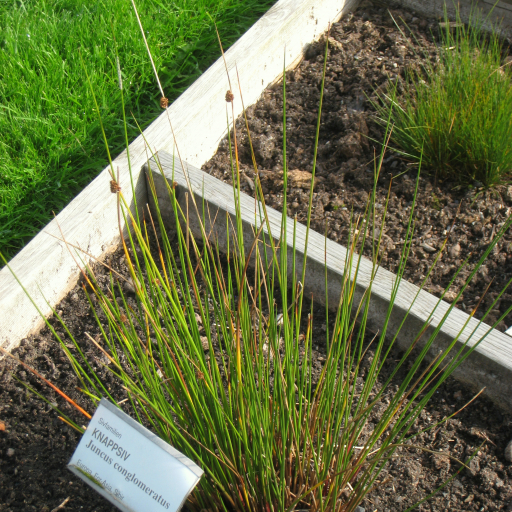
Plant Overview
Often called the Compact Rush, this architectural grass-like plant is a staple of wet meadows and soggy hillsides across Europe and North America. Its name comes from the dense, ball-like clusters of flowers that appear to burst from the side of its tall, ribbed stems. Historically, it was a humble hero of the household, used for everything from weaving sturdy floor mats to providing a cheap source of light in rural homes.
🔍 How to Identify
- 🌾 The Stem: Unlike many grasses, the stems are cylindrical, leafless, and have distinct longitudinal ridges or "stripes" that you can feel with your fingernail.
- 🧶 The Flower Cluster: Look for a very tight, rounded bundle of brownish flowers. Unlike its cousin, the Soft Rush, these flowers don't spread out; they stay in a "conglomerated" ball.
- 🕯️ The Pith: If you (carefully) split a stem lengthwise, you’ll find a solid, continuous white spongey center (pith), which was once prized for making candle wicks.
🏡 In Your Garden
- 💧 Wet Feet Welcome: This plant is a "hydrophile," meaning it loves water. It is the perfect candidate for the edge of a garden pond, a bog garden, or a "rain garden" where drainage is poor.
- 🧱 Soil & Control: It thrives in heavy clay and acidic soils where other plants might rot. However, be mindful that it spreads via rhizomes and seeds; it is a survivor that can quickly dominate a small water feature if not thinned out occasionally.
⚠️ Safety & Toxicity
- ✅ Status: Generally Non-Toxic.
- 🐾 Details: There are no known toxic effects for humans, cats, or dogs. While it isn't considered "edible" or tasty, it is safe to handle and grow around curious pets and children. In pastures, it is often ignored by livestock because the stems are quite tough and low in nutrients.
✨ Fun Fact
Before the widespread use of wax candles, poor households used this plant to make "rushlights." They would peel away the outer green skin of the stem to reveal the inner pith, soak it in leftover kitchen grease or animal fat, and light it—providing a cheap, flickering light for the evening!

Detailed Care Instructions
To successfully grow Juncus conglomeratus, also known as compact rush or jointed rush, you can follow these steps:
- Climate and soil requirements: Juncus conglomeratus thrives in wet soils, such as marshes, bogs, or alongside bodies of water. It prefers full sun but can tolerate partial shade. Ensure the planting site provides the necessary conditions for its growth.
- Propagation: Juncus conglomeratus can be propagated through seeds or by dividing clumps of existing plants. Seeds can be sown in spring, in a mixture of moist soil and sand, and kept consistently moist until germination occurs. Division can be done by separating clumps in early spring or late autumn.
- Soil preparation: Prepare the soil by removing any weeds, rocks, or debris from the planting area. Loosen the soil and ensure it is well-draining. Although it prefers wet conditions, it does not tolerate waterlogged soil.
- Planting: If using seeds, sow them at a depth of around 1/8 inch in the prepared soil, and then cover them lightly with soil or sand. If dividing clumps, plant them at the same depth at which they were previously growing.
- Watering: Keep the soil consistently moist, especially during the establishment period. Ensure the plants receive regular water but avoid waterlogging, which can cause root rot. However, make sure the soil doesn't dry out completely.
- Mulching: Apply a layer of organic mulch around the base of the plants to help retain moisture and suppress weed growth.
- Fertilization: Juncus conglomeratus does not require heavy fertilization. A light application of a balanced, slow-release fertilizer in early spring can help promote growth. Be cautious not to over-fertilize, as excessive nutrients can harm the plant.
- Maintenance: Remove any dead or decaying material regularly, ensuring healthy growth. Additionally, control weeds around the plants to prevent competition.
- Winter care: Juncus conglomeratus is hardy and can withstand colder temperatures. However, it is still beneficial to provide winter protection in harsh climates by mulching around the base of the plants to insulate the root system.
By following these steps, you can successfully grow Juncus conglomeratus and enjoy its attractive, grass-like appearance in your garden or wetland area.

Place in a bright room that is sun drenched almost all day. Or directly in a south-facing window.

Juncus conglomeratus is a plant that requires moist soil. To water it properly, you should ensure that the soil is consistently damp but not overly saturated. It is best to water the plant deeply and infrequently rather than shallowly and frequently. This will encourage the roots to grow deeper and develop a strong root system. Water the plant early in the morning or in the evening when the sun is less intense to avoid evaporating the water before it can be absorbed by the plant. Avoid watering the foliage as this can encourage fungal diseases. Use a watering can or hose with a controlled stream, and water at the base of the plant. If the plant is in a container, ensure that there is proper drainage to avoid waterlogged soil.
To fertilize the Juncus Conglomeratus plant, follow these instructions:
- Select a balanced, slow-release fertilizer with a ratio of NPK (nitrogen, phosphorus, potassium) such as 10-10-10 or 14-14-14.
- Apply the fertilizer in early spring, just as new growth emerges. This is the time when the plant is actively growing and will benefit most from the added nutrients.
- Dilute the fertilizer according to package instructions. Usually, a tablespoon or two of fertilizer per gallon of water is recommended.
- Water the plant thoroughly before applying the fertilizer. This ensures the soil is moist and helps prevent burning of the roots.
- Pour the diluted fertilizer solution directly onto the soil around the base of the Juncus Conglomeratus plant. Avoid getting the fertilizer on the foliage, as it may cause leaf burn.
- Repeat the fertilization process every 4-6 weeks during the growing season (spring to early fall). However, always follow the specific instructions provided with your chosen fertilizer.
- After application, water the plant again to help the fertilizer dissolve and distribute evenly in the soil.
- Avoid over-fertilizing, as excessive nutrients can damage the plant. Follow the recommended dosage and frequency, considering the specific needs of your Juncus Conglomeratus plant.
Remember to always read and follow the instructions on the fertilizer packaging, as different brands may have specific recommendations for application and dosage.
Juncus Conglomeratus is a plant that thrives well in soil that is well-draining and has medium moisture content. The soil should not be too acidic or too alkaline, with a pH range of 6.0 to 7.5 being optimal. It is recommended to use loamy soil that has a mixture of sand, silt, and clay. The addition of organic matter such as compost or peat moss can help improve drainage and nutrient retention in the soil. The plant also prefers a bright, sunny location with plenty of water, but it can tolerate some shade and drier soil conditions once established. Overall, it is important to provide the plant with the right soil environment to ensure proper growth and health.
Juncus conglomeratus is a perennial grass-like plant that can be propagated through various methods. Here's how you can propagate this plant:
- Seed Propagation: Collect mature seeds from the Juncus conglomeratus plant when they turn brown and start to fall off naturally. Sow the seeds in a moist, well-draining potting mix or directly in the garden soil in early spring or fall. Lightly cover the seeds with a thin layer of soil and keep them consistently moist. Germination may take several weeks.
- Division: Divide mature Juncus conglomeratus plants to create new ones. Dig up the plant in early spring or fall, being careful to not damage the root system. Gently separate the plant into smaller sections, ensuring each division has an adequate amount of roots and shoots. Replant the divisions in suitable growing conditions, keeping the soil consistently moist until they establish.
- Cuttings: Take 4-6 inch (10-15 cm) long stem cuttings from the healthy, established Juncus conglomeratus plants during late spring or early summer. Remove the lower leaves, leaving only a few at the top. Dip the cut end in rooting hormone powder or gel to promote root formation. Place the cuttings in a container filled with a well-draining potting mix or directly in a prepared garden bed. Keep the soil consistently moist and provide partial shade until roots develop.
- Rhizome Division: Juncus conglomeratus spreads through underground rhizomes. In early spring or fall, dig up the plant and carefully separate the rhizomes, ensuring each division has healthy shoots and roots attached. Replant the divisions in suitable conditions, ensuring the rhizomes are partially buried and the shoots are above the soil level. Keep the soil consistently moist until new growth appears.
No matter which method you choose, provide the propagated Juncus conglomeratus plants with suitable growing conditions such as moist or wet soil, full sun to partial shade, and regular watering. Some patience may be required as it may take a few months for the new plants to establish themselves.








