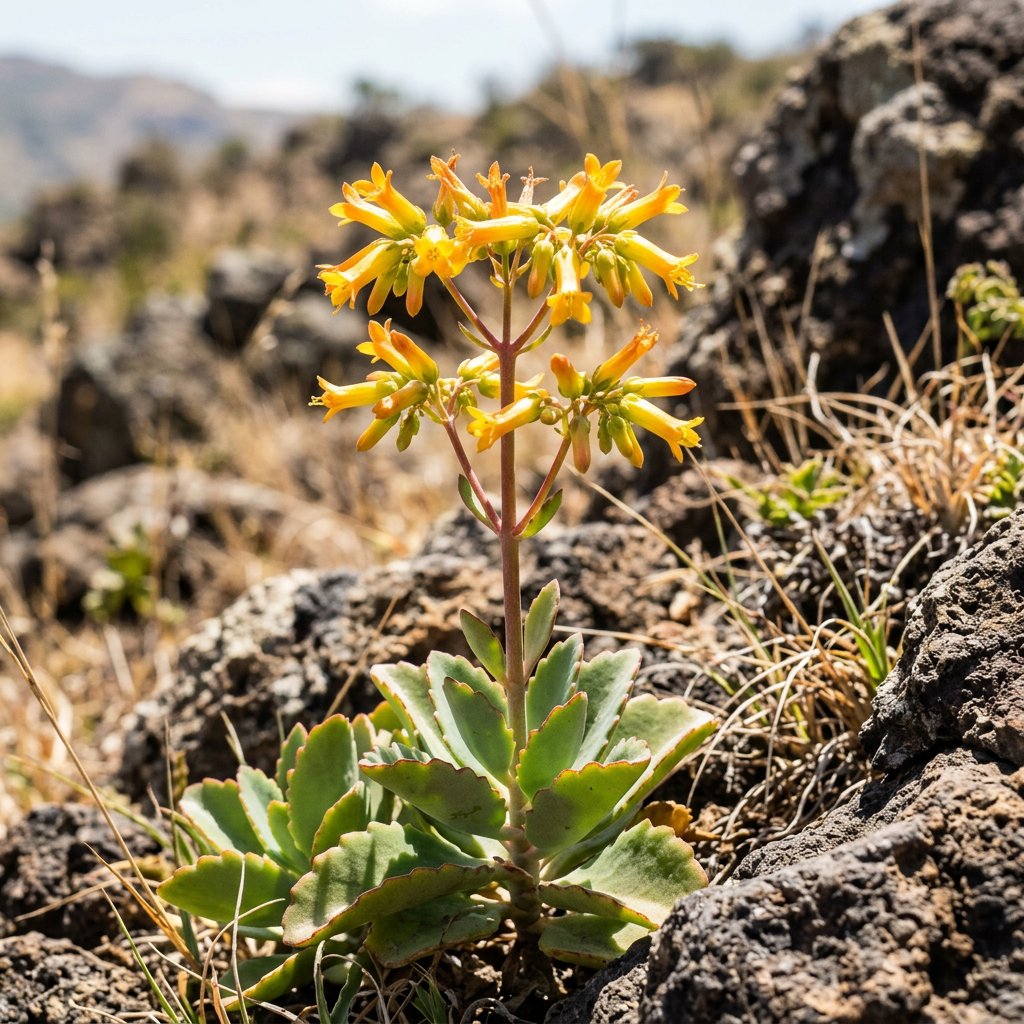
Plant Overview
Often called the "Never-Die Plant" due to its incredible resilience, Kalanchoe crenata is a sturdy succulent native to the warm landscapes of tropical Africa. Its scalloped, thick leaves earned it the species name "Crenata," and it has long been a staple in both traditional medicine and ornamental rock gardens. Whether perched on a sunny windowsill or tucked into a drought-resistant landscape, it brings a geometric, architectural beauty to any plant collection.
🔍 How to Identify
- 🍃 Scalloped Leaves: The most defining feature is the thick, fleshy, oval-shaped leaves that feature distinct rounded teeth (crenations) along the edges.
- 🌸 Tubular Blooms: It produces upright clusters of small, four-petaled flowers that typically range from vibrant orange and yellow to deep coral-red.
- 📏 Upright Stature: Unlike some trailing succulents, this variety grows vertically, often developing a woody base and reaching heights of up to three feet in its natural habitat.
🏡 In Your Garden
- 🪴 Drought Specialist: The "Never-Die" nickname is literal; this plant stores significant water reserves in its foliage, allowing it to survive for weeks without a drink, making it perfect for forgetful gardeners.
- ☀️ Light & Drainage: It craves bright, indirect light to keep its stems from stretching (becoming "leggy") and requires gritty, fast-draining soil to prevent its sensitive roots from sitting in water.
⚠️ Safety & Toxicity
- 🐾 Toxic to Pets: Kalanchoe crenata contains cardiac glycosides, specifically bufadienolides, which are dangerous if ingested.
- ⚠️ Risk Factors: Keep this plant out of reach of curious cats, dogs, and livestock. Ingestion can lead to vomiting, diarrhea, and in severe cases, abnormal heart rhythms.
✨ Fun Fact
In various West African cultures, this plant is used symbolically in traditional rituals to "cool" a situation or ward off bad luck, largely because of its ability to stay green and vibrant even during the harshest dry seasons.

Detailed Care Instructions
To grow Kalanchoe Crenata plant, follow these steps:
- Choose a healthy and disease-free Kalanchoe Crenata plant and a pot with good drainage holes.
- Fill the pot with well-draining potting soil. You can add some perlite or sand to improve the drainage if needed.
- Place the Kalanchoe Crenata plant in the pot, ensuring that the soil level is slightly below the rim of the pot.
- Water the plant thoroughly until water starts to drain out of the bottom. Allow the top inch of soil to dry out before watering again.
- Place the plant in a location with bright, indirect sunlight. Kalanchoe Crenata prefers around 4-6 hours of sunlight per day.
- Maintain a temperature of around 60-75°F (15-24°C) for optimal growth.
- Fertilize the plant with a balanced liquid fertilizer diluted to half strength once a month during the growing season (spring and summer).
- Trim off any dead or damaged leaves to encourage new growth and maintain the plant's shape.
- Kalanchoe Crenata is a succulent plant and can tolerate periods of drought. However, be careful not to overwater as it can lead to root rot. Watering once a week or when the soil is dry is usually sufficient.
- Propagate Kalanchoe Crenata by taking stem cuttings. Allow the cuttings to callus for a couple of days before sticking them into moist well-draining soil. Keep the soil moist until new root growth is observed.
With proper care and maintenance, your Kalanchoe Crenata plant should grow and thrive, producing beautiful clusters of pink flowers.

Place in a window with dappled sun or a spot in the middle of a room. Or directly in a window facing west or east.

To properly water this plant, make sure the soil is completely dry before watering again. Water thoroughly until water drains out of the bottom of the pot, then wait until the top inch of soil feels dry before repeating. Avoid getting water on the leaves as this can cause damage. Use filtered or distilled water if possible, as tap water can contain minerals that can be harmful to the plant.
To fertilize Kalanchoe Crenata, use a balanced fertilizer with equal amounts of nitrogen, phosphorus, and potassium. Apply the fertilizer once a month during the growing season, from spring to fall. Dilute the fertilizer to half strength and water the plant thoroughly before and after fertilizing. Be careful not to over-fertilize as this can damage the roots and cause the leaves to turn yellow.
For Kalanchoe Crenata, it is recommended to use a well-draining soil mix that consists of equal parts of sand, perlite, and peat moss. This will ensure that the plant is provided with adequate drainage while retaining enough moisture to support its growth. Additionally, the soil mix should be slightly acidic, with a pH range between 6.0 and 7.0. The plant prefers full sun to partial shade and it is recommended to apply a balanced liquid fertilizer every two weeks during the growing season. When repotting, choose a pot that is slightly larger than the root ball and ensure it has good drainage holes.
Propagation of this particular plant can be achieved through several methods. One way is by taking stem cuttings, which should be about 3-4 inches in length. After allowing the cuttings to callus for about a week, they can be planted in well-draining soil and kept in a warm, bright location. Another option for propagation is through leaf cuttings, where individual leaves are removed from the plant and laid flat on top of slightly moist soil. The leaf should start forming roots and a new baby plant within a few weeks. It is also possible to propagate this plant through seeds, which can be sown in moist soil and kept in a warm location until they germinate. Regardless of the method chosen, it is important to keep the newly propagated plants moist and in a location with bright but indirect light until they are well established.
Common pests of the neverdie include Scale insect, mealybugs, aphids, thrips. Make a habit of checking your neverdie frequently for pests so that any infestations can be caught and managed early.








