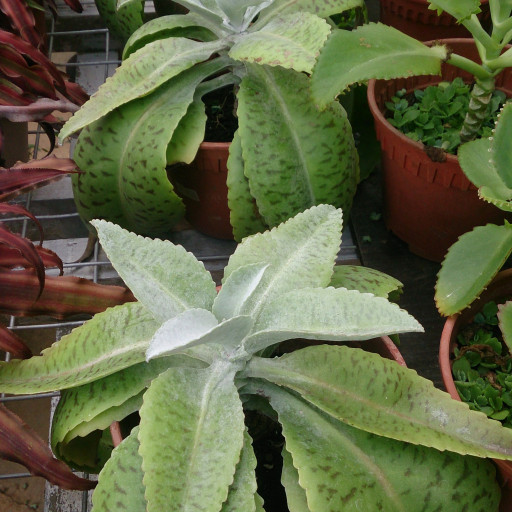
Plant Overview
Often called Donkey Ears for its long, velvety, and spotted foliage, this Madagascan succulent is a true architectural marvel. It is famous for being "viviparous," meaning it grows miniature clone babies right on the tips of its leaves, which eventually drop off to start new lives. Whether hanging from a basket or sitting on a sunny windowsill, it brings a prehistoric, whimsical vibe to any plant collection.
🔍 How to Identify
- 🍃 The Foliage: Large, lance-shaped leaves that can grow up to 12 inches long. They are a dusty silver-green, heavily mottled with dramatic maroon or purple splotches.
- 👶 The "Babies": Look closely at the tips of the mature leaves; you will often see tiny, fully-formed plantlets (complete with their own roots) dangling like charms.
- 🌸 The Blooms: When it matures, it sends up a tall stalk topped with clusters of pendulous, bell-shaped flowers that transition from pale green to a deep salmon-red.
- ❄️ The Coating: The leaves are covered in a fine, waxy white powder called "farina," which acts as a natural sunscreen and gives the plant its ghostly, matte finish.
🏡 In Your Garden
- ☀️ Light and Color: To keep those iconic purple spots vivid, provide plenty of bright, indirect light. In low-light settings, the plant will lose its markings and become "leggy" as it stretches for the sun.
- 🪴 The Life Cycle: Be aware that this species is monocarpic. This means the mother plant will put all its energy into one spectacular flowering event and then slowly fade away. Don't worry, though—the dozens of plantlets it leaves behind will ensure your garden stays full!
- 💧 Drainage is Key: Because it has shallow roots adapted for rocky Madagascar terrain, it hates "wet feet." Use a gritty cactus mix to prevent the base from rotting during the winter months.
⚠️ Safety & Toxicity
- 🐾 Status: Toxic to Pets and Humans.
- 🚫 Details: Like many members of the Kalanchoe family, Donkey Ears contains cardiac glycosides. If ingested by cats or dogs, it can cause drooling, vomiting, or, in rare cases, heart rhythm abnormalities. Keep it on a high shelf away from curious nibblers.
✨ Fun Fact
The plant is named after the French botanist Gaston Bonnier, but its "Donkey Ears" nickname is so fitting that in some regions, it is also called "Life Plant" because of its incredible ability to reproduce a whole new generation from just a single leaf tip!

Detailed Care Instructions
| Soil Ph | Acidic |
| Humidity | Dry |
| Lighting | Full Sun |
| Toxicity | Poisonous |
| Soil Type | Well-Drained |
| Bloom Time | Spring, Summer, Fall, Winter |
| Difficulty | Easy |
| Plant Type | Succulent |
| Mature Size | Up To 36″ Tall |
| Native Area | Africa |
| Temperature | 18°C - 24°C |
| Sun Exposure | Full Sun, Partial Shade |
| Hardiness Zones | 10-12 |
To grow Kalanchoe gastonis-bonnieri plant, also known as the Donkey Ear plant, follow these steps:
- Choose a well-draining pot or container: Kalanchoe gastonis-bonnieri prefers a well-draining soil mixture. Use a pot with drainage holes to prevent waterlogging.
- Soil mixture: Create a soil mixture by combining equal parts of potting soil, sand, and perlite. This mixture allows for proper drainage and aeration. Avoid soil that retains too much moisture.
- Planting: Gently remove the plant from its nursery pot and loosen the root ball. Place the plant in the new pot, ensuring that it sits at the same depth as it was in the previous pot. Fill the remaining space with the prepared soil mixture, lightly pressing it down.
- Light requirements: Kalanchoe gastonis-bonnieri prefers bright, indirect sunlight. Place it near a window with filtered light, or semi-shade it in a well-lit area. Avoid intense, direct sunlight, as it can scorch the leaves.
- Watering: Water the plant sparingly, allowing the soil to dry out between each watering. Overwatering can lead to root rot. Before watering, check the top inch of soil with your finger – if it feels dry, it's time to water. Always water slowly and deeply, ensuring the water reaches the root level.
- Temperature and humidity: The Donkey Ear plant thrives in warm temperatures between 60-75°F (15-24°C). It does well in average indoor humidity, but it appreciates a slight increase in humidity during dry seasons. Placing a tray filled with water near the plant or using a humidifier can help increase humidity levels.
- Fertilization: During the active growing season, which typically occurs in spring and summer, you can use a balanced liquid fertilizer every two weeks. Follow the package instructions to avoid over-fertilization.
- Pruning and propagation: Trim any leggy or unhealthy growth to maintain a compact shape. The cuttings from pruning can be used for propagation. Allow the cuttings to dry for a day or two before planting them in well-draining soil.
By following these guidelines, you should be able to successfully grow and care for your Kalanchoe gastonis-bonnieri plant.

Place in a bright room that is sun drenched almost all day. Or directly in a south-facing window.

To water this particular plant, it is recommended to thoroughly soak the soil until water begins to drain out from the drainage holes at the bottom of the pot. It is important to allow the soil to dry out slightly between waterings, as overwatering can lead to root rot and other issues. It is also important to avoid getting water on the leaves and flowers of the plant, as this can cause damage or disease. Watering should be done at the base of the plant, rather than from overhead. Additionally, if the plant is kept indoors, it is important to ensure adequate humidity levels in the surrounding air to prevent the plant from drying out.
To fertilize this plant, use a balanced fertilizer with equal proportions of nitrogen, phosphorus, and potassium. Dilute the fertilizer to half strength and apply it once a month during the growing season. Be sure to water the plant before and after fertilizing to avoid any potential fertilizer burn. Avoid overfeeding as excessive fertilizer may harm the plant.
Kalanchoe Gastonis-bonnieri plant requires a well-draining soil that does not retain water or become waterlogged. The soil should be a mixture of sand, perlite, and peat moss with a slight acidity level. It should be able to allow air to pass through it, which will prevent the soil from becoming compact. A good quality, nutrient-rich potting mix with a pH balance of 6.0 to 6.5 is best suited for this plant. It is important to ensure that the soil is not too heavy, as this can lead to root rot and other problems. Moreover, the plant should be provided with soil that has good drainage capacity to prevent the occurrence of soggy roots.
To propagate this plant, you will need to take stem cuttings. First, prepare a small pot with well-draining soil. Then, locate a healthy stem from the plant and cut it cleanly with sharp scissors or pruners. It is important to make sure the stem is at least 2-3 inches long and has several sets of leaves.
Once you have your stem cutting, remove the lower leaves, leaving only the top few sets. Dip the cut end of the stem into rooting hormone, if desired, and then plant it in the soil until it is secure and upright. Water the cutting well and place it in a bright area, but out of direct sunlight.
Over the next few weeks, the cutting should begin to form roots and new growth. You can check for root growth by gently tugging on the cutting - if it resists, roots are growing! Once the cutting has established roots, you can move it to a larger pot or into the garden.
Common pests of the donkey ears include Scale insect, mealybugs, aphids, thrips. Make a habit of checking your donkey ears frequently for pests so that any infestations can be caught and managed early.








