Plant Overview
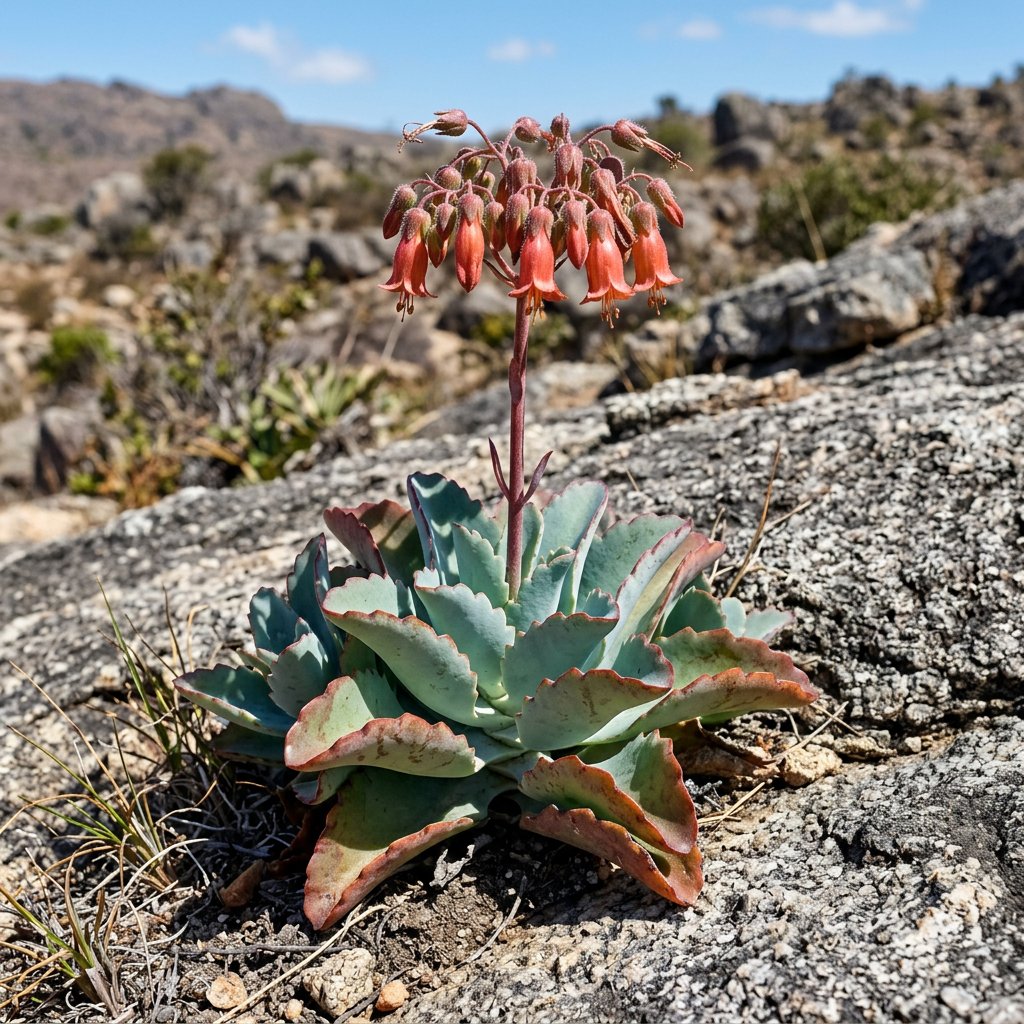
Often called the Milky Widow's Thrill, this elegant succulent hails from the rocky slopes of Madagascar. It is a favorite among collectors for its dreamy, blue-green foliage and its tendency to produce clusters of nodding, bell-shaped flowers that look like tiny lanterns. It bridges the gap between a rugged survivor and a delicate ornamental piece.
🔍 How to Identify
- 🍃 The Leaves: Features fleshy, elliptical leaves with a distinct "crenated" or scalloped edge. The color is a soft glaucous green, often appearing dusty or milky due to a protective waxy coating.
- 🎨 The Margins: Under bright sunlight, the edges of the leaves often blush with a deep red or purple tint, highlighting the unique jagged silhouette of the plant.
- 🔔 The Blooms: It produces tall flower stalks topped with drooping, tubular flowers. These bells are usually a dusty orange, salmon, or red, hanging gracefully in clusters.
🏡 In Your Garden
- ☀️ Light Seeking: While it loves bright light, this Kalanchoe is prone to "stretching" (etiolation) if kept in a dark corner. To keep its stems sturdy and its leaf colors vibrant, place it on a sunny windowsill where it can soak up the morning rays.
- 💧 The "Soak and Dry" Method: Like many Madagascan succulents, it stores water in its leaves. It is highly susceptible to root rot, so it's vital to let the soil dry out completely before watering again. It prefers a gritty, cactus-leaning soil mix that doesn't hold onto moisture.
- ✂️ Pruning for Shape: Over time, Kalanchoe laxiflora can become top-heavy or "leggy." Don't be afraid to behead the plant; it responds well to pruning, and the cuttings can easily be rooted to start a whole new family.
⚠️ Safety & Toxicity
- 🐾 Toxic to Pets: Like most members of the Kalanchoe genus, this plant contains bufadienolide cardiac glycosides. If ingested by cats or dogs, it can cause vomiting, diarrhea, and in rare cases, abnormal heart rhythms.
- 👶 Keep Out of Reach: While generally safe to touch, the sap can occasionally cause mild skin irritation in sensitive individuals. It is best kept on high shelves away from curious toddlers and nibbling pets.
✨ Fun Fact
Kalanchoe laxiflora is a master of "vivipary"—a survival strategy where tiny miniature plantlets (bulbils) sometimes form along the notches of its leaves or flower stalks. These tiny clones eventually drop off, take root in the soil below, and begin growing independently!

Detailed Care Instructions
| Humidity | Normal |
| Lighting | Part Sun |
| Toxicity | Poisonous |
| Difficulty | Easy |
| Temperature | 18°C - 30°C |
| Hardiness Zones | Min 9A |
Here are some steps to help you grow Kalanchoe Laxiflora plant:
- Choose a suitable location: Kalanchoe Laxiflora prefers bright but indirect sunlight. Place it near a window where it receives a few hours of morning or evening sun.
- Prepare the soil: Use a well-draining soil mix for succulent plants. You can mix equal parts of potting soil, sand, and perlite to create a well-draining medium.
- Select a pot: Choose a well-draining pot that has drainage holes at the bottom. This ensures excess water can easily drain out.
- Watering: Allow the top inch of soil to dry out between watering sessions. Over-watering can lead to root rot, so it's better to underwater than overwater. Aim for a slightly drier soil.
- Fertilization: Use a balanced liquid fertilizer once a month during the growing season (spring and summer). Follow the instructions on the fertilizer packaging for proper dosage.
- Propagation: Kalanchoe Laxiflora can be propagated through stem cuttings. Take a healthy stem cutting, let it dry for a few days to form calluses, and then plant it in moist soil. Keep the soil slightly moist during the initial rooting stage.
- Pruning: Prune any dead or wilted leaves or stems to maintain the plant's health and appearance.
- Pest control: Keep an eye out for common succulent pests like mealybugs or spider mites. If you spot any pests, treat them with insecticidal soap or a natural remedy like neem oil.
Remember that Kalanchoe Laxiflora is a hardy plant, so it can tolerate some neglect. However, it's essential to provide the right conditions for optimal growth and health.

Place in a window with dappled sun or a spot in the middle of a room. Or directly in a window facing west or east.

To water this plant, it is important to check the soil moisture level first. Stick your finger about an inch into the soil and if it feels dry, then it is time to water. Use room temperature water and pour it gently onto the soil until water begins to drain out of the bottom of the pot. Do not allow the plant to sit in standing water as it can lead to root rot. Watering frequency will depend on environmental factors such as temperature, humidity, and air flow, but typically this plant needs to be watered once a week. It is important to also fertilize the plant regularly with a balanced fertilizer to encourage healthy growth.
To fertilize this plant, mix a well-balanced fertilizer solution at half strength and apply it to the soil every 2-3 weeks during the growing season. Do not fertilize during the dormant season. Water the plant thoroughly after fertilizing to ensure the nutrients are absorbed properly. Be sure to follow the manufacturer's instructions for the fertilizer you are using.
The preferred soil type for the Kalanchoe Laxiflora plant is a well-draining soil mixture that is nutrient-rich and slightly acidic. The pH level should be between 6.0 and 7.0. The soil should be moist but not soggy, as too much water can lead to root rot. Adding perlite or sand to the soil mixture can help improve drainage. Additionally, adding organic matter such as compost or peat moss can help improve soil fertility. It is important to choose a pot with drainage holes and use a saucer to catch excess water.
To propagate this plant, you can take stem cuttings from the mother plant. Select a healthy stem that is around 3-4 inches long and has no flowers or buds. Cut the stem with sharp scissors or pruning shears and leave a small portion of the stem attached to the parent plant. Remove the lower leaves from the cutting, leaving only a few leaves on the top. Dip the cut end of the stem in rooting hormone powder and gently tap to remove the excess powder. Plant the stem in a well-draining potting mix and water lightly. Place the pot in a bright location with indirect sunlight and maintain a temperature of around 65-75°F. Keep the soil moist, but not overly wet, and mist the cutting daily to provide some humidity. Within a few weeks, roots should start forming, and new growth will emerge from the top. Once the plant has developed a well-established root system, you can transplant it to a larger pot or into the garden.
Common pests of the milky widow's thrill include Scale insect, mealybugs, aphids, thrips. Make a habit of checking your milky widow's thrill frequently for pests so that any infestations can be caught and managed early.








