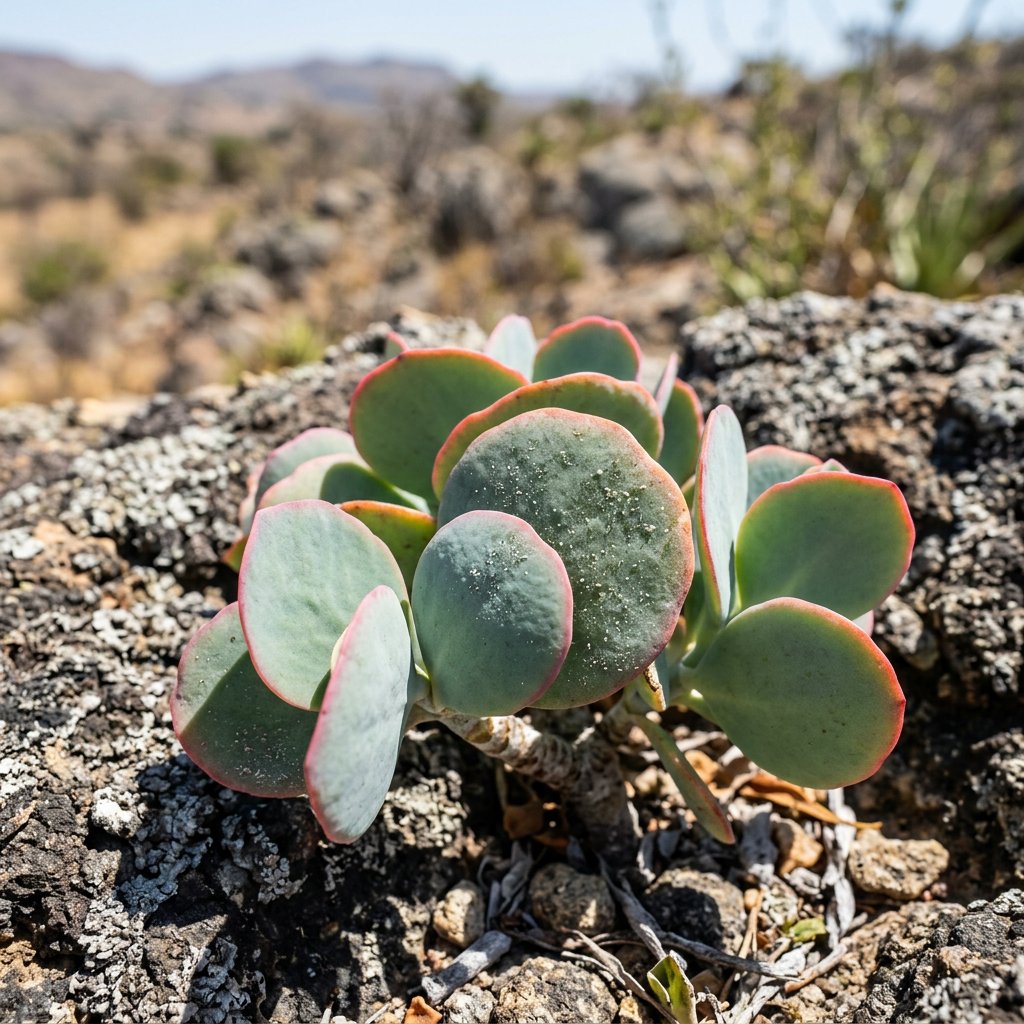
Plant Overview
Often called "Marnier’s Kalanchoe," this Madagascar native looks like a collection of sea-smoothed pebbles stacked neatly along a stem. It is a slow-growing succulent beloved by collectors for its architectural "book-leaf" structure and its ability to blush deep coral when basking in the sun. In the winter, it surprises gardeners by transforming from a quiet green sculpture into a vibrant display of dangling, bell-like flowers.
🔍 How to Identify
- 🍃 Paddle Leaves: Features flat, rounded, blue-green leaves that grow in opposite pairs, looking like they are "clamping" onto the stem.
- 🎨 Dusty Coating: The leaves are covered in a fine, waxy powder called "epicuticular wax" that gives them a soft, matte, glaucous appearance.
- 🔔 Pendulous Blooms: Produces tall flower stalks that transition into clusters of hanging, tubular flowers in shades of orange, pink, or red.
🏡 In Your Garden
- ☀️ The Sun Blusher: This plant acts like a mood ring; while it survives in partial shade, the iconic pink and purple leaf margins only appear when the plant is "stressed" by bright sunlight.
- 🪴 Drainage is King: Because it is adapted to rocky cliffs in Madagascar, it has a very shallow root system. It prefers terracotta pots and gritty soil to prevent the roots from suffocating in moisture.
- ✂️ Easy Multiplication: It is incredibly easy to propagate. A single leaf tucked into the soil or a stem cutting will quickly sprout new roots, making it a favorite for sharing with friends.
⚠️ Safety & Toxicity
- 🐾 Toxic to Pets: This plant contains bufadienolides, which are cardiac glycosides. If ingested by cats or dogs, it can cause vomiting, diarrhea, and in rare cases, abnormal heart rhythms.
- 👶 Keep Out of Reach: While beautiful, it should be kept on high shelves away from curious children, as the leaves can cause gastric distress if eaten.
✨ Fun Fact
🍹 The Liqueur Connection: The plant was named in honor of Julien Marnier-Lapostolle, a famous French botanist who was also the director of the company that produces the world-famous Grand Marnier liqueur!

Detailed Care Instructions
| Soil Ph | Acidic |
| Humidity | Dry |
| Lighting | Full Sun |
| Toxicity | Poisonous |
| Soil Type | Well-Drained |
| Bloom Time | Spring, Summer, Fall, Winter |
| Difficulty | Easy |
| Plant Type | Succulent |
| Native Area | Africa |
| Temperature | 18°C - 24°C |
| Sun Exposure | Full Sun, Partial Shade |
| Hardiness Zones | 10-12 |
To grow Kalanchoe marnieriana (also known as the Mexican hat plant or mother of thousands), follow these steps:
- Start with a healthy Kalanchoe marnieriana plant or obtain cuttings or offsets from an established plant.
- Choose a suitable pot or container with drainage holes to ensure proper drainage.
- Use well-draining soil with a mixture of potting soil and perlite or sand. This will prevent waterlogged soil and root rot.
- Place the plant in a bright location with indirect sunlight. Kalanchoe marnieriana prefers partial shade or filtered light rather than intense sunlight.
- Water the plant thoroughly, allowing the soil to dry out between waterings. Overwatering can lead to root rot, so make sure the topsoil is dry before watering again. In the winter months, reduce the frequency of watering as the plant goes into a dormant phase.
- Fertilize the plant every two to four weeks during the growing season (spring and summer) with a balanced fertilizer diluted to half strength.
- Kalanchoe marnieriana is a succulent plant and can tolerate dry conditions. However, if you notice the leaves becoming shriveled or the plant starts to wilt, it may need more water.
- Propagation can be done by taking stem or leaf cuttings. Allow the cuttings to dry and form calluses before planting them in a well-draining soil mix. Keep the soil lightly moist until the cuttings root and establish themselves.
- Prune the plant regularly to maintain its shape and to prevent overcrowding. Kalanchoe marnieriana can become leggy over time, so trim back any long, spindly stems to encourage bushier growth.
- Avoid exposure to frost or extremely low temperatures, as this may damage the plant. Keep the plant indoors during colder months if necessary.
With proper care and maintenance, your Kalanchoe marnieriana plant should thrive and grow well.

Place in a bright room that is sun drenched almost all day. Or directly in a south-facing window.

To take care of this plant's water needs, you should allow the soil to dry out between waterings. Check the moisture level by feeling the surface of the soil with your finger. When the top one to two inches feel dry to the touch, it's time to water. When watering, do so slowly and thoroughly, allowing the water to soak into the soil. Avoid getting water on the leaves or stem as this may cause damage or encourage fungal growth. Use room temperature water that has been sitting out for a few hours to avoid shocking the plant with cold water. In general, this plant prefers well-draining soil and can tolerate brief periods of drought, but overwatering can quickly lead to root rot.
To fertilize this plant, use a balanced fertilizer with an N-P-K ratio of 10-10-10. Apply the fertilizer once a month during the growing season, which is in the spring and summer. Dilute the fertilizer to half strength and apply it directly to the soil around the plant. Avoid getting the fertilizer on the foliage or stem of the plant. Water the plant thoroughly after fertilizing.
The ideal soil for this plant is a well-draining mixture of organic and inorganic materials. It should be a sandy or loamy soil with a pH level between 6.0 and 7.0. The soil should be enriched with perlite or coarse sand to improve aeration and drainage. The plant prefers soil that is slightly moist but not waterlogged, so it's important to not overwater. Adding fertilizer every 3-4 weeks during the growing season can help keep the plant healthy and encourage new growth.
To propagate this plant, you can take stem cuttings from the parent plant. Use a clean, sharp pair of scissors or pruners to cut a healthy stem from the plant, making sure to include several sets of leaves. Remove the lower leaves from the stem, leaving a few sets of leaves at the top.
Dip the end of the cutting into rooting hormone powder and gently tap off any excess. Place the cutting in a container filled with well-draining soil, water lightly, and cover the container with a clear plastic bag to create a humid environment.
Place the container in a bright, indirect location and keep the soil moist but not waterlogged. After a few weeks, the cutting should develop roots and can be transplanted into a larger pot or outdoor garden.
Common pests of the marnier's kalanchoe include Scale insect, mealybugs, aphids, thrips. Make a habit of checking your marnier's kalanchoe frequently for pests so that any infestations can be caught and managed early.








