Plant Overview
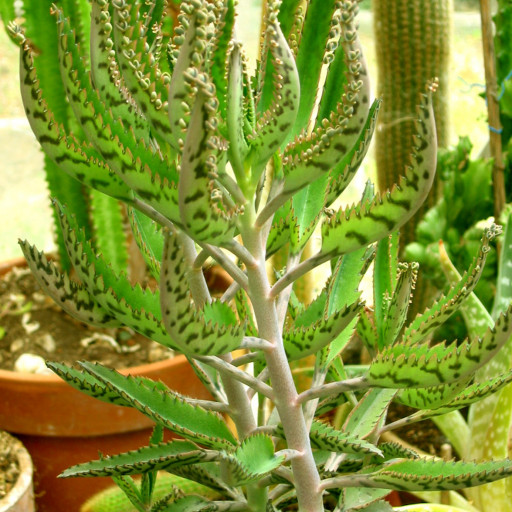
Known commonly as the Mother of Thousands or Hybrid Mother of Millions, Kalanchoe x houghtonii is a striking architectural succulent that seems to defy the laws of nature by "birthing" clones along its leaves. This hybrid—a cross between two Madagascan species—is often called the "Alligator Plant" due to its serrated, tooth-like leaf edges. It is a favorite for beginners because of its nearly indestructible nature, though its enthusiasm for growth can sometimes make it a bit of a garden takeover artist.
🔍 How to Identify
- 🍃 V-Shaped Leaves: The leaves are narrow, boat-shaped (folded upward), and feature dark, mottled purple spots on the underside.
- 👶 Adventitious Plantlets: Tiny, miniature versions of the parent plant grow in the "notches" along the leaf margins, eventually falling off to root instantly wherever they land.
- 🦒 Upright Stature: It grows on a single, sturdy central stem that can reach up to three feet tall, giving it a prehistoric, sculptural appearance.
🏡 In Your Garden
- 🏜️ Drought Specialist: This plant stores water in its fleshy foliage, making it perfect for those who occasionally forget to water. It thrives on "neglect" and requires gritty, well-draining soil to prevent its only real weakness: root rot.
- 🚀 The Escape Artist: Because the plantlets drop and root with zero effort, this species can quickly colonize neighboring pots. If you are growing it outdoors in a frost-free climate, it is best kept in a dedicated container to prevent it from out-competing your other garden plants.
⚠️ Safety & Toxicity
- 🚫 Toxic Status: Toxic. All parts of the plant contain naturally occurring poisons that affect the heart.
- 🐾 Pet & Child Alert: It contains cardiac glycosides (bufadienolides) which can cause drooling, vomiting, or dangerous heart rhythm changes in cats, dogs, and livestock. It should be kept on high shelves or in areas inaccessible to curious nibblers.
✨ Fun Fact
Even though it produces beautiful clusters of drooping, bell-shaped orange flowers in the winter, the plant rarely relies on them to survive. It is so efficient at cloning itself that a single leaf can produce dozens of genetically identical "babies" in a single season, essentially making the plant immortal!

Detailed Care Instructions
To grow Kalanchoe x houghtonii (also known as Mother of Thousands), follow these steps:
- Choose a suitable location: Kalanchoe x houghtonii can be grown both indoors and outdoors. If growing indoors, find a spot with bright, indirect sunlight. If growing outdoors, ensure a warm and dry climate.
- Select the right container: Use a well-draining pot or container with drainage holes to prevent waterlogging. Ensure it is large enough to accommodate the plant and allow for growth.
- Prepare the soil: Use a well-draining soil mix, preferably a succulent or cactus mix. These offer good drainage and air circulation for the roots. You can also add perlite or sand to improve drainage further.
- Planting: Gently remove the Kalanchoe x houghtonii from its nursery pot and loosen the roots slightly. Place it in the prepared pot, ensuring the top of the root ball is level with the soil surface. Add more soil around the sides, gently firming it in place.
- Watering: Water the plant moderately, allowing the soil to dry out between waterings. Overwatering can lead to root rot. Test the soil moisture by sticking your finger about 1 inch into the soil – if it feels dry at that depth, it's time to water.
- Fertilizing: Use a balanced, water-soluble fertilizer specifically formulated for succulents or cacti. Apply it according to the package instructions, usually once a month during the growing season (spring and summer).
- Pruning: Kalanchoe x houghtonii can become leggy over time. To encourage bushier growth, pinch back the stems regularly, which will promote new, compact growth.
- Propagation: One interesting characteristic of this plant is its ability to produce small, baby plants along the edges of its leaves. Gently detach these plantlets and place them in a separate container with well-draining soil to propagate new plants.
- Temperature and humidity: Kalanchoe x houghtonii prefers temperatures between 60-75°F (15-24°C) during the day and slightly cooler temperatures at night. It is tolerant to dry conditions but appreciates moderate humidity.
- Pest control: Inspect your plant periodically for pests such as mealybugs or aphids. If you notice any, wipe them off with a cotton swab dipped in rubbing alcohol or use an appropriate insecticidal soap.
By following these steps, you can successfully grow and care for your Kalanchoe x houghtonii plant.

Place in a window with dappled sun or a spot in the middle of a room. Or directly in a window facing west or east.

To water Kalanchoe X Houghtonii, first check the soil moisture level by inserting your finger about an inch into the soil. If the soil feels dry, it is time to water. Use a watering can or a hose with a gentle stream of water to moisten the soil thoroughly, being careful not to overwater and cause root rot.
Allow excess water to drain out of the bottom of the pot and remove any standing water in the saucer. Repeat watering when the soil feels dry to the touch. It is important to provide adequate drainage to prevent waterlogging.
During the growing season, which is typically spring and summer, the plant may require more frequent watering as it actively grows. In the winter months, reduce watering and allow the soil to dry out slightly between watering.
It is also recommended to avoid getting water on the leaves as this can lead to rot or fungal issues. Water the soil directly at the base of the plant instead.
For optimal growth and health of the plant, fertilize it every two weeks during the growing season with a balanced, water-soluble fertilizer. Dilute the fertilizer to half strength to avoid burning the plant's roots. Apply the fertilizer directly to the soil and not the leaves to avoid any damage to the plant. During the dormant season, reduce the frequency of fertilization to once a month. Avoid over-fertilizing the plant as it can lead to leaf drop and stunted growth.
The ideal soil composition for the plant should be well-draining, slightly acidic, and nutrient-rich. The soil should contain a mixture of organic matter, like peat moss or compost, and inorganic materials, like perlite or coarse sand, to allow for good water drainage. The pH level of the soil should ideally be between 6.0 and 7.0. Avoid using heavy soils that tend to retain water, as this can cause root rot and other issues. Additionally, it is important to ensure that the soil is not compacted and has a loose consistency, allowing air flow and root growth.
To propagate this plant, one should take stem-cuttings of about 3-4 inches in length with a sterilized pair of pruning shears or scissors. The cuttings should be taken from the base of the plant where there are strong and healthy stems. The lower leaves should be removed from the cutting, leaving only the top few leaves. Then, the cut end of the stem should be left to dry and callus over for a few days.
After the cuttings have callused over, they should be planted in well-draining soil, such as cactus mix, and placed in bright, indirect sunlight. The soil should be kept consistently moist, but not soggy or waterlogged, as this can cause the cutting to rot. Covering the pot or container with a plastic bag can help to create a humid environment and encourage healthy growth. After a few weeks, the cutting should take root and new growth should appear.
It is important to keep the plant out of direct sunlight and to avoid overwatering, as this can cause the cutting to dry out or rot. The new plant can be gradually acclimatized to more intense sunlight and a less humid environment before transplanting to a larger pot or outdoor location.
Common pests of the alligator plant include Scale insect, mealybugs, aphids, thrips. Make a habit of checking your alligator plant frequently for pests so that any infestations can be caught and managed early.







