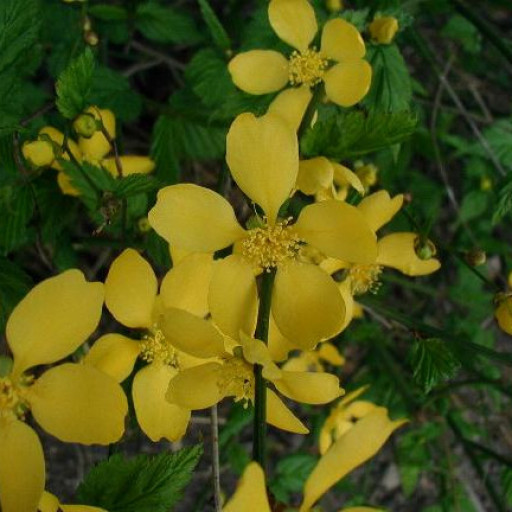
Plant Overview
Often called the "Japanese Rose" or "Easter Rose," Kerria japonica is a spring-blooming gem that brings a burst of sunshine to the shadiest corners of your garden. Unlike most members of the rose family, this hardy shrub thrives in the shadows, offering bright golden blooms when most other plants are still waking up. It is beloved by gardeners for its graceful, arching habit and its ability to stay vibrant even in the dead of winter.
🔍 How to Identify
- 🌿 Winter Greenery: It is easily recognized by its slender, "zig-zag" stems that remain a vivid, pea-green color all year long, providing architectural interest in a snowy landscape.
- 🌼 Golden Blooms: It features bright yellow flowers that appear in mid-to-late spring. Depending on the variety, these can be simple five-petaled stars or dense, pom-pom-like "double" flowers.
- 🍃 Sawtooth Leaves: The leaves are bright green, heart-shaped at the base, and have a distinctively "doubly-serrated" (toothed) edge with a textured, pleated surface.
🏡 In Your Garden
- 🌥️ The Shade Solution: While most flowering shrubs crave the sun, Kerria is a rare beauty that prefers partial to full shade. In fact, too much direct afternoon sun can actually bleach the golden flowers to a pale, washed-out cream color.
- ✂️ Post-Bloom Grooming: This shrub blooms on "old wood" (last year’s growth). To keep it tidy and ensure a heavy bloom next year, you should prune it immediately after the flowers fade in late spring.
- 🏃 Spreading Nature: It grows via underground runners (suckers). If you have a small space, keep an eye on new shoots popping up a few feet away from the main plant—they are easy to dig up and gift to a neighbor!
⚠️ Safety & Toxicity
- ✅ Status: Generally non-toxic and safe.
- 🐾 Details: Kerria is considered safe for households with cats, dogs, and children. It does not have the sharp thorns associated with traditional roses, making it a much "friendlier" shrub for high-traffic walkways or play areas.
✨ Fun Fact
- The double-flowered variety, Kerria japonica 'Pleniflora', was so popular in the Victorian era that it was often nicknamed the "Bachelor’s Buttons" or the "Globe Flower." It was a staple in English cottage gardens long before it became a mainstay in modern landscaping.

Detailed Care Instructions
To grow Kerria Japonica, also known as Japanese rose, follow these steps:
- Choose a suitable location: Kerria Japonica prefers partial shade to full sun but can tolerate a wide range of conditions. Ensure the soil is well-draining and fertile.
- Planting: Dig a hole slightly larger than the root ball of the plant. Place the Kerria Japonica in the hole, ensuring the top of the root ball is level with or slightly above the soil surface. Backfill the hole with soil and gently firm it around the plant.
- Watering: After planting, water the plant thoroughly to settle the soil. Water regularly, especially during dry spells, to keep the soil consistently moist but not waterlogged. Mulching around the base of the plant can help retain moisture.
- Fertilizing: Apply a balanced, slow-release fertilizer in early spring. Follow the package instructions for application rates. Avoid over-fertilizing as it can lead to weak growth.
- Pruning: Prune Kerria Japonica after it blooms. Remove any dead, damaged, or crossing branches to maintain a healthy and attractive shape. Pruning can also encourage more flowers.
- Propagation: Kerria Japonica can be propagated through softwood cuttings taken in late spring or semi-hardwood cuttings in late summer. Dip the cut end in rooting hormone and plant in a well-draining soil mix. Keep the cuttings consistently moist and provide them with bright, indirect light until they develop roots.
- Pests and Diseases: Kerria Japonica is generally resistant to pests and diseases. However, it can occasionally be susceptible to aphids, scale insects, or powdery mildew. Monitor the plant regularly, and if necessary, treat with insecticidal soap or horticultural oil for pests, or a fungicide for powdery mildew.
Remember to adjust the care and maintenance based on your specific growing conditions and climate. Regular monitoring, watering, and care will help your Kerria Japonica plant thrive and grow into a beautiful shrub.

Place in a window with dappled sun or a spot in the middle of a room. Or directly in a window facing west or east.

Kerria Japonica plant can be watered once the top layer of soil becomes dry to touch. It is essential to avoid overwatering, as it can lead to root rot. When watering, ensure that water reaches all areas of the soil, including the rootzone. One can water the plant using a watering can or a hose, but it's crucial not to let water accumulate on the leaves. Additionally, watering in the morning is advisable as it allows the plant to dry off before the cooler evening temperatures set in, which can prevent diseases. It is also essential to choose well-draining soil to avoid waterlogging and provide adequate drainage in the pot to allow excess water to drain out.
To fertilize this plant, it is recommended to use a balanced fertilizer with equal amounts of nitrogen, phosphorus, and potassium. Apply the fertilizer in early spring, before the plant begins to actively grow. Use a granular fertilizer and scatter it evenly around the base of the plant, being careful not to get any on the leaves or stems. Water the plant thoroughly after fertilizing. Repeat this process every 4-6 weeks during the growing season. Avoid over-fertilizing, as this can cause damage to the plant.
Kerria japonica requires a well-draining and nutritious soil that is slightly acidic in nature. The ideal soil mixture for this plant should consist of a blend of organic matter, such as compost or peat moss, and inorganic materials, such as sand or perlite. The soil should be rich in nutrients, particularly nitrogen and phosphorus, and should have a pH level between 5.5 and 6.5. It is also important to ensure that the soil is not compacted, as this can lead to poor drainage and root rot. Additionally, supplemental fertilization may be necessary to maintain healthy growth and blooms.
To propagate this plant, one can take softwood cuttings in late spring or early summer. Cuttings should be about 4-6 inches long and should include at least one node. Remove any leaves at the bottom of the cutting, leaving only the top two or three leaves. Dip the cut end of the cutting in rooting hormone and then plant it in a well-draining soil mix. Cover the pot with a plastic bag to create a humid environment and place it in a bright, indirect light. Keep the soil moist but not waterlogged. After a few weeks, roots should develop and the plant can be transplanted into its permanent location.
Common pests of the japan kerria include Spider mites, aphids, larvae. Make a habit of checking your japan kerria frequently for pests so that any infestations can be caught and managed early.








