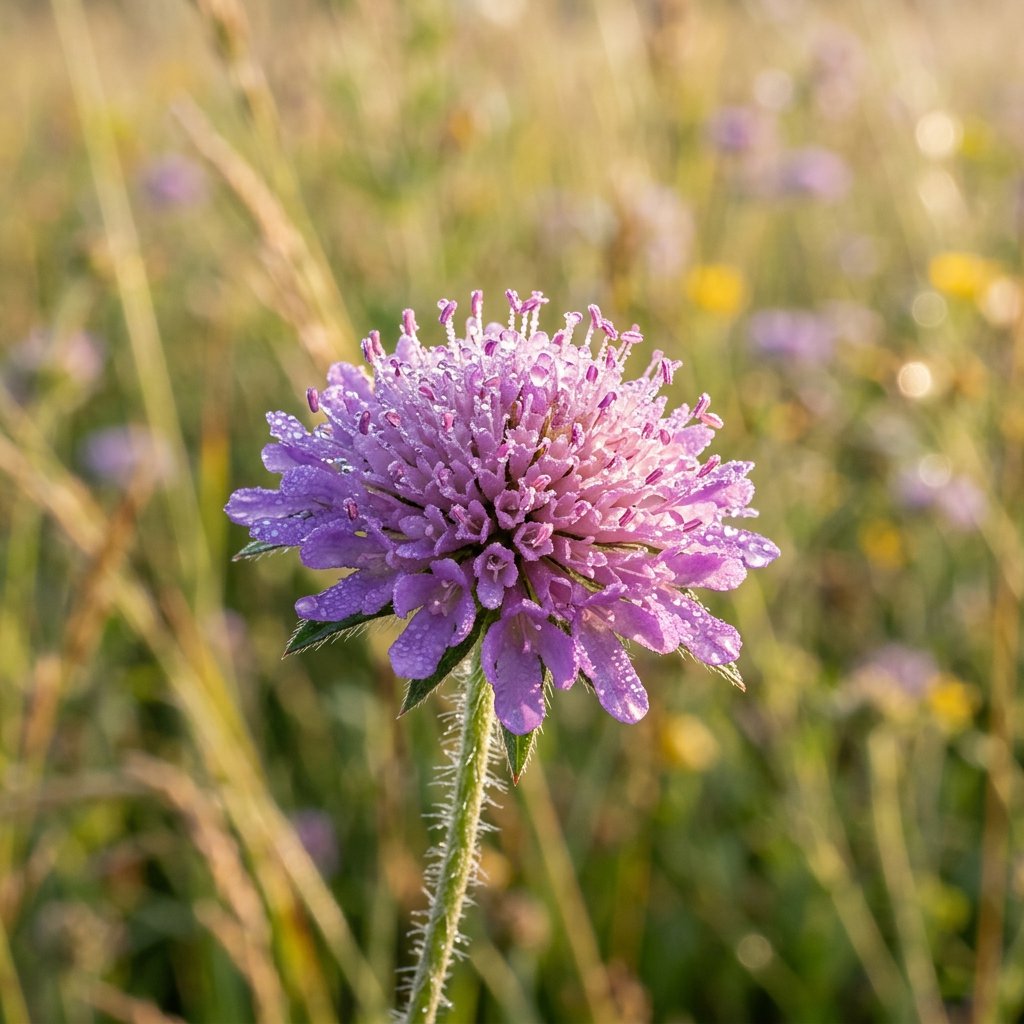
Plant Overview
Often called "Blue Buttons" or the "Gipsy Rose," the Field Scabious is a charming perennial wildflower that dances gracefully on wiry stems in the summer breeze. Its name sounds a bit clinical, but this plant is a romantic staple of traditional cottage gardens and sun-drenched meadows, cherished for its incredible ability to attract a literal cloud of butterflies.
🔍 How to Identify
- 🌸 The Flower Head: Soft, lilac-to-mauve blooms that look like tiny velvet pincushions. The outer florets are larger than the inner ones, giving the flower a ruffled, lace-like appearance.
- 🌿 The Foliage: The leaves are a clever giveaway; the bottom leaves are simple and lance-shaped, while the leaves further up the stem are deeply lobed and look like jagged feathers.
- 🧶 The Stem: Stiff, upright, and covered in rough, bristly hairs. These hairs help deter crawling insects from climbing up to steal nectar without providing pollination services.
🏡 In Your Garden
- 🦋 Pollinator Paradise: This is one of the highest-rated nectar plants for wildlife. It is a vital food source for the Narrow-bordered Bee Hawk-moth and several rare species of butterflies that rely on its long blooming season.
- 🏜️ Tough and Lean: Field Scabious actually thrives in "poor" or rocky soil. If you plant it in overly rich, fertilized garden beds, it tends to grow too tall and flop over. It is exceptionally drought-tolerant once its deep taproot is established, making it perfect for gravel gardens.
⚠️ Safety & Toxicity
- ✅ Safe Status: Knautia arvensis is generally considered non-toxic to humans, dogs, cats, and horses.
- ✋ Mechanical Irritation: While not chemically poisonous, the stiff, bristly hairs on the stems can sometimes cause a mild "itchy" sensation for people with very sensitive skin. It’s best to wear gloves if you are harvesting a large bouquet.
✨ Fun Fact
🩺 The Itch Cure: The name "Scabious" originates from the Latin word scabere (to scratch). In ancient herbalism, because the plant’s scaly base looked like irritated skin, it was used as a traditional remedy for scabies and even more serious ailments like the bubonic plague!

Detailed Care Instructions
To grow Knautia Arvensis, also known as field scabious, follow these steps:
- Choose a suitable location: Knautia Arvensis prefers well-drained soil and full sun to partial shade. It can tolerate different soil types and pH levels but grows best in nutrient-rich, loamy soil.
- Prepare the soil: Remove any weeds or grass from the planting area. Loosen the soil with a garden fork or tiller to improve drainage and promote healthy root development. If the soil is heavy or poor in nutrients, mix in organic matter such as compost or well-rotted manure.
- Sowing seeds: You can sow the seeds directly into the ground in spring or late summer/early fall. Rake the soil to create a fine, level surface. Scatter the seeds evenly over the area and lightly press them into the soil. Since Knautia Arvensis is a wildflower, you can also consider scattering seeds in a meadow or wildflower garden.
- Watering: Keep the soil consistently moist after sowing until the seeds germinate. Water deeply, making sure not to overwater and create waterlogged conditions.
- Germination: Knautia Arvensis seeds usually take about 2-3 weeks to germinate, but it can sometimes take longer. Be patient and continue to provide adequate moisture during this period.
- Thin out seedlings: Once the seedlings are about 2-3 inches tall, thin them out to a spacing of about 10-12 inches. This allows each plant to have sufficient space to grow.
- Maintain care: Water the plants regularly during dry spells and mulch around the base to conserve moisture and limit weed competition. Deadhead spent blooms to encourage continuous flowering. In colder regions, adding a layer of mulch over the root zone in winter can provide additional protection.
- Optional propagation method: Alternatively, you can propagate Knautia Arvensis by dividing mature plants in spring. Dig up the clump, separate the root sections, and replant them in well-prepared soil. Keep them well-watered until they establish.
Overall, Knautia Arvensis is a resilient plant that does not require excessive care. With proper attention to watering and adequate sunlight, it should thrive and produce beautiful blooms.

Place in a bright room that is sun drenched almost all day. Or directly in a south-facing window.

1. Identify the plant's specific watering needs: Before watering the plant, it's important to research how much water it needs and how frequently. Factors such as soil type, humidity, and sunlight exposure can affect its water requirements.
2. Monitor soil moisture levels: Check the soil moisture regularly by inserting your finger into the soil up to your knuckle. If the soil feels dry to the touch, it's time to water the plant.
3. Use the right watering technique: To avoid damaging the plant's roots, it's essential to water it gently and at the base of the stem. One way to do this is to use a watering can with a narrow spout, allowing you to control the flow of water.
4. Water at the right time: Avoid watering your plant during the hottest part of the day, as the evaporation rate will be high, and the water may not reach the roots. Early morning or late evening is the best time to water the plant.
5. Avoid overwatering: Overwatering can lead to root rot, which can be fatal to the plant. To avoid this, make sure the soil has proper drainage and that there is no standing water around the roots.
6. Adjust watering frequency based on seasons: During the plant's active growing season, it may require more frequent watering than during the dormant phase. Adjust watering based on seasonal changes for optimal plant health.
7. Monitor the plant's response to watering: If the plant looks droopy, leaves are turning yellow or brown, or the soil feels constantly wet, it may be a sign to adjust your watering regimen. Observe the plant's response to watering and make adjustments as needed.
To fertilize the Knautia Arvensis plant, start by choosing a balanced, slow-release fertilizer. Follow these steps:
- Before applying fertilizer, make sure the soil is slightly moist. Water the plant a day or two before fertilizing, as dry soil can lead to nutrient burn.
- Measure the recommended amount of fertilizer according to the package instructions. Be cautious not to over-fertilize, as it can harm the plant.
- Spread the fertilizer evenly around the base of the plant, avoiding direct contact with the stems or foliage.
- Gently work the fertilizer into the top layer of soil, taking care not to disturb the plant's root system. Use a garden fork or a hand tool for this process.
- Once the fertilizer is applied, water the plant thoroughly to help dissolve and distribute the nutrients into the root zone.
- It is advisable to fertilize Knautia Arvensis in early spring and again in mid-summer to provide a steady supply of nutrients.
- Regularly monitor the plant for any signs of nutrient deficiency or excessive fertilizer application, such as yellowing leaves or stunted growth. Adjust fertilization accordingly.
Remember, each plant has specific fertilization needs, so it is vital to follow these general instructions while considering the specific requirements of the Knautia Arvensis plant.
The ideal soil for the Knautia Arvensis plant should be well-draining and fertile. The soil pH should be between neutral and slightly acidic, with a range of 6.0 to 7.0. This plant prefers soils that are rich in organic matter and nutrients but not too rich as it can cause excessive leaf growth at the expense of flowers. A loamy soil with good water retention capacity is best for the Knautia Arvensis plant. This native flowering plant prefers full sun or partial shade and can tolerate a range of soil types, from sandy to mildly clayey. If planting in a container, use a loamy soil mix with added peat moss or vermiculite to improve the water retention capacity. Always ensure that the soil is moist but not waterlogged.
Knautia arvensis is a perennial plant that can be propagated through various methods. Here are some detailed steps on how to propagate Knautia arvensis:
- Division: This method is most effective in early spring or late autumn. Start by digging up an established Knautia arvensis plant from the ground, making sure to carefully lift the entire plant with its root system intact.
- Gently separate the clumps of the plant by carefully breaking them apart. Each divided clump should have a well-developed root system and several healthy shoots or rosettes of leaves.
- Prepare the desired planting location by loosening the soil and adding organic matter to improve its fertility and drainage.
- Dig a hole for each divided clump, ensuring that it is large enough to accommodate the entire root system without crowding. Place the divided clump into the hole, making sure that the crown (where the shoots meet the roots) is level with or slightly above the soil surface.
- Backfill the hole with soil, firming it gently around the roots to eliminate any air pockets. Water the newly planted divisions thoroughly to settle the soil and provide moisture.
- Stem Cuttings: In early summer, select a healthy stem from an established Knautia arvensis plant. It should be non-flowering and firm yet flexible.
- Using sharp, clean pruners, cut a 4-6 inch (10-15 cm) section of the stem just below a set of leaves or leaf node. Remove any leaves from the lower one-third to half of the cutting.
- Dip the cut end of the stem into a rooting hormone powder to promote root development (optional but can improve success rates).
- Prepare a suitable rooting medium, such as a mix of equal parts peat moss and perlite or sand. Fill a small container or seed tray with the rooting medium, ensuring it is moist but not waterlogged.
- Insert the treated end of the stem cutting into the rooting medium, burying approximately one-third to one-half of the cutting. Firm the medium gently around the stem to hold it in place.
- Place the container in a warm, bright location that receives indirect sunlight. Cover it with a clear plastic bag or a propagation dome to create a humid environment that will aid in root development.
- Mist the cutting daily to maintain humidity and prevent the rooting medium from drying out. Avoid overwatering, as excess moisture can lead to rot.
- After a few weeks, gently tug on the cutting to check for resistance, indicating root development. Once significant resistance is felt, the cuttings are likely rooted.
- Transplant the rooted cuttings into individual pots filled with a well-draining potting mix, and gradually acclimate them to outdoor growing conditions.
With proper care, both divided plants and stem cuttings should grow into new Knautia arvensis plants, allowing you to propagate and expand your garden without reliance on common names.
Common pests of the field scabious include Spider mites, aphids, thrips. Make a habit of checking your field scabious frequently for pests so that any infestations can be caught and managed early.








