Plant Overview
Often mistaken for a common lawn grass, Kyllinga bulbosa—commonly known as the Whitehead Spike Sedge—is a hardy survivor with a hidden secret tucked beneath the soil. While it may look humble, its ability to thrive in poor, sandy soils has earned it a reputation for being both a resilient groundcover and a persistent garden guest. In many tropical regions, its tiny, nut-like tubers have even served as a traditional source of food and medicine.
🔍 How to Identify
- 🧅 The Underground "Bulbs": The most defining feature is the small, brown, bulb-like swellings (tubers) found on the roots. These act as energy storage, allowing the plant to survive through dry spells.
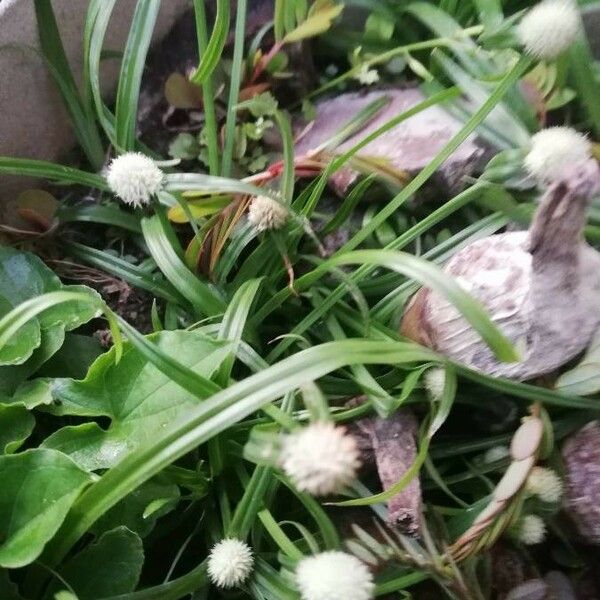
- ⚪ White Pompom Flowers: It produces distinct, spherical white flower heads that sit at the very tip of the stem. These "whiteheads" are actually dense clusters of tiny spikes.
- 🌿 Triangular Stems: Like most sedges, the stem is not round; if you roll it between your fingers, you will feel three distinct edges.
- 🍃 Star-Shaped Bracts: Directly beneath the white flower head, three or four long, leaf-like structures (bracts) spread out horizontally, making the flower look like it’s sitting in the center of a green star.
🏡 In Your Garden
- 🏜️ Sandy Specialist: This plant thrives in loose, sandy, or disturbed soils where other plants might struggle to find a foothold. It is frequently seen in coastal areas or along the edges of pathways.
- 🌱 Rhizome Runner: It spreads via underground runners. While this makes it excellent for stabilizing loose soil, it can be quite aggressive in a manicured garden. If you see one, expect its "siblings" to pop up nearby very soon!
⚠️ Safety & Toxicity
- ✅ Safe Status: Kyllinga bulbosa is generally considered non-toxic to humans and common household pets.
- 🦷 Fibrous Texture: While not poisonous, the leaves are quite tough and have high silica content. If a pet or child chews on them, the coarse texture may cause mild mouth irritation or an upset stomach.
✨ Fun Fact
🌾 The Ancient Snack: The small "bulbs" of this plant are edible and are sometimes called "bush onions" or "nutgrass." In various cultures, they are roasted to provide a nutty, starchy snack that tastes remarkably similar to water chestnuts!

Detailed Care Instructions
To water this plant, you should thoroughly soak the soil around the base of the plant, making sure to not get water on the leaves or flowers. This can be done by either using a watering can or hose, or by placing the pot in a saucer filled with water and allowing the soil to absorb the water from the bottom. It is important to avoid over-watering, as excess moisture can lead to root rot or other fungal diseases. Allow the soil to dry out slightly before watering again. Watering frequency will depend on the climate and humidity levels of your surroundings.
The ideal soil for this plant should be rich in nutrients and have good drainage. It is recommended to use a well-draining soil mix that is composed of sand, peat moss, and perlite. The pH level of the soil should be slightly acidic to neutral, with a range of 5.5 to 7.0. Prior to planting, it is advisable to enrich the soil with organic matter such as compost to provide adequate nutrition to the plant. Additionally, this plant prefers moist soil, so regular watering is necessary to keep the soil consistently moist, without becoming waterlogged.








