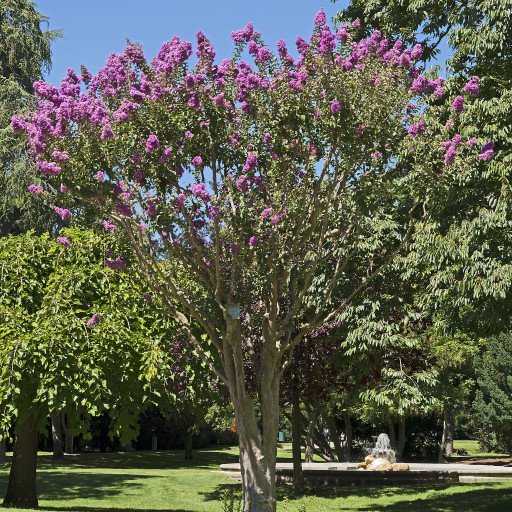
Plant Overview
Often called the "Lilac of the South," the Crepe Myrtle is a landscape superstar celebrated for its explosive summer color and year-round visual interest. Native to East Asia, it has become a staple in temperate and subtropical gardens due to its resilience and stunning, paper-like blooms. In many cultures, it is planted near temples and homes as a symbol of longevity and good fortune.
🔍 How to Identify
- 🌸 Petal Texture: The flowers feature incredibly ruffled, frilly edges that resemble wrinkled fabric or tissue paper, appearing in dense, cone-shaped clusters.
- 🍂 Exfoliating Bark: As the tree matures, its thin, gray outer bark peels away in strips to reveal a smooth, cinnamon-to-pinkish under-layer that feels almost like polished stone.
- 🍃 Foliage Transition: The small, oval leaves emerge as a bronze-green in spring, turn deep emerald in summer, and often ignite into vibrant oranges and fiery reds during autumn.
🏡 In Your Garden
- ☀️ Sun Worshiper: To achieve those iconic blooms, this plant needs full, unabashed sunlight. Planting it in the shade will lead to "leggy" growth and a significant drop in flower production.
- ✂️ The "Crepe Murder" Warning: Avoid the common mistake of "Crepe Murder"—the practice of hacking the branches back to thick stubs. Instead, prune lightly to maintain the natural, graceful vase-like shape and encourage better airflow to prevent powdery mildew.
- 💧 Drought Resilience: While it appreciates regular water while settling into its new home, a mature Crepe Myrtle is remarkably tolerant of heat waves and dry spells once its root system is established.
⚠️ Safety & Toxicity
- ✅ Pet-Friendly: You can breathe easy; Lagerstroemia indica is considered non-toxic to dogs, cats, and horses according to the ASPCA.
- 👶 Child Safe: The plant is generally safe for children’s play areas, though the small seed pods can be a minor choking hazard for toddlers if they are curious enough to pick them up.
✨ Fun Fact
🐒 The Monkey Slider: In Japan, this tree is known as Sarusuberi, which literally translates to "monkey slip." The name refers to the exfoliating bark being so incredibly smooth and slippery that even a skilled climbing monkey would struggle to get a grip on the trunk!

Detailed Care Instructions
No. It depends on the cultivar and how you wish to prune and train your plant.
Can crepe myrtles be used as hedges?
Yes, crepe myrtles make excellent hedges, though they do require regular pruning.
Do Crepe myrtles only come in pink?
Some cultivars give white, lavender, red, purple, burgundy, pale blue, purple, and mauve and different sizes and forms. If you choose a different species of Lagerstroemia, you can even find evergreen crepe myrtles.
| Color | Red-Rose |
| Soil Ph | 6.0-6.5 |
| Humidity | Normal |
| Lighting | Full Sun |
| Soil Type | Average, Medium Moisture, Well-Drained |
| Bloom Time | July-September |
| Difficulty | Medium |
| Plant Type | Deciduous Tree / Large Shrub |
| Hibernation | Cold Period |
| Mature Size | 6-25 Ft. Tall, 6-20 Ft. Wide |
| Native Area | China, Indochina, Himalayas, Japan |
| Temperature | 15°C - 30°C |
| Sun Exposure | Full Sun |
| Hardiness Zones | 6-9 |
To grow Lagerstroemia indica, commonly known as crape myrtle, follow these steps:
- Choose a suitable location: Crape myrtle thrives in full sun, so select a spot that receives at least 6-8 hours of direct sunlight every day. The soil should be well-draining and rich in organic matter.
- Planting: Dig a hole twice as wide and slightly deeper than the root ball of the plant. Gently place the crape myrtle in the hole, ensuring that it sits at the same level as it was in the container. Backfill the hole with soil, firming it around the roots to eliminate any air pockets. Water thoroughly after planting.
- Watering: Crape myrtles require regular watering, especially during their first growing season. Keep the soil moderately moist, but avoid overwatering as it can lead to root rot. Once established, they are relatively drought-tolerant and can withstand dry periods.
- Fertilizing: Apply a balanced slow-release fertilizer formulated for flowering plants in early spring, just before new growth appears. Follow the packaging instructions for dosage. Avoid fertilizing in late summer or fall, as this can encourage new growth that may not have enough time to harden off before winter.
- Pruning: Prune crape myrtles during late winter or early spring when they are dormant. Remove any dead or damaged branches. To enhance flowering and shape the plant, selectively prune branches to create an open, vase-like structure. Avoid cutting off more than one-third of the plant's overall height.
- Mulching: Apply a 2-3 inch layer of organic mulch, such as wood chips or bark, around the base of the plant. This helps retain moisture, suppresses weed growth, and regulates soil temperature.
- Protection from winter cold: Crape myrtles are generally hardy and can tolerate mild winter temperatures. However, in colder regions, they may need extra protection during harsh winters. Apply a layer of mulch around the base of the plant, and cover the branches with burlap or a frost blanket.
- Pests and diseases: Crape myrtles are relatively resistant to pests and diseases. Occasionally, they may become infested with aphids, spider mites, or powdery mildew. Regularly inspect the plant for any signs of pests or disease, and treat accordingly using organic or chemical solutions.
By following these steps, you can successfully grow Lagerstroemia indica and enjoy its beautiful flowers throughout the summer.

Place in a bright room that is sun drenched almost all day. Or directly in a south-facing window.

To properly water this plant, you should aim to provide it with adequate hydration while also avoiding overwatering. One effective watering method involves waiting until the soil begins to feel slightly dry to the touch before giving the plant a thorough watering. When watering, use a watering can or hose to evenly distribute water throughout the soil around the base of the plant. Take care not to let water pool or accumulate in the soil or on the surface of the plant, as this can lead to root rot and other issues. Additionally, it can be helpful to water this plant in the morning or evening when the temperature is cooler, as this can help the plant retain moisture and reduce water loss due to evaporation.
To fertilize this plant, begin by selecting a balanced fertilizer that contains equal amounts of nitrogen, phosphorus, and potassium. Mix the fertilizer with water according to the instructions on the package. Then, apply the fertilizer to the soil around the base of the plant, taking care not to get any on the leaves or stems. Water the plant thoroughly after applying the fertilizer. Repeat this process every four to six weeks during the growing season.
Lagerstroemia Indica is a flowering plant that requires well-drained soil with a neutral to slightly acidic pH. The soil should be rich in organic matter and nutrients, and should also allow for good air circulation around the roots. It is important to avoid using heavy clay soils, as they can cause waterlogging and root rot. A mix of sandy loam and compost is a good choice for Lagerstroemia Indica, as it provides good drainage and aeration while also supplying essential nutrients. Additionally, mulching around the base of the plant can help retain moisture and regulate soil temperature.
Propagation of this plant can be done through softwood cuttings taken in late spring or early summer. Cuttings should be around 4-6 inches in length and taken from the tips of the branches. Remove the lower leaves and dip the cut end in rooting hormone. Plant the cuttings in a well-draining soil mix and keep them moist and in a bright, indirect light until roots have formed. Alternatively, Lagerstroemia Indica can also be propagated through layering, where a low-lying branch is bent down and buried in soil until roots have formed, and then detached from the parent plant.
Common pests of the crepe myrtle include Spider mites, aphids. Make a habit of checking your crepe myrtle frequently for pests so that any infestations can be caught and managed early.








