Plant Overview
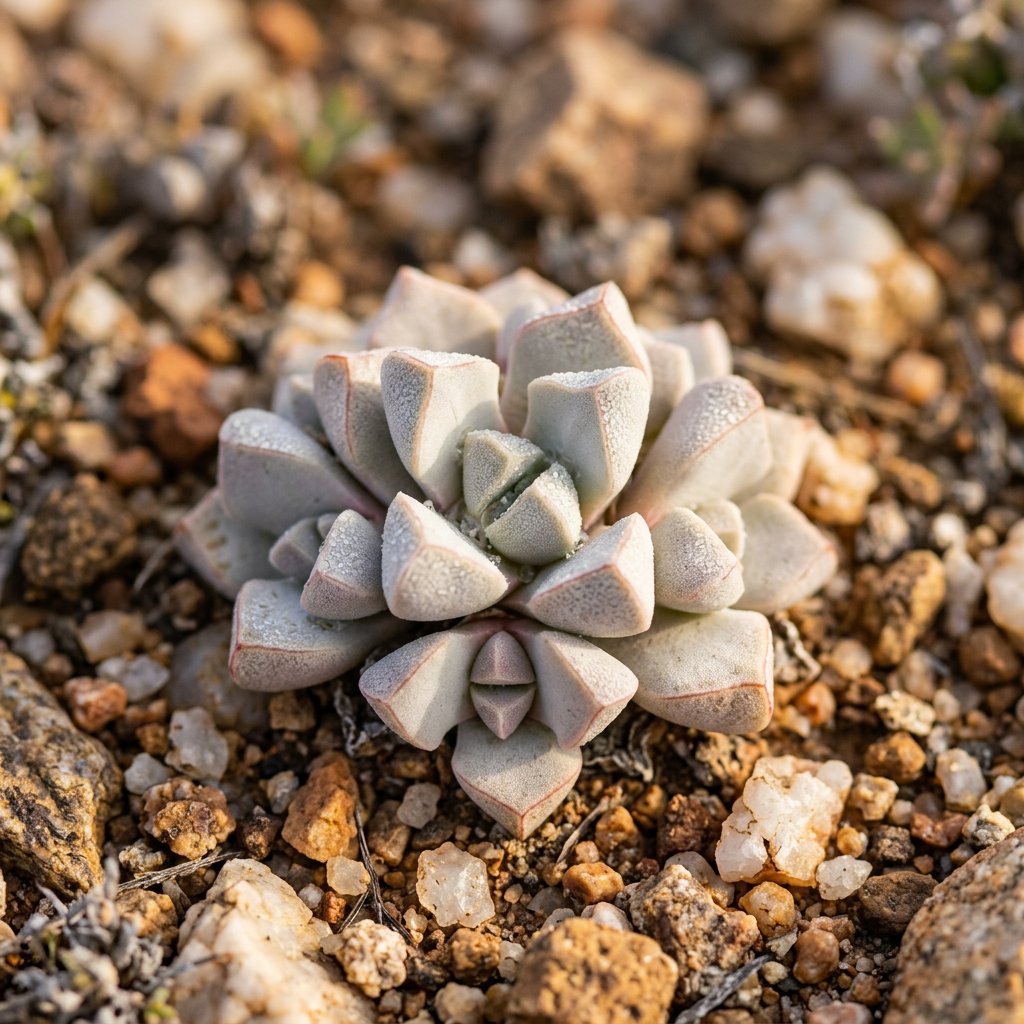
Often called the "Karoo Rose," this stunning succulent looks less like a living organism and more like a handful of rose-tinted quartz pebbles scattered across the desert floor. Hailing from the arid borders of Namibia and South Africa, it is a master of disguise, blending perfectly into the rocky landscape to avoid being eaten by thirsty animals. It is a favorite for minimalist indoor gardens due to its architectural, gemstone-like appearance.
🔍 How to Identify
- 💎 The Leaves: Unlike many other "Living Stones," the Karoo Rose has sharply angled, geometric leaves with flat faces that look like they were precision-cut by a jeweler.
- 🎨 The Color: The skin has a beautiful matte finish in shades of pale silver-blue, soft pink, or chalky white, often with slightly reddish edges.
- 🌼 The Bloom: In late autumn or early winter, it produces a surprisingly large, bright yellow daisy-like flower that can almost hide the entire plant beneath its petals.
🏡 In Your Garden
- 🏜️ Mineral Diet: This plant thrives on "tough love." It prefers a soil mix that is almost entirely grit, sand, or pumice; traditional potting soil stays damp for too long and can cause the plant to literally burst from over-hydration.
- ☀️ Light & Rest: It craves intense, bright light to maintain its compact shape. If the plant starts to "stretch" upward and lose its geometric tightness, it is a cry for more sunshine.
- 💧 The "Touch Test": Never water on a schedule. Instead, wait until the leaves feel slightly soft to the touch or show tiny wrinkles. If the leaves are rock-hard, the plant is full and doesn't need a drop.
⚠️ Safety & Toxicity
- ✅ Non-Toxic: The Karoo Rose is generally considered safe and non-toxic for cats, dogs, and curious children.
- 🛡️ Fragility: While it isn't poisonous, the plant is physically delicate. The leaves are brittle and can "bruise" or snap off if handled roughly or dropped.
✨ Fun Fact
While most "Living Stones" (like the famous Lithops) are limited to just one pair of leaves at a time, the Karoo Rose is an overachiever—it can grow up to three or four pairs of leaves simultaneously, creating a beautiful, multi-faceted cluster that looks like a miniature mountain range.

Detailed Care Instructions
| Humidity | Dry |
| Lighting | Full Sun |
| Difficulty | Easy |
| Temperature | 15°C - 35°C |
| Hardiness Zones | Min 9A |
To grow Lapidaria margaretae, also known as Karoo rose, follow these steps:
- Light requirements: Lapidaria margaretae requires bright indirect sunlight. Place it near a south-facing window or provide it with 12-14 hours of artificial grow lights per day.
- Temperature and humidity: This plant prefers warm temperatures between 70-85°F (21-29°C) during the day and cooler temperatures between 50-60°F (10-15°C) at night. Maintain a humidity level of around 40-60%.
- Potting: Choose a well-draining potting mix specifically formulated for succulents and cacti. Ensure the pot has drainage holes to prevent waterlogging. Transplant the plant into a slightly larger pot when its roots outgrow the current one.
- Watering: Water the plant thoroughly but infrequently. Allow the soil to dry out between waterings. Overwatering can lead to rot. During the growing season (spring and summer), water every 10-14 days. In winter, reduce watering to once every 4-6 weeks.
- Fertilizer: Lapidaria margaretae is not a heavy feeder. Fertilize sparingly during the growing season with a balanced, water-soluble fertilizer formulated for succulents. Dilute the fertilizer to half strength and apply it once every 2-4 weeks.
- Pruning: Remove any dead or dried leaves by gently pulling them away from the base of the plant. Be cautious not to damage the healthy leaves.
- Propagation: Lapidaria margaretae can be propagated from offsets or leaf cuttings. To propagate from offsets, carefully remove the offsets from the parent plant and let them callus for a few days. Plant them in a well-draining succulent mix and water sparingly. For leaf cuttings, let the leaves callus for a few days and place them in well-draining soil. Water lightly until roots start to form.
- Pests and diseases: Monitor the plant for common succulent pests like mealybugs, aphids, or scale insects. If necessary, treat with an appropriate insecticide or try natural remedies like using neem oil or wiping the pests off with a cotton swab soaked in rubbing alcohol.
Remember to research and follow specific care instructions for Lapidaria margaretae, as individual factors like climate and growing conditions can affect its overall well-being.

Place in a bright room that is sun drenched almost all day. Or directly in a south-facing window.

Lapidaria Margaretae is a small succulent plant that requires little watering. When watering this plant, it is important to use a well-draining soil mixture to prevent the roots from sitting in water, which can lead to root rot.
To water the plant, wait until the soil has completely dried out, which may take several weeks depending on the temperature and humidity of the environment. Then, slowly pour water onto the soil until it begins to drain out the bottom of the pot. It is important not to overwater the plant, as this can also lead to root rot.
During the winter months, when the plant goes dormant, it requires even less watering. In general, it is better to underwater this plant than to overwater it.
- Choose a well-draining soil mix for the plant, as too much moisture can damage its roots.
- Water the plant sparingly, only when the soil has completely dried out.
- Use a balanced, slow-release fertilizer during the plant's active growing season (typically spring and summer).
- Dilute the fertilizer to half strength before applying to avoid over-fertilizing.
- Apply the fertilizer once a month, following the manufacturer's instructions.
- Do not fertilize during the plant's dormancy period (typically in the fall and winter months).
Lapidaria Margaretae plant prefers a well-draining soil that is low in organic matter. A good soil mix could consist of a combination of coarse sand, perlite, and gritty or coarse gravel. It is important to avoid using regular potting soil or garden soil as these tend to be too heavy and can lead to root rot. In addition, it is advised to mix in some small pieces of limestone gravel to help buffer the soil pH and prevent acidity buildup. Overall, the key is to provide a soil that replicates the rocky and gravelly soil conditions of the plant's natural habitat.
To propagate this plant, take a healthy and mature leaf from the parent plant and allow it to callus over for a few days. Then, plant the leaf into well-draining soil and keep it in a warm and bright location. The soil should be kept moist but not over-watered. After a few weeks, new rosettes will begin to form from the base of the leaf. Once these rosettes become large enough, they can be separated from the leaf and planted into their own pots. It's important to handle the baby plants with care as they are delicate and can easily snap off. With proper care, the new Lapidaria margaretae plants will grow and thrive.








